Far below the surface of the ocean, deeper than sunlight can reach, a steel tube carries a crew of more than a hundred people through water that would crush an ordinary ship like a tin can. That tube is the pressure hull of a submarine, and it is the only thing standing between the crew and the crushing weight of the sea. At the depths a modern submarine patrols, the water presses on every square centimetre of the hull with a force greater than a car balanced on a coin.
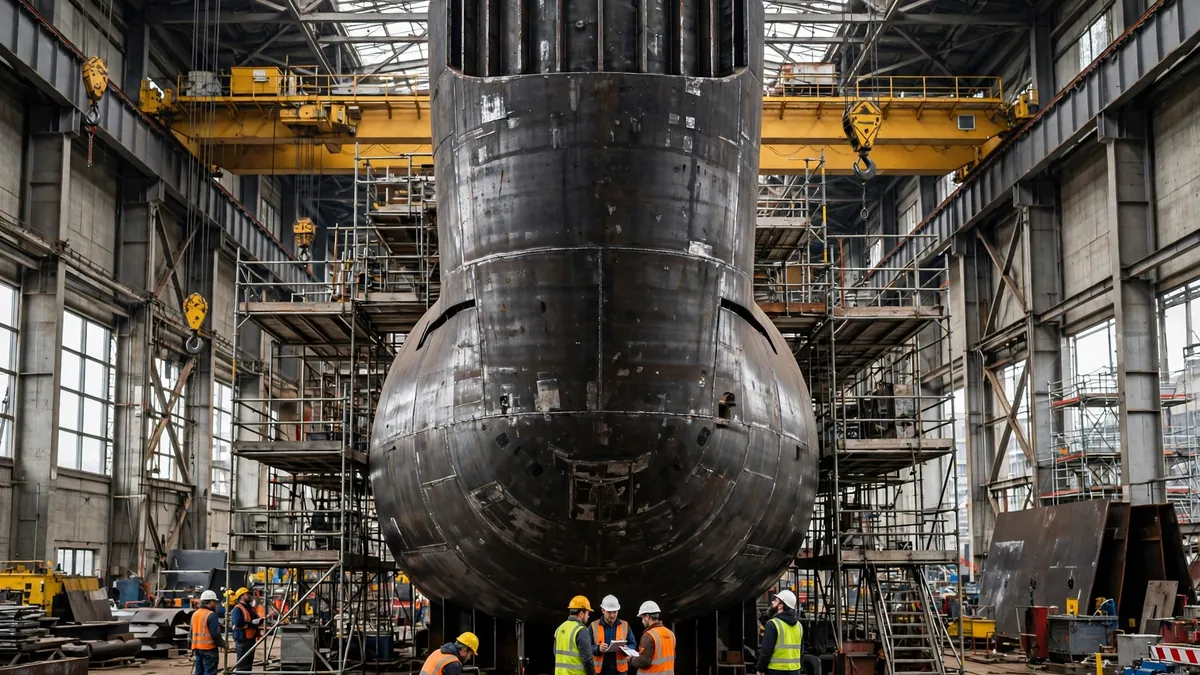
The pressure hull is built in a shipyard, in sections, by welders working inside and outside a steel cylinder as tall as a house. The steel plates are rolled, welded, and tested with a care that no other shipbuilding job demands, because a single weak weld at depth would be fatal. This is how a submarine pressure hull is produced.
How It’s Made
Step 1: Choosing the steel
Production begins with the steel, and a submarine hull is not made from ordinary ship plate. The steel must be both immensely strong and able to bend without cracking, because the hull flexes slightly as the submarine dives and surfaces, and it must keep its toughness in cold deep water. Modern hulls use high-yield steels with a yield strength of around 550 to 690 megapascals, roughly twice that of ordinary ship steel, and each batch of plate is tested for its chemistry, its grain structure, and its toughness before it is accepted.
Step 2: Rolling the plates into rings
Each plate is cut to size and rolled into a curved section on huge rolling machines, a process that must be done cold and slowly, so the steel is not weakened by heat. The curved plates are then fitted together to form a ring, a short cylinder that will become one section of the hull, and the joints between the plates are prepared by bevelling the edges, cutting them at an angle so the weld metal can penetrate the full thickness of the plate. The rings are checked for roundness with templates and lasers, because a hull that is even slightly oval would concentrate the water pressure on its flattest side.

Step 3: Welding the rings together
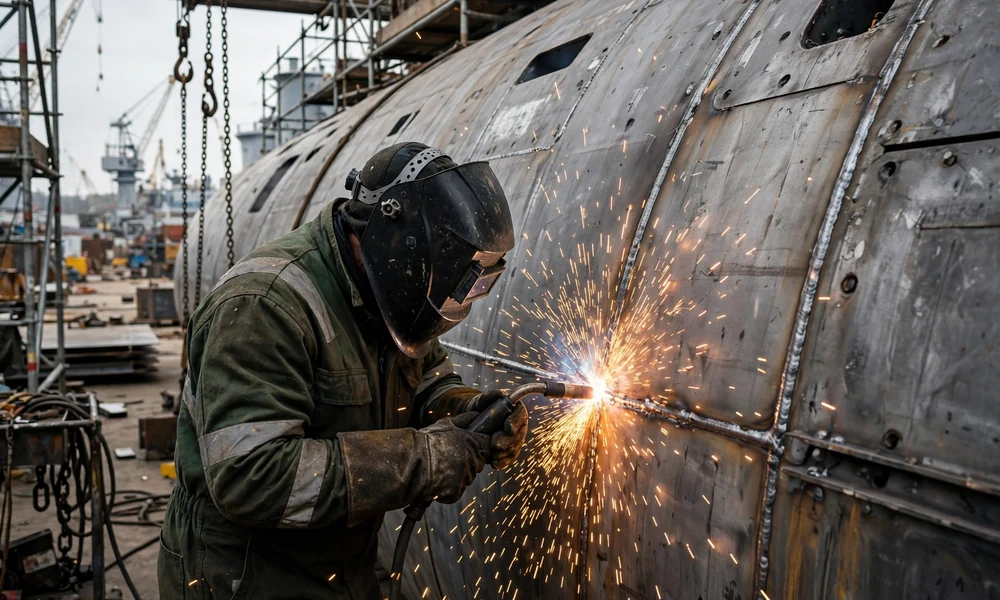
Welding a pressure hull is a job for the most skilled welders in the shipyard, and it is done in passes, layer by layer, until the joint is filled through the full thickness of the plate. The welders work in teams, one inside the hull and one outside, and the steel is preheated before welding, so the joint cools slowly and does not become brittle. Each pass is cleaned and inspected before the next is laid down, and the welders rotate around the ring so the heat is spread evenly and the hull does not distort. The full story of how the hull is built from plate to finished tube is told in how a submarine pressure hull is made, and the welding stage is the longest single part of the whole build.
Step 4: Fitting the frames and stiffeners
A bare steel cylinder would buckle under deep-water pressure, so the inside of the hull is fitted with frames and stiffeners, rings of steel that run around the hull at regular intervals and give it the strength to resist crushing. The frames are rolled, cut, and welded to the inside of the hull, and longitudinal stiffeners run along its length, tying the frames together into a rigid cage. The welding of the frames is done with the same care as the hull joints, and each frame is checked for alignment, because a frame that is out of place would leave a section of hull unsupported.
Step 5: Joining the sections into a hull
The finished rings are joined end to end to form the full pressure hull, in a sequence that starts with the central sections and works outward toward the bow and the stern. Each joint is a full circumferential weld, made with the same multi-pass technique as the ring joints, and the sections are aligned with lasers and jacks before the first weld is laid, so the hull runs straight from end to end. The hatches, the torpedo tube doors, and the openings for the sail are cut and fitted at this stage, each one reinforced with a heavy steel ring so the opening does not weaken the hull. A hull that has been joined well will look, from the outside, like a single smooth tube, with no sign of the many sections it was made from.
Step 6: Testing the hull to destruction, almost
Before the hull is accepted, it is tested in ways no other ship is tested. Every weld is inspected with ultrasound and X-rays, which reveal cracks and voids hidden inside the metal, and any weld that fails is ground out and rewelded, then tested again. The hull is then pressure-tested, with water pumped into a test tank around it or into the hull itself, raising the pressure in stages to well beyond the depth the submarine will ever dive to, while sensors measure how much the steel flexes. Only a hull that passes every test is handed over to the outfitting teams, who will fill it with reactors, engines, sonar, and living quarters, turning a steel tube into a submarine.
Specs
| Specification | Typical figure |
|---|---|
| Hull steel | High-yield steel, about 550 to 690 megapascals |
| Hull diameter | Roughly 10 to 13 metres |
| Hull length | Roughly 100 to 170 metres |
| Plate thickness | Roughly 25 to 50 millimetres |
| Frame spacing | Roughly 600 to 900 millimetres apart |
| Test depth | Well beyond the maximum operating depth |
| Weld inspection | Ultrasound and X-ray on every weld |
| Build time | Several years from first plate to launch |
Price
A submarine pressure hull is not sold on its own, so its cost is estimated as a share of the whole submarine, which is estimated at roughly $2 billion to $4 billion for a modern nuclear attack submarine. The hull steel, welding, and testing are estimated to account for roughly $300 million to $600 million of that total, including the shipyard labour and the years of inspection and pressure testing.
A Rare Fact
The deepest-diving submarines ever built were not made of steel at all. The Soviet Alfa class used a titanium hull, which is stronger and lighter than steel and can dive far deeper, but titanium is so hard to weld that the shipyard had to build the hull in a chamber filled with argon gas, because titanium catches fire in ordinary air when it is hot.
A pressure hull is the part of a submarine its crew trusts with their lives, and the numbers behind it are set out in the submarine pressure hull specifications, while the submarine pressure hull materials explain why the steel must be both strong and able to bend. The next time a submarine slips beneath the surface and disappears, remember the rolled plates, the multi-pass welds, and the pressure tests that made the steel tube around its crew.


