You press your thumb to the glass of your phone, half asleep, and before you have even finished the thought the screen is awake and unlocked. There is no password typed, no pattern drawn, no face held up to a camera. A patch of skin no bigger than a postage stamp has just been read, measured, and matched against a secret map stored inside the phone — and the whole thing took less time than a blink.
The part doing that reading is the fingerprint sensor, and it is one of the most quietly remarkable pieces of engineering in your pocket. It has to recognise the tiny ridges of your skin through glass, through a smudge of grease, sometimes through a wet thumb, and it has to do it thousands of times without ever mistaking you for someone else. This is how it pulls that off.

How a Fingerprint Sensor Works
Step 1: Your finger touches the sensing surface
Everything starts with contact. On a modern phone the sensor hides beneath the display glass, invisible until it lights up. On other devices it sits in a power button or a small pad on the back, a piece of hardened glass or ceramic no thicker than a credit card. When your finger lands on it, the sensor wakes from a low-power sleep and begins a scan that lasts only a few hundredths of a second. The ridges of your fingerprint touch the surface, while the valleys between them leave tiny air gaps. That difference between ridge and valley is the raw material the sensor works with, and every type of sensor is really just a different way of measuring it. The materials that make this possible are explored in fingerprint sensor materials engineering, where the layered stack is taken apart piece by piece.
Step 2: The sensor captures the ridge pattern
Most phones use one of three methods. A capacitive sensor builds a grid of microscopic electrodes and measures the tiny electrical charge at each point — ridges touching the surface hold a different charge from valleys hovering above it — and turns that grid into a picture. An optical sensor shines light up through the glass and photographs the fingerprint with a tiny camera beneath the screen. An ultrasonic sensor fires inaudible sound pulses and listens for the echoes, mapping the skin in three dimensions from the time each echo takes to return. The result is a detailed map of ridges, valleys, and the points where ridges end or split.
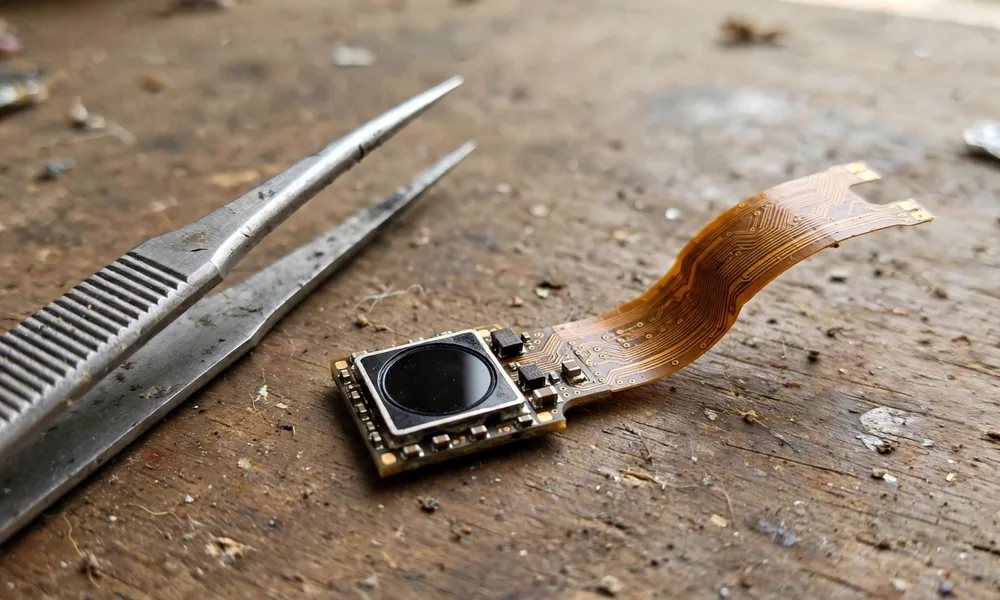
Step 3: The raw scan is cleaned up
The raw image is rarely clean. It may be smeared by a greasy finger, blurred by a damp one, or broken by a scratch across the glass. Before any matching happens, the sensor’s processor cleans the scan: it sharpens the ridge lines, fills in small gaps, and throws away parts too damaged to trust. It also checks that the finger is alive, not a photograph or a mould — looking for signs such as blood flow beneath the skin or the way a real finger deforms slightly as it presses down. A fake that cannot pass this liveness check never reaches the matching stage, which is why a printed fingerprint will not unlock a modern phone.
Step 4: The pattern is turned into a template
Your phone never stores a photograph of your fingerprint. Instead, the processor picks out the features that make your print unique — the minutiae, the exact places where ridges end, split, or form loops and whorls — and records their positions and directions as a mathematical template, a string of numbers. Two prints from the same finger produce templates that match closely; prints from different fingers do not. That template is encrypted and locked away in a separate, sealed part of the chip called a secure enclave, where even the phone’s own operating system cannot read it directly. When you add a new finger, the phone asks you to press it again and again at different angles, building a template that recognises your print however you hold the device.
Step 5: The template is matched in milliseconds
Each time you touch the sensor, a fresh template is built from the live scan and compared against the stored ones. The software scores how closely the minutiae line up, allowing for a finger pressed off-centre, a little rotated, or a little damp. If the score passes a strict threshold, the answer is yes; after a few failures it asks for your PIN instead. The whole comparison takes a few tens of milliseconds, which is why unlocking feels instant. Other tiny sensors in your devices do the same kind of work in their own way — how a smartwatch health sensor works shows how a watch reads a pulse from the same wrist, and how a lidar sensor works explains how pulses of light map the world around a car.
Step 6: The phone unlocks — and learns
When the match succeeds, the secure enclave releases a yes to the phone and the lock screen falls away. But the sensor is not finished. Each successful unlock quietly teaches it: the template is updated a fraction at a time to follow the slow changes in your skin, a cut healing or dry winter skin. That is why a fingerprint set up in summer still works in January. The sensor never sends your fingerprint anywhere — no copy ever leaves the phone. Lose the phone, and the thief gets a locked box, not your identity.

Fingerprint Sensor Specifications
| Specification | Typical figure |
|---|---|
| Sensor types | Capacitive, optical, ultrasonic |
| Sensing area | About 8 mm by 8 mm on a phone |
| Resolution | 500 dpi class, often higher |
| Match time | Roughly 50 to 200 milliseconds |
| False acceptance rate | Around 1 in 50,000 for a good sensor |
| Cover material | Glass, ceramic, or sapphire |
How Much Does a Fingerprint Sensor Cost?
Industry estimates put a basic capacitive sensor at roughly $2 to $5 per unit in volume, an optical under-display sensor at roughly $8 to $15, and an ultrasonic sensor at roughly $15 to $25 — these are estimates, not list prices. The real cost sits in the research: years of work on algorithms, security, and the clean-room fabrication of the silicon beneath the glass.
A Rare Fact About the Fingerprint Sensor
Here is something few people realise: your fingerprints are not fixed for life. They form before you are born, as the skin of your fingertips buckles under pressure in the womb, and no two people — not even identical twins — share the same pattern. But the prints themselves slowly wear and change. Bricklayers and guitarists can wear their ridges smooth enough that a sensor struggles, and a deep cut can redraw a small part of a print for good. That is why the best sensors keep learning from every successful unlock, quietly redrawing their map of you as you change.
So the next time your phone wakes at a touch, remember what happened beneath the glass: electrodes or ultrasound reading the ridges of your skin, a processor cleaning the picture, a template matched in a sealed vault, and a lock opened in a blink — all without your fingerprint ever leaving your hand.