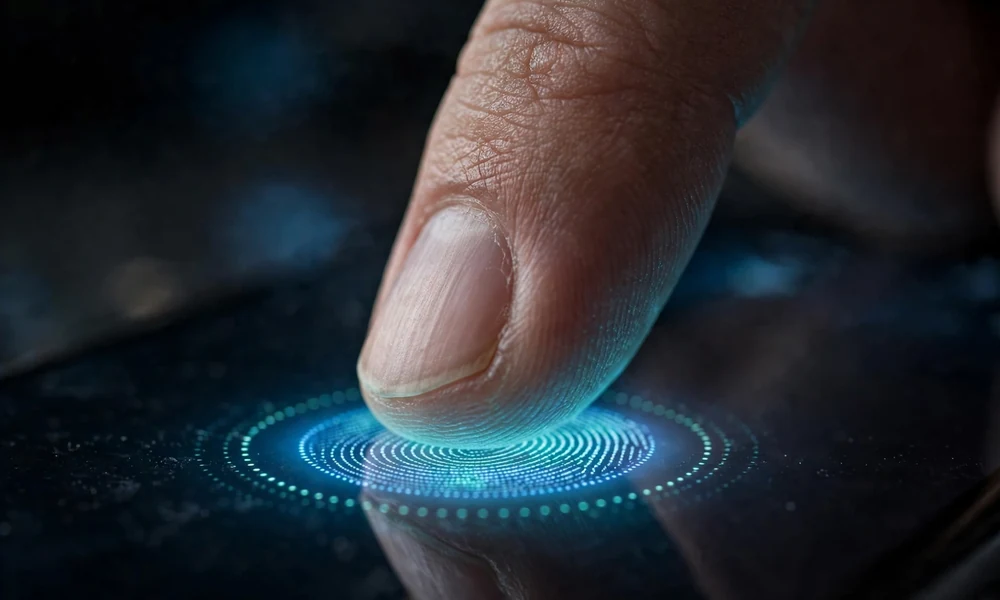
Touch a fingertip to the glass and the phone unlocks before you have finished thinking about it. There is no button, no slot, no visible sensor at all, just a patch of ordinary-looking screen that somehow knows the ridges of your skin. Under that glass sits one of the smallest and most secretive machines in consumer electronics: a fingerprint sensor that maps the valleys and peaks of your finger in a fraction of a second, using materials chosen to read living tissue through solid glass.
The challenge is absurd when you spell it out. A fingerprint ridge is about half a millimetre wide, and the sensor must tell ridge from valley through a layer of glass, glue and a display panel, while your finger may be wet, dry, cold or greasy. It must do this tens of thousands of times over the life of the phone without wearing out, and it must never mistake one person for another. The answer is a stack of silicon, glass and clever chemistry, each layer doing a job no other material can do.

The Materials Behind the Sensor
At the bottom of the stack is silicon, the same semiconductor that powers every computer chip, etched into an array of tiny electrodes or light-sensitive pixels. In a capacitive sensor, each electrode measures the tiny electrical difference between a ridge touching the surface and a valley hovering a hair above it; skin conducts, air does not, and that contrast becomes the image. In an optical sensor, the silicon is a CMOS image sensor that photographs your fingerprint through the display. In an ultrasonic sensor, a layer of piezoelectric material sends sound waves into your finger and listens for the echoes.
Above the silicon sits the cover material, and this is where the engineering gets delicate. Early sensors used a thin sheet of sapphire, grown as a single crystal of aluminium oxide, because it is almost as hard as diamond and shrugs off scratches that would blind a lesser window. Modern under-display sensors usually read through the phone’s own cover glass instead, a chemically strengthened aluminosilicate that is toughened by swapping small sodium ions for larger potassium ions at the surface, squeezing the glass into a permanent state of compression. Between glass and silicon, layers of optically clear adhesive bond the stack without bubbles, because a single bubble would appear in the fingerprint image as a smudge.
The ultrasonic versions add another exotic layer: a piezoelectric film of aluminium nitride or a polymer called PVDF, which converts electricity into sound and back again. When the film vibrates, it fires ultrasound into the finger; ridges return a strong echo and valleys a weak one, building a three-dimensional map that even works through grease and water. It is a remarkable piece of materials science, and it sits in the same family of tiny silicon machines as the rest of the phone: the display above it is an organic light-emitting panel, as explained in how an OLED display panel is made, and the frame that protects the whole stack is a study in metalwork, as in how a smartphone titanium frame is made.
How It Is Made
A fingerprint sensor begins life on a silicon wafer in a chip factory and ends as a paper-thin module glued under a sheet of glass. The journey runs through six broad steps.
- Grow and etch the wafer. A silicon wafer is patterned with photolithography, building the electrode array or image sensor layer by layer, then coated with a protective passivation film.
- Add the piezo or optical layer. Ultrasonic sensors receive a sputtered film of aluminium nitride; optical sensors get a microlens array that focuses light onto each pixel.
- Dice the wafer. The wafer is sawn into individual sensor dies, each one tested electrically before it is allowed to continue, and defective dies are marked and discarded.
- Attach the flexible circuit. Each good die is bonded to a thin flexible printed circuit of polyimide and copper, which carries signals to the phone’s processor.
- Bond the cover glass. The sensor module is laminated under the display cover glass with optically clear adhesive in a vacuum chamber, so no air is trapped between the layers.
- Calibrate and enrol. The finished module is tested against reference fingerprints, its software tuned to the exact thickness of that phone’s glass, and only then sealed into the handset.
Why These Materials Win
Silicon wins because no other material can pack tens of thousands of sensing elements into a patch the size of a fingernail, and because decades of chipmaking make it cheap at scale. Sapphire wins where it is used because nothing else is both transparent and nearly scratch-proof, though its cost keeps it out of most phones. Chemically strengthened glass wins the volume game: it is tough enough to survive keys and drops, clear enough to let light and sound through, and cheap enough to cover an entire phone. Aluminium nitride wins for ultrasound because it converts electricity to sound efficiently in a film thinner than a human hair.
Failure modes are unforgiving. A deep scratch across the sensor window creates a permanent blind line in every fingerprint image. A bubble in the adhesive looks like a ridge that never moves. That is why phone makers test each module against thousands of fingers, wet and dry, before it ships, and why its data is stored in an isolated enclave on the phone, in the same protected world as the solid-state drive inside the device. The sensor is small, but the trust placed in it is enormous.
Specifications
| Specification | Detail |
|---|---|
| Sensor types | Capacitive, optical, ultrasonic |
| Sensor chip | Silicon CMOS or electrode array |
| Cover material | Chemically strengthened aluminosilicate glass, or sapphire on some models |
| Ultrasonic layer | Aluminium nitride piezoelectric film |
| Adhesive | Optically clear adhesive, vacuum-laminated |
| Resolution | Typically 500 dots per inch or higher |
| Recognition time | Well under half a second on modern phones |
| Module thickness | Less than 1 millimetre under the display |
Price
The fingerprint sensor is one of the least expensive parts of a phone to buy, and one of the most expensive to get wrong. A complete sensor module is estimated to cost manufacturers roughly $5 to $15 at volume (estimate), with ultrasonic modules at the higher end because of their piezoelectric film and calibration. For the owner, the cost appears differently: replacing a damaged under-display sensor usually means replacing the whole screen assembly, which can run into hundreds of dollars (estimate), because the sensor is laminated to the glass and cannot be separated. It is a small part with an outsized repair bill.

Rare Fact
Ultrasonic fingerprint sensors do not just see the surface of your finger: their sound waves penetrate the skin and map the living tissue underneath, including pores and blood flow, which makes them far harder to fool with a printed copy of a fingerprint than an optical sensor. Early ultrasonic sensors were so sensitive to the thickness of the glass above them that engineers had to calibrate every single phone individually on the factory line, measuring the exact stack of materials over each sensor before it was allowed to ship.
That is the quiet achievement of the fingerprint sensor: a chip that reads you through solid glass, in the dark, in the rain, in less time than it takes to blink, built from silicon, sapphire, sound and light. It turns the oldest identification system in the world into a key that never leaves your pocket.


