The television is switched on in a sunlit living room, and the picture does not wash out. Blacks are truly black, not the dark grey of a backlit screen, and a single candle flame on the screen glows against a night scene without bleeding light into the darkness around it. Every pixel is making its own light.
That is the promise of Micro-LED, a display technology in which each pixel is a microscopic light-emitting diode, far smaller than the width of a human hair. A 4K screen needs nearly twenty-five million of them, each one placed individually, each one able to switch on, switch off, and change brightness on its own. It is the most ambitious display ever attempted, and the hardest to build.
Micro-LED combines the perfect blacks of OLED with brightness that OLED cannot reach, and with a lifespan that does not fade the way organic materials do. It is already appearing in giant video walls and premium televisions, and engineers are shrinking it towards watches, glasses, and car windscreens. Here is how it works.

How It Works
Step 1: Millions of microscopic LEDs
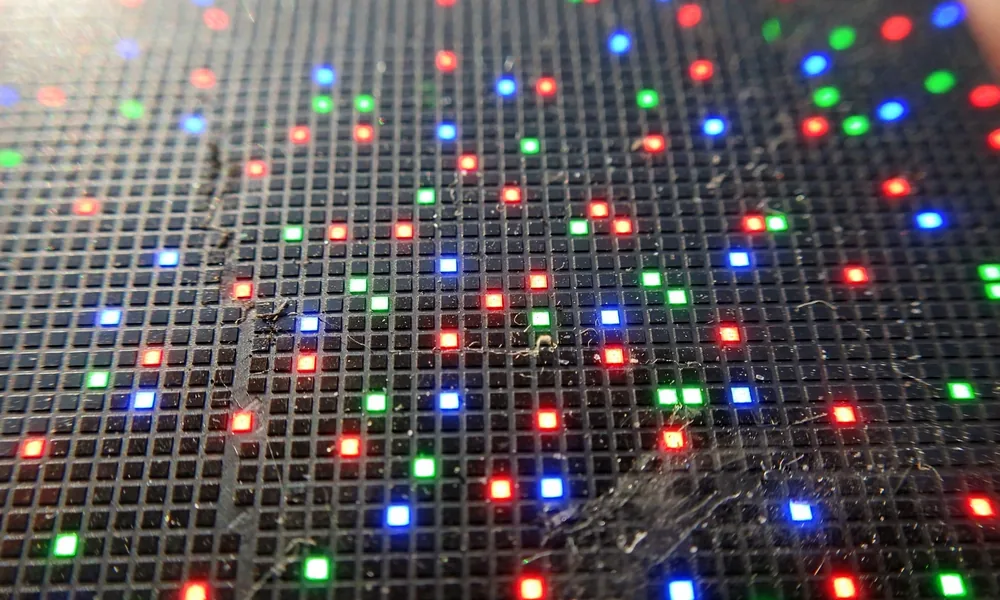
At the heart of a Micro-LED display are the LEDs themselves: tiny chips of gallium nitride, each one measuring only a few micrometres across. A red, a green, and a blue LED sit together to form one pixel, and a 4K display holds more than eight million pixels, which means nearly twenty-five million individual LEDs. Each LED is a solid crystal that glows when electricity passes through it, with no liquid, no gas, and no organic material involved. Because the light comes from the crystal itself, there is nothing to burn in, nothing to fade quickly, and nothing that needs a separate backlight behind it.
Step 2: Moving them into place
The greatest challenge is not making the LEDs but placing them. They are grown by the millions on a wafer, then lifted off and transferred onto the display’s backplane in a process called mass transfer. A stamp, a laser, or a fluid bath picks up thousands of LEDs at once and sets them down in exact positions, aligned to within a few micrometres. This is the step that has kept Micro-LED expensive, and the factories that master it are the ones that will bring the price down.
Step 3: Each pixel makes its own light
Once in place, every pixel is independent. When a scene calls for black, that pixel simply switches off, emitting no light at all, which is why Micro-LED blacks are absolute. When a scene calls for a bright highlight, that pixel can blaze at full power while its neighbour stays dark, giving the picture a contrast that backlit screens cannot match. There is no light leaking sideways from one pixel into the next, so a star in a night sky stays a sharp point instead of a soft smudge. This self-emissive design is the core of the technology, and it is what makes the picture look so startlingly real.
Step 4: The backplane drives them all
Behind the LEDs sits the backplane, a layer of thin-film transistors that controls each pixel’s brightness many times a second. Every pixel has its own tiny circuit that delivers exactly the right current to its three LEDs, mixing red, green, and blue into millions of colours. The engineering of the crystals themselves, and the materials that make them last, is explored in micro-led display materials engineering.
Step 5: Colour without filters
Colour in a Micro-LED display comes from the LEDs themselves. Red and green LEDs are made from different semiconductor recipes, and blue LEDs provide the third primary colour. Some designs simplify the job by making every LED blue and placing a quantum dot layer on top, which converts some of the blue light into red and green. Either way, there is no colour filter absorbing light the way an LCD needs, so more of the energy put in comes out as picture. The result is a wider range of colours, brighter highlights, and a screen that stays vivid even in a bright room.
Step 6: Bonding, testing, and repair
The finished panel is bonded together, sealed against moisture and dust, and then tested pixel by pixel. Cameras scan the whole screen while it shows test patterns, and any dead or dim LED is flagged. On the best production lines, a faulty LED is removed and replaced by a spare, a repair performed at microscopic scale. The panel is then driven through brightness and colour checks, because a display with twenty-five million light sources cannot be judged by eye alone. The journey from bare crystals to a finished television is described in how micro-led display is made.
| Pixel structure | Red, green, and blue microscopic LEDs per pixel, each self-emissive |
| LED size | Only a few micrometres across, smaller than a human hair |
| LEDs in a 4K screen | Nearly 25 million individual LEDs across more than 8 million pixels |
| Peak brightness | Thousands of nits, far brighter than a typical OLED panel |
| Contrast | Effectively infinite, because black pixels emit no light at all |
| Response time | Measured in nanoseconds, with no visible motion blur |
| Lifetime | Tens of thousands of hours with little brightness loss |
| Backplane | Thin-film transistors on glass or silicon, one circuit per pixel |
What Does a Micro-LED Display Cost?
A large Micro-LED television is estimated at roughly $50,000 to $150,000 for the biggest screens, while smaller premium Micro-LED displays are estimated at several thousand dollars. The price is driven by the mass-transfer step: placing twenty-five million LEDs almost flawlessly is slow and expensive, and yields are still improving. As transfer machines get faster and repair gets cheaper, prices are expected to fall sharply, first in commercial video walls and then in living rooms. For now, Micro-LED is the display you buy when only the best picture will do, and the cost is the price of being first.
A Rare Fact
The first public Micro-LED display appeared in 2012, when a prototype video wall showed a picture made from millions of tiny LEDs, and visitors could walk right up to it without seeing the pixels blur. Yet the idea waited more than a decade for manufacturing to catch up: growing the LEDs was solved quickly, but moving them into place at speed took years of new machinery. The strangest part is the scale. A single 4K panel holds more individual light sources than there are people in many cities, and every one of them must work. A display that looks simple from the sofa is, up close, one of the most crowded machines ever built.
Micro-LED is still young, and its price still keeps it out of most homes, but the principle behind it is now proven: a pixel that makes its own light is simply a better pixel. As the machines that place those tiny LEDs get faster, the screens will get smaller, cheaper, and more common, moving from video walls to televisions, from televisions to cars, and eventually to the glasses on our faces. The future of the screen may be made of twenty-five million tiny lights, each one doing its own small job perfectly. The rival technology that Micro-LED is measured against uses a very different trick, as quantum dot display specs explained shows.


