Hold a phone up in a dark room and the screen seems to glow from within, black parts staying truly black while a single icon burns bright. That is the quiet trick of an OLED display panel. Unlike the screens that came before it, there is no lamp behind the glass, no light leaking through a shutter. Every tiny dot on the surface makes its own light, switching on and off in microseconds, and the whole picture is built from millions of these self-lit points working together.

How an OLED Display Panel Works
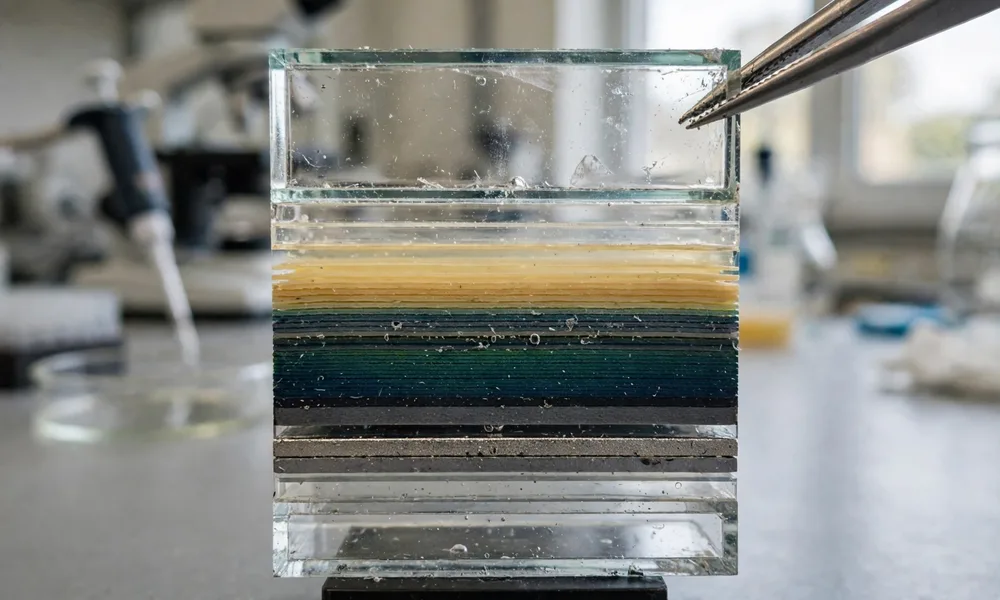
OLED stands for organic light-emitting diode. The word organic sounds strange for electronics, but it simply means the light comes from carbon-based molecules, thin films of them sandwiched between two electrodes. Run a current through one of these films and it glows. Do that for millions of sub-pixels, each one red, green or blue, and you have a picture. The panel is a stack of layers, each thinner than a human hair, and every layer has one job to do.
Step 1: The substrate holds everything flat
At the bottom of the stack sits the substrate, a sheet of glass in most phones and televisions, or a flexible plastic film in foldable screens. It has to be almost perfectly flat, because the layers above it are measured in nanometres and a bump of even a few microns would show up as a defect. Factories handle these sheets in clean rooms where a single speck of dust can ruin a whole panel.
Step 2: The backplane switches each pixel
On top of the substrate sits the backplane, a grid of thin-film transistors, one or more for every sub-pixel. These transistors are the traffic controllers of the display. They decide exactly how much current reaches each glowing dot, and therefore how bright it shines. Modern phone panels use low-temperature polysilicon transistors, prized for switching fast and holding a charge steady, while some large televisions use oxide transistors instead. Without this layer the panel would be a single glowing sheet with no picture at all. The materials behind micro-LED displays solve the same switching problem in a different way, with individual chips rather than organic films.
Step 3: The anode injects positive charge
Above the backplane comes the anode, usually a transparent layer of indium tin oxide, which injects positive charges, known as holes, into the organic layers. The anode must conduct electricity well while letting light pass through, two demands that fight each other, which is why indium tin oxide has survived so long despite its cost. Engineers polish this layer to a smoothness measured in atoms.
Step 4: The organic layers turn current into light
Here is the heart of the panel. Between the two electrodes sit several organic films: a hole-transport layer, an emissive layer, and an electron-transport layer. The emissive layer holds the dye molecules that actually glow, a different molecule for red, green and blue. When a hole from one side meets an electron from the other inside this layer, they combine and release their energy as a photon, a particle of light. The colour depends on the molecule, not on a filter, which is why OLED colours can look so vivid. These layers are deposited by evaporation in a vacuum, the molecules rising like steam and condensing on the glass in patterns finer than a hair.
Step 5: The cathode completes the circuit
The top electrode, the cathode, injects electrons into the organic stack from the other side. It is usually a thin metal film, often a magnesium-silver alloy, and it has to be thin enough to let light out in a top-emitting design, or thick and reflective in a bottom-emitting one. The current flows from anode to cathode through the organic films, and the brightness of each sub-pixel rises with the current, giving the display its fine control over shade.
Step 6: Encapsulation keeps air and water out
Organic molecules hate water and oxygen. A single drop of moisture can oxidise the emissive layer and leave a black spot that slowly grows, so the finished stack is sealed under a barrier of alternating glass-like and polymer films, a technique called thin-film encapsulation. This seal is what lets a foldable phone bend without letting the weather in. Then a polariser and a touch sensor are laminated on top, and the whole assembly is bonded to the cover glass. The engineering inside an e-ink display takes the opposite approach to sealing, since its capsules are already waterproof, but the goal is the same: keep the picture stable for years.
Step 7: The driver chip paints the picture
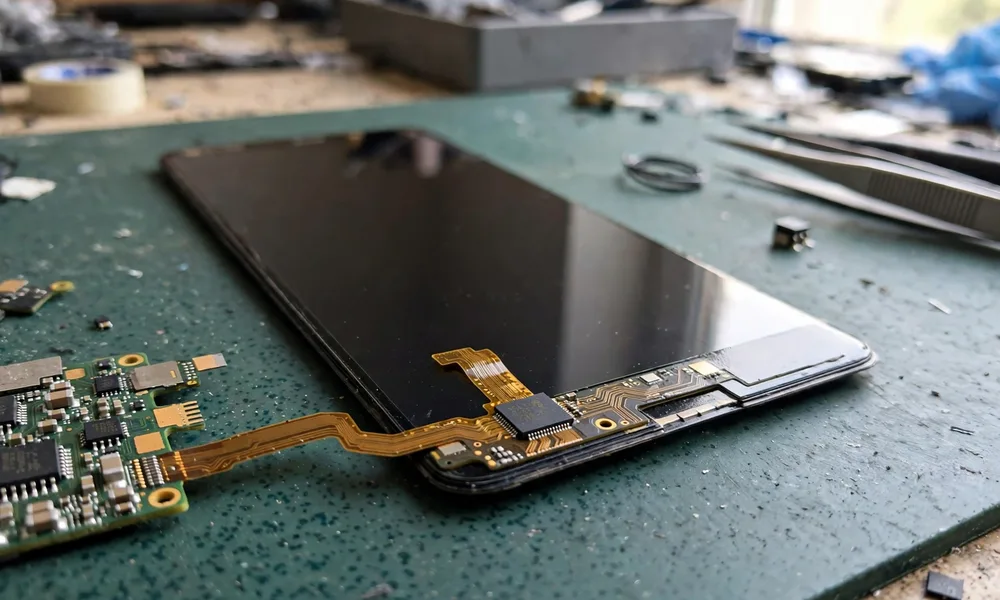
The final piece is the driver integrated circuit, a chip bonded to the edge of the panel that translates the phone’s video signal into voltages for millions of transistors. It refreshes the picture 60, 90 or 120 times a second, dims individual pixels for dark scenes, and manages the power so a mostly black screen uses almost no energy. When you swipe through photos, it is this chip doing the heavy lifting, sixty times a second.
| Specification | Typical value |
|---|---|
| Panel thickness (phone) | About 1 to 2 millimetres including cover glass |
| Sub-pixel size | Roughly 20 to 40 microns across |
| Peak brightness | 1,000 to 3,000 nits on flagship phones |
| Response time | Under 0.1 milliseconds |
| Contrast ratio | Effectively infinite, since black pixels are off |
| Refresh rate | 60 to 120 hertz, up to 144 on some panels |
| Viewing angle | Near 180 degrees with little colour shift |
Price is hard to pin down because panels are sold to manufacturers, not to the public, but estimates put a flagship phone OLED at roughly 70 to 110 US dollars per panel in volume, while a large television panel can cost a manufacturer several hundred dollars. A replacement phone screen fitted by a repair shop typically runs from about 150 to 350 dollars depending on the model, The panel itself is often the most expensive single component in a phone, ahead of the processor.
A rare fact: the blue light in an OLED panel is the weak link of the whole technology. Blue organic molecules need more energy to glow and degrade faster than red or green, so engineers have spent two decades hunting for a stable deep-blue emitter. Some premium televisions dodge the problem entirely by using only blue or white OLEDs behind a colour filter, while others stack two blue layers to share the load. The first phone maker to ship a truly long-lived efficient blue emitter will quietly improve the battery life of every screen that follows.
What makes the OLED panel special is not any single layer but the way the whole stack disappears into the picture. There is no backlight to leak, no shutter to slow the image, just current becoming light at the exact spot it is needed. That is why a dark scene on an OLED looks like a window into a night, and why, once you have seen it, an older screen looks grey by comparison. The sensor inside a cinema camera chases a similar goal from the other side, capturing light pixel by pixel with the same obsession over precision, and together the two technologies decide what the pictures we watch actually look like.


