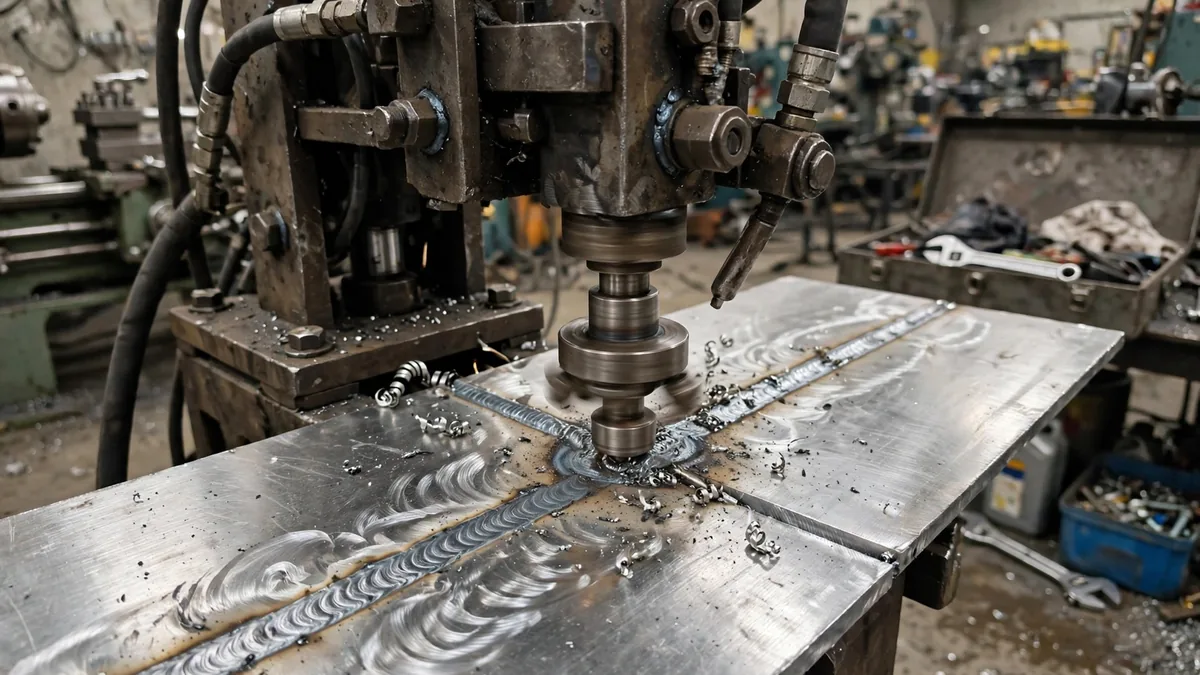
Two plates of aluminium lie side by side on a bench, and a spinning tool presses down into the seam between them. There is no flame, no shower of sparks, no blinding arc. The metal never melts. Yet when the tool moves on, the two plates have become one piece, joined by a seam stronger than the metal around it.
It is real, and it has changed how aeroplanes, rockets and trains are built. Friction stir welding joins metals by rubbing them together so hard that they soften and flow, like clay under a thumb, and then knit back together as one solid piece. It works best on aluminium, the metal that ordinary welding struggles with most, and it produces joints so clean that engineers now trust it with fuel tanks that carry liquid hydrogen into space.
How Friction Stir Welding Works
The idea is disarmingly simple: spin a hard tool fast, press it into the joint between two metal plates, and drag it along the seam. Friction between the tool and the metal generates heat, and the heat softens the metal without melting it. The spinning tool then stirs the softened metal from both sides together, and as the tool moves away, the metal cools and solidifies into a single, continuous joint. The friction stir welding process has no filler metal, no shielding gas and no arc — just a spinning pin, a shoulder, and pressure.
Step 1: Clamping the plates
Before anything spins, the two plates are clamped firmly to a backing bar, edge to edge, with the seam exactly where the tool will travel. This step matters more than it looks. The tool pushes down with a force of several tonnes, and the sideways drag is enormous; if a plate shifts by even a millimetre, the joint is ruined. Clamping is the unglamorous foundation the whole weld stands on.
Step 2: Plunging the tool
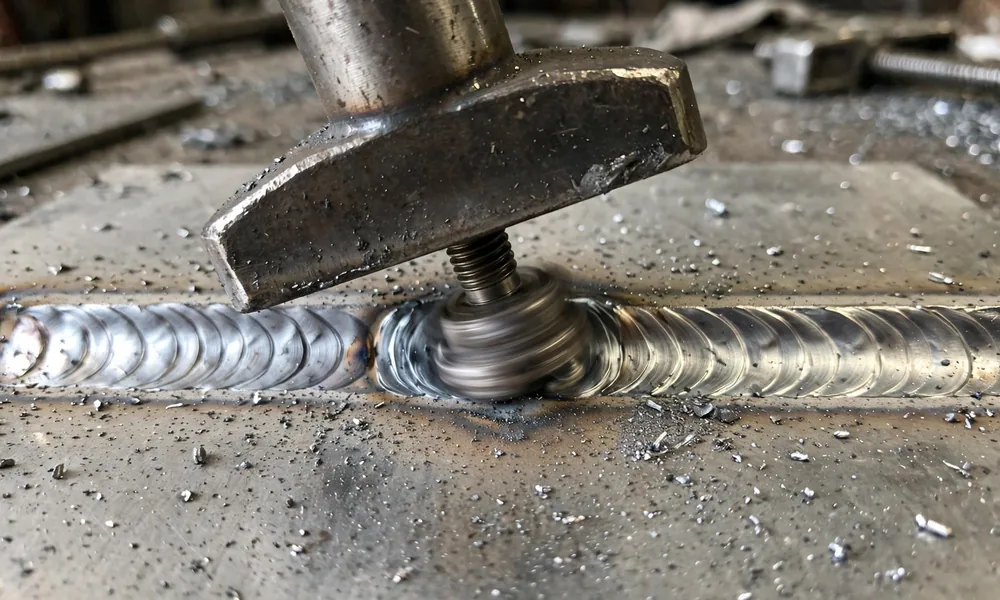
The tool itself is a short cylinder with a shoulder on the bottom and a small pin sticking out of its centre, like a stubby drill bit with a flat top. It is made of tool steel, or a harder alloy for tougher metals, and it spins at several hundred revolutions per minute. The operator lowers it onto the seam, and the pin plunges into the metal while the shoulder presses against the surface. Friction between the spinning shoulder and the plate generates most of the heat, and within seconds the metal under the tool softens to a hot, dough-like state — typically around 400 to 500 degrees Celsius for aluminium, well below its melting point of about 660 degrees.
Step 3: Stirring the seam
Now the tool travels along the joint, and this is where the welding actually happens. The spinning pin churns the softened metal from both plates together, carrying material from the front of the tool to the back in a swirling flow. Engineers call this plasticised flow: the metal behaves like thick putty, moving around the pin and knitting together behind it. The shoulder on top does two jobs at once — it keeps the softened metal from escaping upward, and its rotation irons the surface flat. Behind the tool, the stirred metal cools and recrystallises into a fine, strong grain structure.
Step 4: Traversing the full joint
The tool moves steadily along the seam, usually at 100 to 500 millimetres per minute, while the machine holds the downward force constant. Too fast and the metal does not get hot enough, leaving a cold, weak joint with a tunnel defect inside. Too slow and the metal overheats, growing coarse grains that weaken the weld. The operator — or more often the computer — balances rotation speed, travel speed and downward force for the thickness and alloy in front of it.
Step 5: Withdrawing and finishing
At the end of the seam, the tool lifts out, leaving a small round hole where the pin was — the exit hole, the one visible flaw in the process. On critical parts, engineers plan for this: they weld onto a run-off tab that is cut away afterwards, or they use a retractable pin that pulls back into the shoulder as the weld ends. The plates are then unclamped, and the joint needs remarkably little finishing. A good friction stir weld in aluminium can reach 80 to 90 percent of the parent metal’s strength — and in some alloys, it is stronger than a conventional weld by a wide margin.
Step 6: Why it beats melting
The payoff for all this machinery is a joint that ordinary welding cannot match in aluminium. Because the metal never melts, there is no molten pool to crack as it cools, no filler wire to match, and no shielding gas to protect the arc. Aluminium forging shapes metal with pressure in a similar spirit, but friction stir welding is the only common process that joins aluminium this cleanly without melting it.

Friction Stir Welding at a Glance
| Specification | Typical value |
|---|---|
| Process type | Solid-state, no melting |
| Peak temperature | 400–500 °C for aluminium |
| Tool rotation | 200–1,500 rpm |
| Travel speed | 100–500 mm per minute |
| Downward force | Several tonnes |
| Joint strength | 80–90% of parent metal |
| Best for | Aluminium, copper, magnesium; long straight seams |
What Friction Stir Welding Costs
A friction stir welding machine can cost roughly $500,000 to $2 million as an estimate, depending on size and automation, and the tools themselves wear out and must be replaced. For high-volume work the running costs are low: no filler wire, no shielding gas, and little finishing labour. The process earns its keep on parts where a conventional weld would be risky, slow or simply impossible, and on those jobs it is often the cheapest option in the end.
A Rare Fact
Friction stir welding was invented in 1991 at The Welding Institute in Cambridge, England, by a man named Wayne Thomas — and it was almost an accident of curiosity. Today, the largest friction stir welders in the world join the fuel tanks of the Space Launch System rocket, welding aluminium panels more than eight metres across. A process invented to fix a cracking problem now holds together the rockets that carry people toward the Moon.
Where Friction Stir Welding Shows Up
The process is now a workhorse wherever aluminium structures must be both large and flawless. The fuel tanks of rockets are its most famous application, but the same machines weld the bodies of high-speed trains, the decks of ships, and the panels of aircraft. Car makers use it for battery trays in electric vehicles, where a leak-proof, distortion-free enclosure matters more than anything, and even the frames of some premium bicycles are friction stir welded. Wherever a long aluminium seam has to be strong, straight and free of cracks, the spinning tool is the first choice engineers reach for.
The next time you board a high-speed train or watch a rocket climb into the sky, remember the seam you cannot see. Additive manufacturing materials get most of the attention in modern engineering, but for joining big aluminium structures, the quiet spinning tool is still the one engineers trust with the most important joints of all.