The first time you ride an electric hydrofoil surfboard, the moment it lifts feels like a trick. One second you are lying on a board, pushing through the water like any beginner on a surfboard. The next, the board rises, the water noise stops, and you are gliding a foot above the surface on something you cannot see. It is quiet, it is smooth, and it feels impossible. Then you look at the price, and the trick feels expensive. An electric hydrofoil surfboard, usually called an eFoil, is a small machine doing a very hard job, and its specifications explain both the magic and the money.
An eFoil is a surfboard with a mast underneath, a wing at the bottom of the mast, a propeller, a motor and a battery inside the board. At low speed it behaves like a normal board, floating on the water. As you gain speed, water flowing over the wing creates lift, just as air flowing over an aeroplane wing creates lift, and the board rises out of the water. The mast, usually 60 to 80 centimetres long, holds the board above the surface, and the wing and propeller stay submerged. Once you are foiling, only the mast and wing touch the water, so drag falls away and the ride becomes silent and smooth.
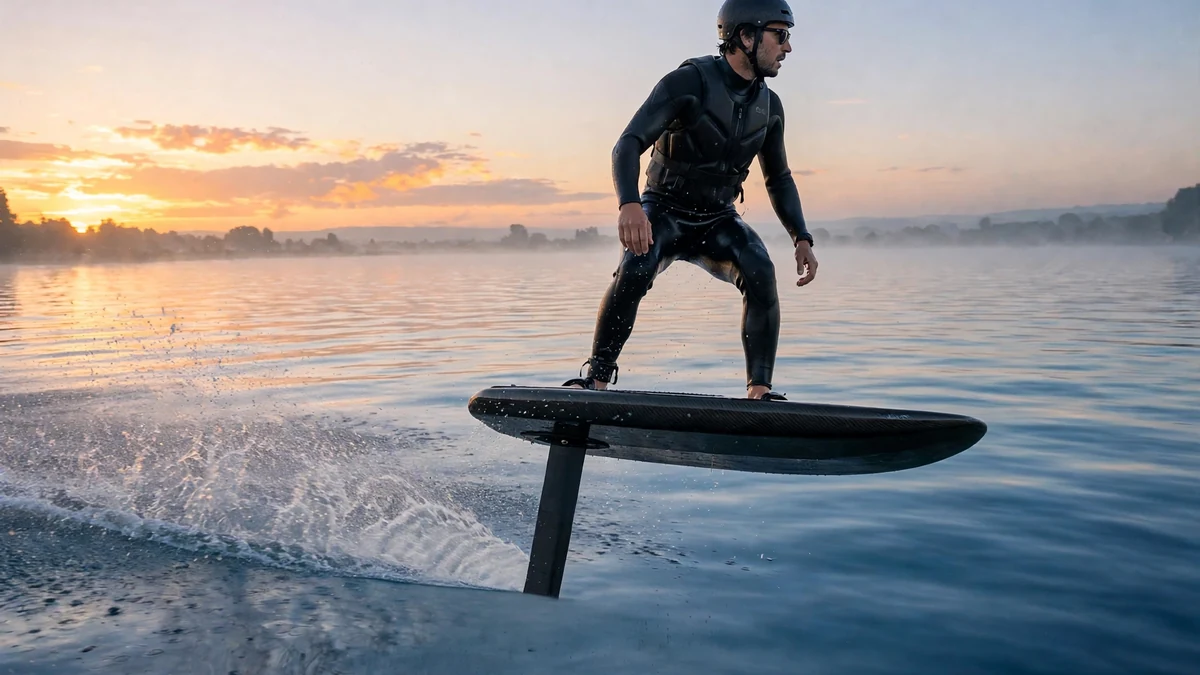
Board size is the first specification, and it decides who can ride it. A larger board, around 5 feet 6 inches or more, is stable and easy to learn on, with enough volume to float a heavier rider. A smaller board is faster and more agile, but harder to balance and harder to get going. Volume, measured in litres, is the number to check: a beginner usually wants 100 litres or more, while an experienced rider might choose 70 to 90 litres.
The wing is the heart of the machine. A large wing, around 1,500 to 2,000 square centimetres, lifts at low speed and is forgiving for beginners. A smaller wing, 800 to 1,200 square centimetres, is faster and more responsive but needs more speed before it lifts, and it punishes mistakes. Wing shape matters as well: a high-aspect wing, long and narrow, is efficient and glides far, while a low-aspect wing, short and wide, is stable and turns easily. Most boards come with a wing suited to learning, and riders swap wings as they improve, the way surfers swap boards for different waves.
| Specification | Typical electric hydrofoil surfboard | What it means for you |
|---|---|---|
| Board length | 4 ft 6 in to 5 ft 10 in | Stability and ease of learning |
| Board volume | 70 to 120 litres | How well it floats your weight |
| Wing area | 800 to 2,000 sq cm | How early it lifts and how fast it goes |
| Mast length | 60 to 85 cm | How high you ride above the water |
| Battery | 1.5 to 2.5 kWh | Ride time, usually 60 to 100 minutes |
| Motor power | 3 to 5 kW | How quickly it gets you foiling |
| Top speed | 22 to 30 mph | Fast enough to feel like flying |
| Rider weight limit | Up to 110 to 120 kg | Check it honestly before buying |
| Total weight | 25 to 35 kg | How hard it is to carry to the water |
Battery and ride time are the numbers buyers ask about most. A typical eFoil battery holds 1.5 to 2.5 kWh, which sounds small next to an electric car, but it is enough for 60 to 100 minutes of riding, because foiling is efficient once you are up. Riding hard, at full speed, drains it faster. Cruising gently, it lasts longer. Charging takes one to two hours from empty, and a second battery, if the board supports swapping, doubles your day. The battery is also the most expensive single part of the board, sealed against water, cooled, and protected by a management system that stops it from overheating or overcharging.
The motor deserves attention too. Most eFoils use a waterproof electric motor mounted on the mast, driving a propeller directly. It needs to be powerful enough to push a rider from a standstill to foiling speed, which is the hardest part of the ride, and then efficient enough to keep going for an hour. How an electric scooter motor works explains the same kind of small, powerful motor in a different machine, and the principles are identical: instant torque, quiet running, and a controller that turns a twist of the throttle into smooth power. On an eFoil the throttle is a handheld wireless remote, and learning to use it gently is half the skill of riding.

How an Electric Hydrofoil Surfboard Works
Learning to ride takes most people a few sessions, and the machine does a lot of the work for you. Here is what happens from the beach to the glide.
- You start lying down. Lie on the board, hold the remote, and squeeze the throttle gently to build speed.
- The board planes. At low speed the board sits on the water like a surfboard, pushing through it.
- The wing starts to lift. As speed rises, water flowing over the wing creates lift, and the nose of the board begins to rise.
- You stand up slowly. Once the board is moving steadily, rise to your feet, knees bent, weight centred over the mast.
- The board leaves the water. With a little more speed, the board lifts clear and you are foiling, supported only by the wing below.
- You control height with your weight. Lean forward to lower the board, lean back to rise, and use small throttle changes to hold a steady speed.
- You land gently. Release the throttle and the board settles back onto the water, ready for the next run.
Price is the number that stops most people, so here it is plainly. A good electric hydrofoil surfboard typically costs roughly $6,000 to $12,000, with premium models reaching $12,000 to $15,000. Those are estimates based on current pricing, and they include the board, mast, wing, battery, remote and charger. Running costs are low: electricity is cheap, servicing is mostly cleaning and checking seals, and the main wear items are the propeller, the wing and the battery over several years. Why an electric hydrofoil board is so expensive breaks down where that money goes, and the short answer is the waterproof battery, the precision wing and the tiny production numbers.
Here is a rare fact to carry with you. The hydrofoil itself is older than the aeroplane. The first working hydrofoils were tested in the early 1900s, and the Italian inventor Enrico Forlanini built a hydrofoil boat that reached 45 mph in 1906, decades before fast boats were common. The idea waited a century for small, powerful batteries and waterproof motors to make it practical for a single rider on a surfboard. You are riding a hundred-year-old idea, finally small enough and cheap enough to carry to the beach, and that is a remarkable thing to think about while you are gliding a foot above the water.

When you choose an eFoil, choose it for your weight, your experience and the water you will actually ride in, not for the top speed on the box. A big stable board with a large wing will give you more good days than a small fast one you cannot get going. Yacht toys and tenders ranked shows where an eFoil fits among the toys on a yacht, and it fits well: it is quiet, it needs no fuel, and it turns a calm anchorage into a playground. Learn slowly, respect the water, and the board will do the rest.


