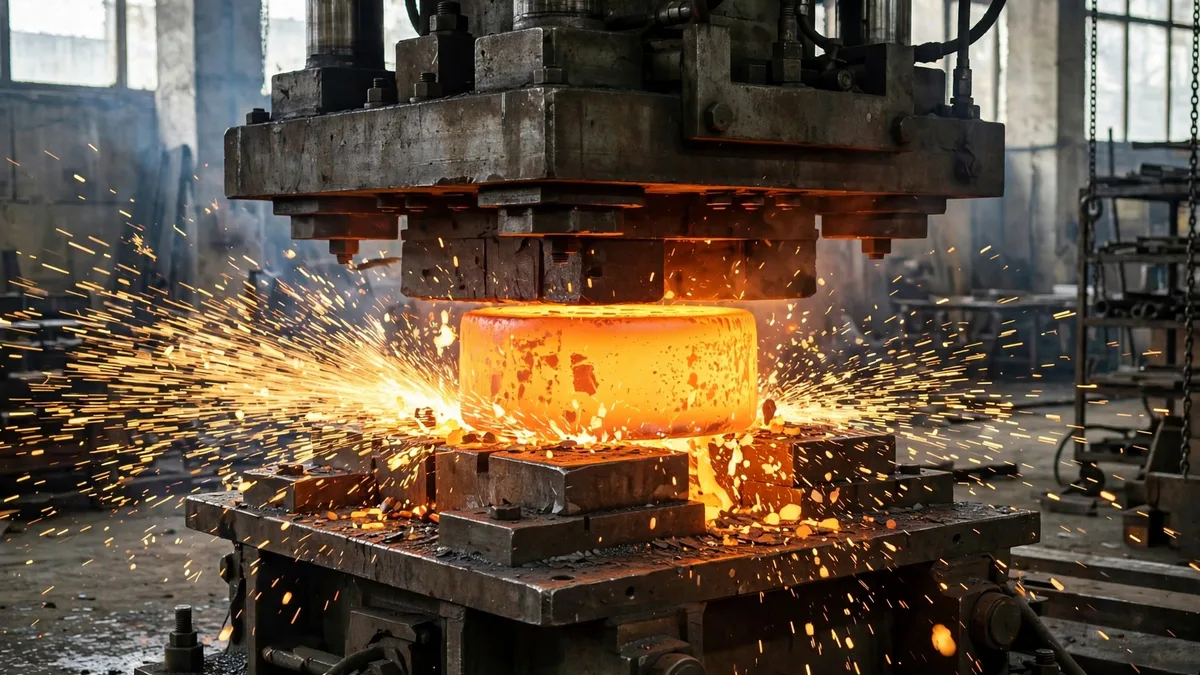
There is a moment in a forge when a glowing block of aluminium, heated until it shines like a small sun, is squeezed between two steel dies — and in a single blow it becomes something else entirely: a wheel, a suspension arm, a part of an aircraft that will fly for thirty years. The press closes with a force measured in thousands of tonnes, the metal flows like thick honey into every corner of the die, and when the press opens, a shape emerges that no casting or machining could have made as strong. Forging is the oldest way of shaping metal, and for aluminium it remains the best.
Aluminium forgings are everywhere and almost nowhere noticed: in the wheels of the car you drive, in the landing gear of the plane you fly in, in the suspension of a racing motorcycle and the frame of a high-end bicycle. The materials behind aluminium forging are a quiet science of alloys, temperatures and grain structure — the invisible arrangement of crystals inside the metal that decides whether a part bends, or breaks, when it is loaded to its limit.
The Materials Behind Aluminium Forging
The workhorse alloys of aluminium forging are the 6000 and 7000 series — alloys whose strength comes from small additions of magnesium, silicon, zinc and copper. The 6061 alloy is the general-purpose choice, weldable and corrosion-resistant, while 7075 is far stronger, nearly as strong as some steels, but harder to work and more prone to corrosion. The choice of alloy decides everything that follows: the forging temperature, the number of press blows, the heat treatment, and the life of the finished part. There is no single best forging aluminium, only the right one for the job.
Step 1: Choosing the alloy for the part
A wheel and an aircraft bracket need different things from their metal. A wheel must resist fatigue from millions of rotations and shrug off road salt, so a corrosion-resistant 6000-series alloy is the natural pick. An aircraft structural part needs maximum strength for minimum weight and lives in a dry, inspected environment, so a 7000-series alloy wins despite its cost and corrosion sensitivity.
Step 2: Heating the billet to the forging window
Aluminium is forged hot, but not too hot. Most forging alloys are heated to around 400–480 degrees Celsius, a narrow window where the metal flows easily under the press but does not melt at the grain boundaries. Too cold and the metal cracks instead of flowing; too hot and it burns, losing magnesium and silicon at the surface and weakening the part.
Step 3: The press and the flow of the grain
Forging’s great advantage is what it does to the metal’s grain. In a casting, the crystal grains point in random directions; in a forging, the press forces the grains to flow along the shape of the part, like the grain in a piece of wood following its curves. That aligned grain is what makes a forging stronger than a casting of the same alloy and shape, and far more resistant to fatigue cracks. The press operator works in a sequence of blows, each one moving the metal a little further, and the aluminium forging takes its strength from that controlled flow as much as from the alloy itself.

Step 4: Trimming, cooling and the first inspection
A forging leaves the die with a rim of excess metal — flash — squeezed out between the die halves, which is trimmed off while the part is still warm. The part is then cooled, sometimes in air and sometimes quenched in water, depending on the alloy and the properties wanted. The first inspection follows immediately: the shape is checked against gauges, the surface is examined for cracks or laps where the metal folded over itself, and suspect parts are set aside.
Step 5: Heat treatment that unlocks the strength
A freshly forged aluminium part is surprisingly soft. Its real strength only appears after heat treatment: solution heat treatment, where the part is heated to dissolve the alloying elements, quenched to trap them, then aged — held at a lower temperature for hours — so that tiny strengthening particles precipitate throughout the metal. This is what turns a soft forging into a part as strong as steel at a third of the weight. The anodised aluminium finish that many forgings receive afterwards adds a hard, corrosion-resistant skin, but the strength was already built in by the furnace.
Step 6: Machining to final shape
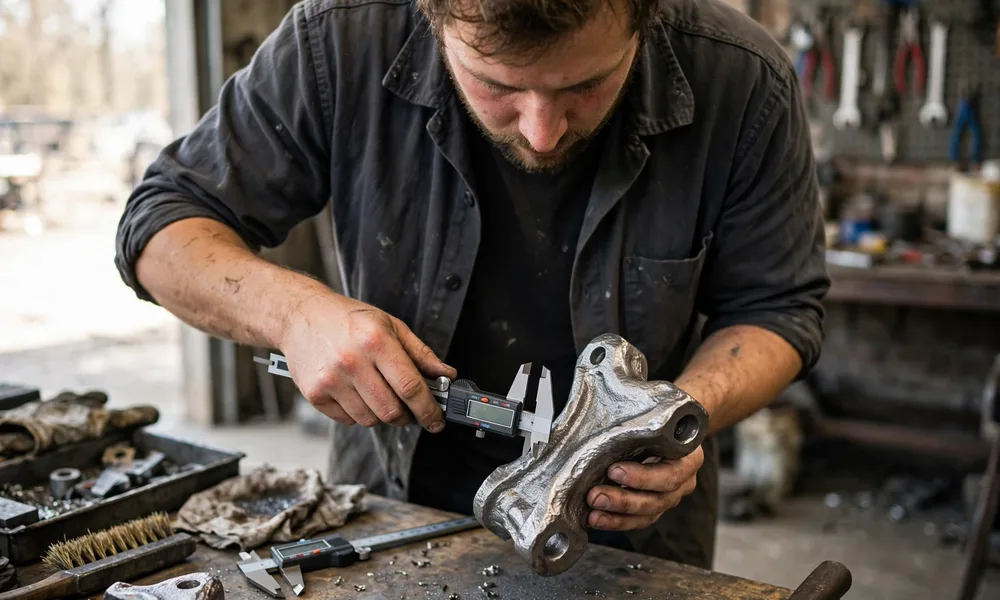
Even the best forging is not a finished part. Critical surfaces — bearing seats, bolt holes, mating faces — are machined to tolerances a forging die cannot hold, often to a few hundredths of a millimetre. The titanium forging process follows the same logic at far higher temperatures, and the two crafts share more than most people realise.
Step 7: Testing that proves the part will not fail
Before a forged aluminium part goes into service, samples from the same batch are tested to destruction: pulled apart, bent until they break, cycled millions of times to prove their fatigue life. Finished parts are checked with ultrasound and dye penetrant for internal flaws, and critical aerospace forgings are individually traced from billet to aircraft. A forging’s reputation is built on the parts that never failed — and the testing is what keeps it that way.
Aluminium Forging at a Glance
| Specification | Detail |
|---|---|
| Common alloys | 6061 and 7075, plus 6082 and 2014 for specialist parts |
| Forging temperature | Around 400–480°C, depending on alloy |
| Press force | Thousands of tonnes for large parts |
| Strength after heat treatment | 7075 can approach the strength of some steels |
| Weight vs steel | Roughly a third the weight for the same volume |
| Key advantage | Aligned grain flow gives superior fatigue resistance |
| Typical uses | Wheels, suspension parts, aircraft structures, bicycle frames |
What Does It Cost?
A forged aluminium wheel for a car typically costs a few hundred dollars (estimate), several times the price of a cast wheel, and an aerospace forging can run into thousands of dollars (estimate) once heat treatment, machining and testing are counted. The raw aluminium is the smallest part of the bill: the cost is in the dies, which can cost tens of thousands of dollars (estimate) to make, the energy of heating and pressing, and the inspection. Forgings only make economic sense at volume or where failure is unacceptable — which is exactly where they are used.
A Rare Fact
The world’s largest aluminium forgings are made for aircraft, and one of the most famous is the bulkhead of a fighter jet — a single forging so large that only a handful of presses on Earth can make it, the biggest of them a 50,000-tonne press built in the 1950s. That press was built to forge magnesium aircraft parts during the Cold War and still works today, its dies older than most of the engineers who use it. When a new aircraft needs a forging bigger than any modern press can handle, designers still call on machines built before the jet age — proof that in forging, size and age are features, not flaws.


