Take a sheet of material one atom thick, stronger than steel and lighter than paper, and try to build something useful from it. That is the puzzle of graphene. On its own, a single layer of carbon atoms is almost impossible to handle: it tears, it folds, it clumps. But mixed into plastics, resins, and metals in tiny amounts, graphene turns ordinary materials into something remarkable, stiffer, tougher, and able to carry heat and electricity. A graphene composite is not a sheet of wonder material. It is a carefully engineered mixture, and making one is a balancing act between chemistry, heat, and patience.
Graphene composites are already hiding in tennis rackets, bicycle frames, car parts, and protective coatings. The graphene inside is measured in fractions of a percent, yet it changes how the whole material behaves. Getting it there, evenly spread and properly bonded, is the hard part. This is how a graphene composite is made, from raw graphite to a finished panel ready for use.

How It’s Made
Step 1: Starting with graphite
Almost all graphene begins life as graphite, the same soft mineral found in pencil leads. High-purity graphite flakes are the raw material, chosen for their crystal structure: the better ordered the graphite, the better the graphene that comes out of it. The flakes are washed and sorted, and the best grades are reserved for the highest-performance composites. Other routes exist, such as growing graphene directly on metal foil from a gas, but for composites the graphite route dominates because it can be scaled up to the tonnes that industry needs. The material itself, and what it can and cannot do, is the foundation of the whole process, as our guide to graphene composite materials engineering explains.
Step 2: Peeling graphite into graphene
Graphite is made of millions of graphene layers stacked together, held by weak forces that can be broken. The most common industrial method is liquid exfoliation: graphite flakes are mixed into a solvent and blasted with ultrasound or high-shear mixers, which peel the layers apart into flakes a few atoms thick. Another route oxidises the graphite first, making graphene oxide, which disperses easily in water and can later be chemically reduced back towards graphene. For composites, small flakes a few layers thick work well, as long as they are consistent. The flakes are dried into a fine black powder, light as soot and easy to lose to the air, so the whole process runs in sealed equipment.
Step 3: Dispersing the flakes evenly
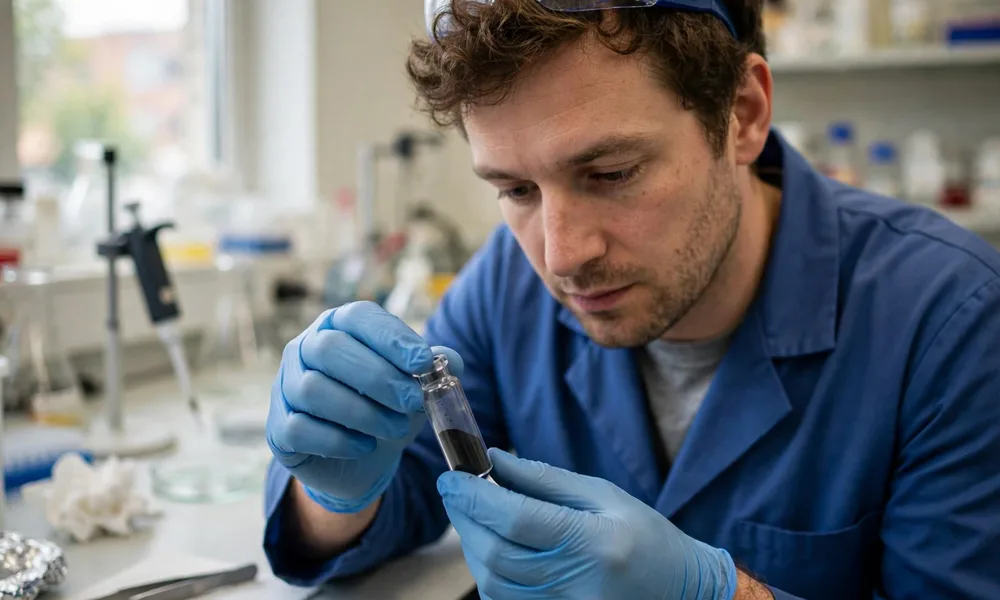
This is the step where most graphene composites succeed or fail. Graphene flakes love to stick to each other, and a clump of flakes in a resin is just an expensive lump of graphite. The powder is mixed into a liquid resin or melted polymer using high-shear mixers, ball mills, or three-roll mills that pull the clumps apart and spread the flakes through the liquid. Surfactants and chemical treatments on the flake surfaces help them stay separated and bond to the surrounding material. The mixture is checked under a microscope: a good dispersion shows individual flakes spread evenly like pepper in soup, while a bad one shows dark clumps. The same challenge applies to other nanoscale reinforcements, including the tubes described in our guide to carbon nanotube composite materials engineering.
Step 4: Mixing into resin or polymer
Once dispersed, the graphene-loaded resin becomes the matrix of the composite. For structural parts, the resin is usually an epoxy, chosen for its strength and its ability to bond to fibres. For flexible products, the graphene goes into a thermoplastic that can be melted and moulded. The loading is tiny, typically between 0.1 and 2 percent by weight, because more graphene does not mean a better composite: too much makes the material brittle and harder to process. The mixed resin is degassed under vacuum to pull out trapped air bubbles, which would become weak spots in the finished part.
Step 5: Laying up and curing the part
For a structural composite, the graphene resin is combined with a reinforcing fabric, usually carbon fibre or glass fibre, laid up layer by layer in a mould. Each layer is brushed or infused with resin, rolled flat to remove air, and aligned so the fibres point in the direction the part needs strength. The mould is then sealed in a vacuum bag and cured, either at room temperature or in an oven or autoclave, where heat and pressure harden the resin into a rigid solid. The graphene stiffens the resin between the fibres, where ordinary composites tend to crack first. The fabric side of the process is a craft of its own, as shown in our guide to carbon fibre weave materials engineering.
Step 6: Trimming, testing, and finishing
The cured part is removed from the mould, trimmed to shape with diamond cutting tools, and its edges are sealed. Then it is tested: samples are bent, pulled, and struck to measure stiffness, strength, and toughness against the specification, and electrical or thermal tests check whether the graphene is doing its second job of conducting heat or charge. Parts that pass are sanded, coated, and inspected for voids or dry patches where the resin never reached the fibres. Factories test small samples from every batch before committing to full parts.
Specs
| Specification | Detail |
|---|---|
| Reinforcement | Graphene flakes a few atomic layers thick, typically 0.1–2% by weight |
| Raw material | High-purity graphite flakes, exfoliated or oxidised and reduced |
| Matrix | Epoxy resin for structural parts, or thermoplastic for moulded products |
| Graphene strength | Single-layer graphene has a tensile strength near 130 GPa in theory |
| Typical improvement | Stiffness and toughness gains of 10–50% over the unfilled resin |
| Conductivity | Can add electrical and thermal conductivity to insulating plastics |
| Curing | Vacuum-bagged and cured in an oven or autoclave |
| Applications | Sports equipment, car parts, coatings, and protective panels |

Price
Graphene is no longer the astronomically expensive curiosity it was when it was first isolated, but it is still far from cheap. Bulk graphene powder now typically sells for around $50 to $200 per kilogram depending on quality (estimate, based on typical commercial pricing for graphene powder), and high-grade material costs far more. Because composites use so little of it, a graphene-enhanced part typically costs around 10 to 30 percent more than the same part without graphene (estimate, based on typical pricing of graphene-enhanced products). The real cost is in the processing and testing.
Rare Fact
Graphene was first isolated with ordinary sticky tape. In 2004, researchers at the University of Manchester pressed tape onto a block of graphite and peeled it off again and again, each time splitting the flakes thinner, until a single layer of carbon atoms remained. The work won the Nobel Prize in Physics in 2010, and it remains the purest graphene ever made: tape-peeled flakes are still the benchmark that industrial graphene is measured against. Every tonne of graphene powder made today is, in a sense, trying to copy what a piece of tape did on a lab bench.


