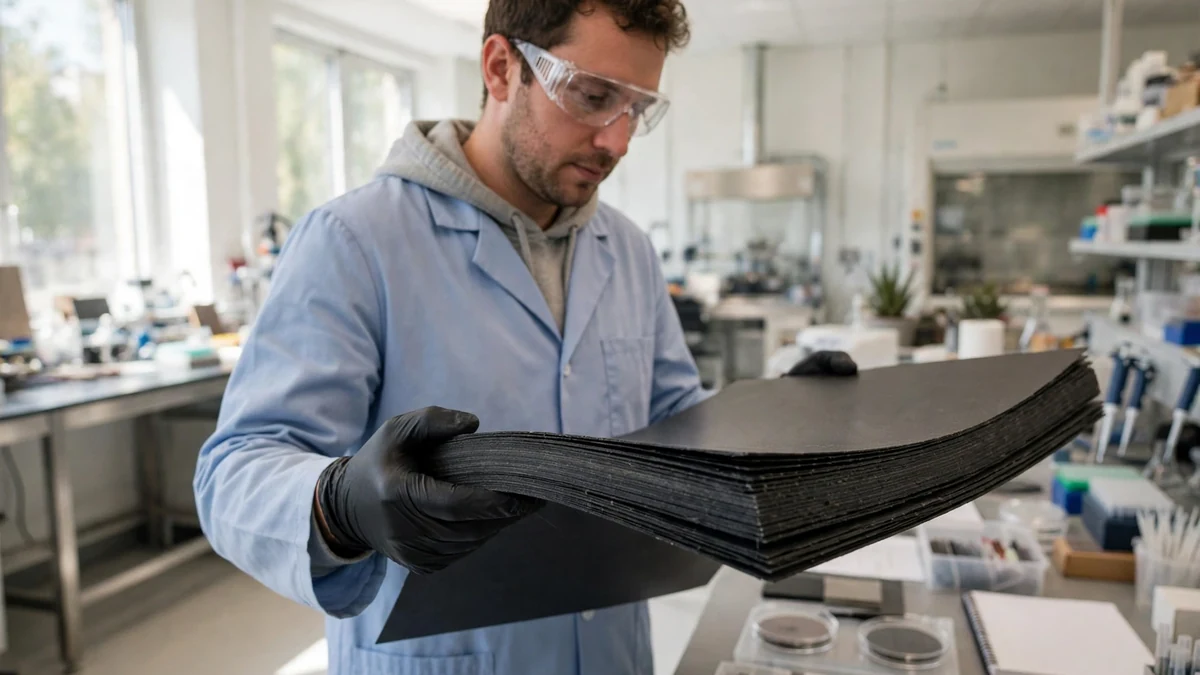
In a quiet laboratory, a researcher in a blue coat and safety glasses lifts a sheet of black material so thin and light it barely seems real. It flexes like paper, yet it is stronger, weight for weight, than steel. She holds it up to the light and checks its edge for flaws, because this sheet is not ordinary carbon fibre. It is a composite laced with graphene, a material only one atom thick, and making it has taken a whole factory of machines, chemicals and patience.
Graphene is famous for being extraordinary on paper: stronger than steel, lighter than paper, and able to conduct electricity better than copper. The hard part has never been the theory. It has been making the stuff in sheets big enough, clean enough and cheap enough to build things from. The factory that makes graphene composite is part chemistry lab, part textile mill, and part bakery, and this is how it turns a wonder material into something you can hold in your hands.
Inside the Factory
Step 1: Graphene is grown, not mined
Graphene starts as a gas. In a furnace heated to around 1,000 degrees, a carbon-rich gas flows over a sheet of copper foil, and carbon atoms settle onto the metal and link up into a single layer of hexagons, one atom thick. The process is called chemical vapour deposition, and it is watched closely, because the temperature, the gas flow and the timing all decide whether the graphene grows as one clean sheet or as a patchwork of flaws. Growing it at this scale is the first great challenge, and it is described in how graphene composite is made, where the furnace and the foil set the quality of everything that follows.
Step 2: The graphene is transferred onto a carrier
A single layer of graphene cannot be picked up like a sheet of paper. It must be moved from the copper foil onto a plastic or resin film without tearing it, and this is one of the most delicate jobs in the factory. The foil is coated with a support layer, the copper is dissolved away in a chemical bath, and the floating graphene is scooped up onto its new carrier and dried. Some factories skip the transfer altogether and mix tiny graphene flakes directly into resin instead, which is simpler and cheaper, though it gives up some of the strength of a perfect single sheet.
Step 3: Graphene is mixed into resin and fibre
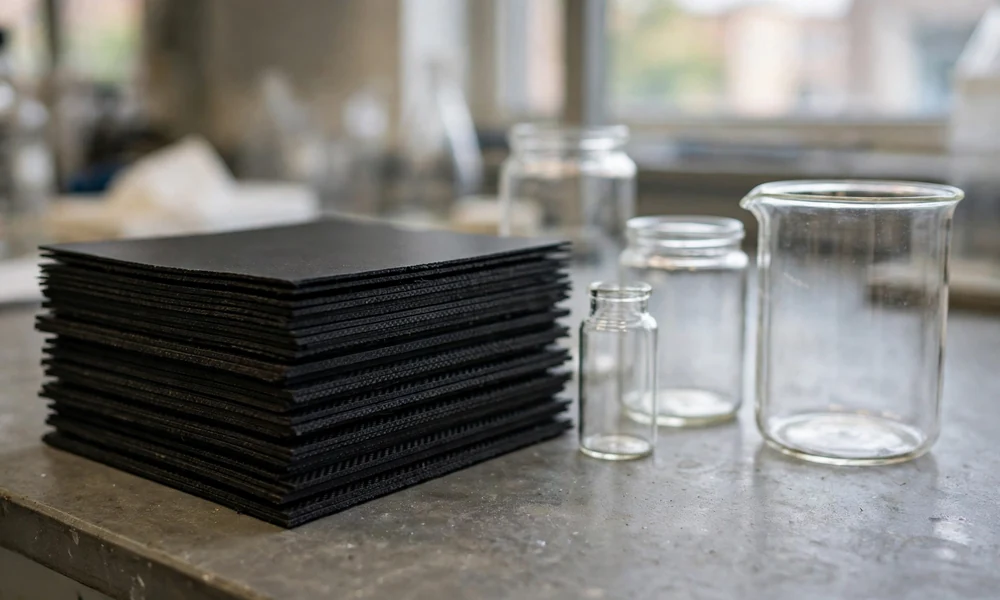
To make a composite, the graphene must be spread evenly through a resin or layered with carbon fibre, and this is where most factories fail. Graphene flakes love to clump together, and a clump is a weak spot, so the resin is stirred with high-shear mixers and ultrasound until the flakes are separated and evenly scattered. The mixture is then spread onto carbon fibre cloth, or the graphene film is laid between layers of fibre, building up a stack that will become a panel.
Step 4: The stack is pressed and cured
The layered stack goes into a heated press or an autoclave, where heat and pressure squeeze the layers together and harden the resin around them. The temperature rises slowly to around 120 to 180 degrees, and the pressure forces out any trapped air, leaving a solid panel with the graphene locked inside. The cure cycle can last for hours, and sensors track the temperature at several points, because a panel that cures unevenly will warp or crack. It looks unremarkable, which is the point: the extraordinary part is inside, at a scale no eye can see.
Step 5: Panels are cut, tested and graded
The cured panels are cut to size with diamond saws or water jets, and samples from every batch are tested to destruction. Tensile machines pull strips until they snap, and the force at which they break is recorded and compared against the specification. Other samples are checked for electrical conductivity, because a well-made graphene composite should conduct electricity far better than ordinary carbon fibre, and that test reveals whether the graphene is properly spread or clumped. The materials behind this process are covered in graphene composite materials engineering, where each ingredient is chosen for how it behaves at the atomic scale.
Step 6: The composite is shaped into parts
The panels that pass are shaped into finished parts, from aircraft panels and car bodywork to sports equipment and phone cases. Some are pressed into moulds while the resin is still soft, and others are machined after curing, with diamond tools that cut the hard composite without tearing the fibres. The parts are then drilled, bonded and finished, and each one is inspected under bright lights for surface flaws. A graphene composite part is often used where ordinary carbon fibre is almost good enough but not quite: where a little more stiffness, a little less weight, or a little electrical conductivity makes the difference.

Graphene Composite Specifications
| Specification | Detail |
|---|---|
| Graphene thickness | One atom, about 0.34 nanometres |
| Graphene strength | Over 100 times stronger than steel, weight for weight |
| Growth method | Chemical vapour deposition on copper foil at around 1,000 degrees |
| Typical graphene content | 0.1 to 5 percent by weight in the finished composite |
| Curing temperature | Around 120 to 180 degrees Celsius |
| Density | About 1.5 grams per cubic centimetre |
| Electrical conductivity | Far higher than standard carbon fibre when well dispersed |
| Testing | Tensile testing to failure, conductivity checks, batch traceability |
What Graphene Composite Costs
Graphene composite is expensive, and the price is falling slowly rather than quickly. Industry estimates put finished graphene-enhanced composite panels at roughly $200 to $1,000 per kilogram, depending on the graphene content and the quality of the material, compared with tens of dollars per kilogram for ordinary carbon fibre. The graphene itself is the costly part: growing clean sheets, transferring them without damage, and dispersing them evenly all take time, equipment and skilled labour, and the yields are still far from perfect. These are estimates, not list prices, and the real figures vary widely between suppliers. The reason the number stays high is explored in why graphene composite is so expensive, where the furnace, the transfer step and the low yields are the biggest costs.
A Rare Fact
A single gram of graphene, if it could be spread out as one perfect sheet, would cover a football pitch. That is because it is only one atom thick, so a tiny amount of material goes an enormous way. The factories that make graphene composite are, in effect, trying to handle a material that is both the strongest thing ever measured and almost impossible to pick up.
The sheet the researcher held up at the start of this story weighed almost nothing, and yet it carried inside it a material that could one day replace steel in aircraft and cars. That is the promise that keeps the furnaces running and the clean rooms full. Graphene composite is not yet cheap, and it is not yet everywhere, but every panel that leaves the factory is a small proof that the hardest part, making the wonder material real, is already being done, one atom-thick layer at a time.


