Hold a sheet of it up to the light and you see a grid of empty hexagonal cells, walls thinner than paper, mostly air. It weighs almost nothing — you could lift a panel the size of a door with two fingers — and yet the floor of a passenger jet is made of it, the doors of a race car are made of it, and the walls of a satellite are made of it. It is the honeycomb core, one of the most counterintuitive materials in engineering: mostly empty space, and stronger for it.
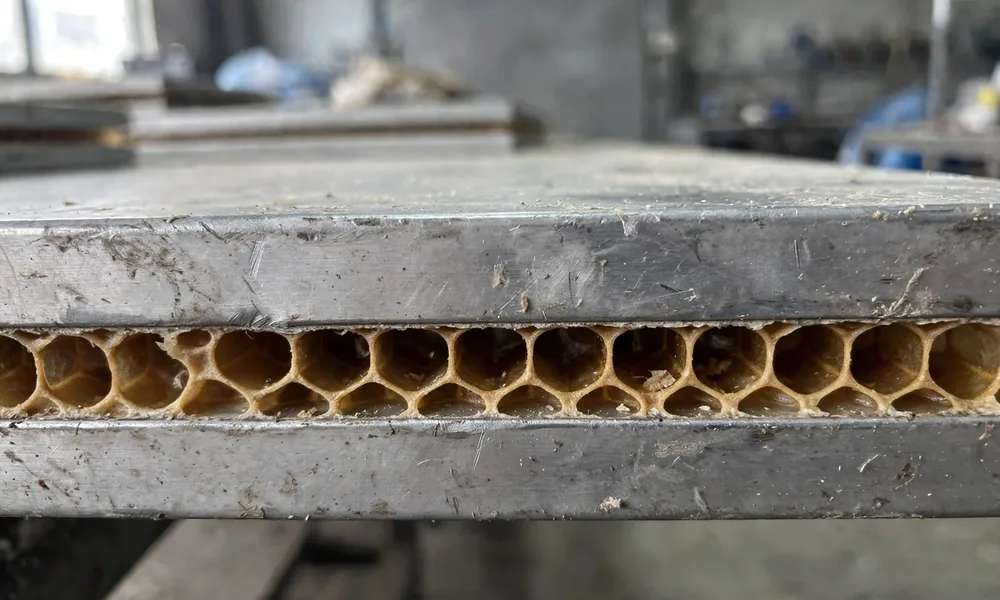
The honeycomb core works because of a trick bees discovered millions of years ago. A hexagon is the most efficient shape for dividing a flat surface — it encloses the most area with the least wall — and when thousands of hexagons are packed together, the walls support each other, so a sheet of thin foil becomes a rigid, crush-resistant structure. Engineers sandwich that core between two thin, stiff skins, and the result is a panel almost as stiff as a solid slab at a fraction of the weight.

How It Works
Step 1: The hexagon shares the load
A single hexagonal cell is not strong on its own — its walls are paper-thin. Its strength comes from the pack: each cell shares its walls with its neighbours, so a load pressing on one cell spreads across dozens of others. Press down on the honeycomb and the vertical walls act like tiny columns, resisting compression. The geometry does the work solid material would do in a heavier panel, with as little as five percent of the material.
Step 2: Two stiff skins turn the core into a beam
The core on its own is useful, but the real magic happens when it is bonded between two thin skins of aluminium, carbon fibre, or fibreglass. This is the sandwich panel, and it works exactly like a steel I-beam. This is the sandwich panel, and it works exactly like a steel I-beam: the skins carry the tension and compression on the outside, while the core keeps them apart and stops them buckling. Move the skins further apart and the panel gets dramatically stiffer, so a thick, light core gives a panel the stiffness of a solid slab at a tenth of the weight. The bond between skin and core is the panel’s Achilles’ heel, checked with ultrasound, because a hidden delamination is the one failure you cannot see.
Step 3: The core is made by expanding, not by building cells one by one
Nobody builds a honeycomb cell by cell. The core starts as flat sheets of aluminium foil or aramid paper, printed with stripes of adhesive and stacked in a block. The block is sliced to the thickness of the core, then pulled apart — expanded — so the glued stripes become the walls of thousands of hexagons at once, like opening a paper lantern. The process is fast and cheap: a solid block of foil becomes a lattice of air in a single pull. Aluminium cores are the workhorses, aramid cores are lighter and tougher, and paper cores are used where cost matters more than performance. Aluminium cores are the workhorses, aramid cores are lighter and tougher, and paper cores are used where cost matters more than performance.
Step 4: Crushing is a feature, not a failure
One of the honeycomb core’s most valuable traits is how it fails. Hit a solid panel hard and it cracks; hit a honeycomb panel hard and the cells crush progressively, folding like an accordion and absorbing the energy of the impact. That controlled crush is why honeycomb is used in crash structures, in the nose cones of race cars, and in aircraft floors — it turns a violent impact into a long, slow deceleration. Engineers can tune the crush strength by changing the cell size and foil thickness, so the same material can be a rigid floor panel or a soft energy absorber.
Step 5: Weight saved everywhere it is used
The numbers explain the obsession. In an aircraft, every kilogram saved is fuel saved on every flight for twenty years, so honeycomb turns up in floors, doors, overhead bins, and control surfaces. In a race car, it is the survival cell around the driver — the Formula 1 monocoque that protects a driver relies on the same sandwich principle, with a honeycomb core at its heart. In a satellite, where every gram costs thousands of dollars to launch, the core is the structure itself. The lightweight skins it is paired with owe much to the same world of composites — the carbon fibre weave that forms those skins is the core’s most common partner.
Step 6: Where the limits lie
Honeycomb is not a miracle material. It hates water: if moisture gets into the cells and freezes, it can split the core, so panels are sealed carefully. It is hard to fasten things to — a bolt through a honeycomb panel will crush the cells unless a solid insert is bonded in first, which is why aircraft panels have metal inserts wherever a seat or a bin is attached. And it is expensive to repair: a damaged section is usually cut out and replaced rather than patched. On a superyacht, where weight saved is speed gained, the same sandwich thinking shapes the structure above the waterline, and the aluminium superstructure that crowns a superyacht is built on the same obsession with strength per kilogram.

Specs
| Specification | Typical figure |
|---|---|
| Cell size | Typically 3–6 mm across the flats |
| Core materials | Aluminium, aramid paper, or kraft paper |
| Core density | Typically 30–80 kg per cubic metre |
| Skin materials | Aluminium, carbon fibre, or fibreglass |
| Panel thickness | Typically 5–50 mm depending on use |
| Weight saving | Up to 80% lighter than a solid panel of equal stiffness |
| Compressive strength | Typically 1–5 MPa depending on density |
| Uses | Aircraft floors, race car cells, satellites, yachts |
| Temperature range | Aluminium cores to around 175°C |
| Failure mode | Progressive cell crushing, absorbing impact energy |
Price
Honeycomb core is cheap as a material and expensive as a finished panel. As an estimate, aluminium honeycomb core costs roughly $30 to $100 per square metre depending on cell size and density, while a finished carbon fibre sandwich panel can cost roughly $200 to $800 per square metre — these are estimates, and the real figure depends on materials, size, and certification. Aircraft-grade panels cost far more than the raw core, because every panel is tested, certified, and traceable.
A Rare Fact
Bees build hexagonal cells because the hexagon is the most efficient shape in nature — it holds the most honey with the least wax — and engineers proved it mathematically only in 1999, when Thomas Hales proved the honeycomb conjecture that had stood unproven since antiquity. But the engineering honeycomb has one trick the bees never needed: it can be made from paper. The cheapest honeycomb cores in the world are made from kraft paper, and they hold up the floors of delivery vans, the doors of offices, and the stages of theatres. A material built to fly to the Moon also holds up the door you walked through this morning.


