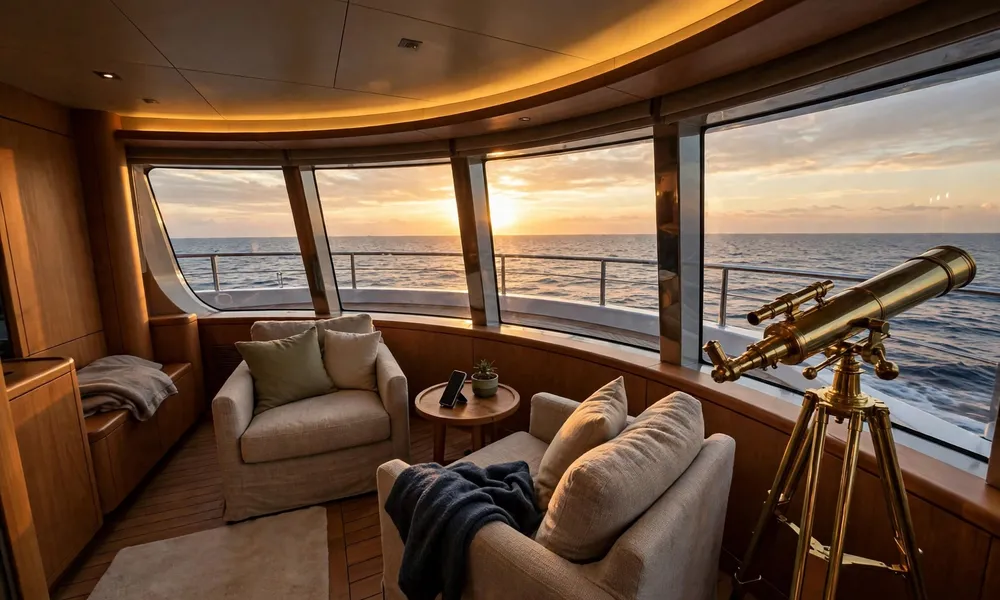
At dusk, the most beautiful room on a superyacht is the top one. Above the decks, the radar mast and the funnel sits a bubble of glass glowing warm against the darkening sea, and inside it people are doing something humans have done from ships for centuries: looking up. The superyacht observatory is a lounge, a lookout and a piece of precision engineering at once, a room built to give its guests the whole sky while the sea moves beneath them.

How a Superyacht Observatory Works
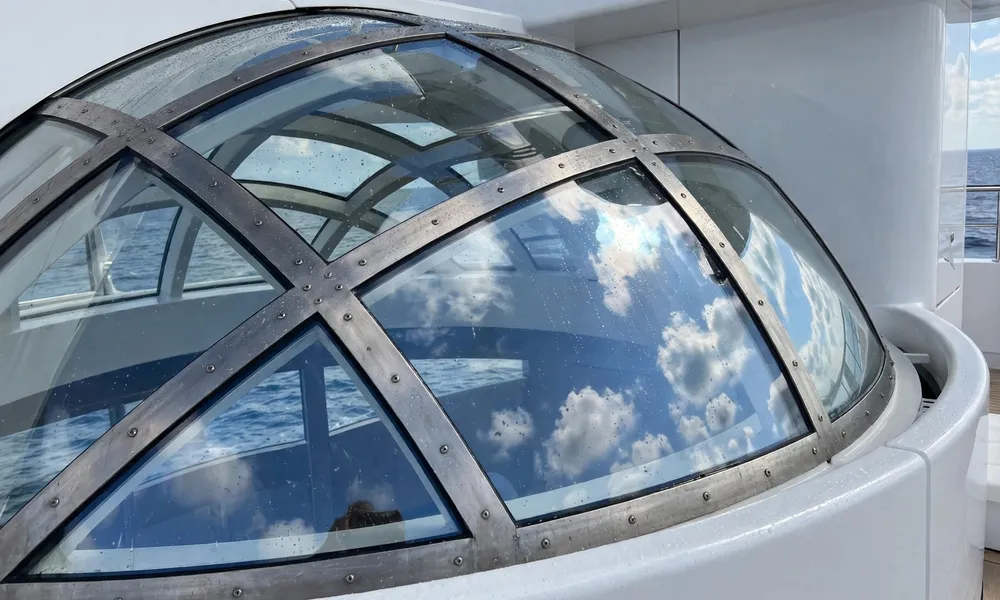
A superyacht observatory is a glass-enclosed room on the highest deck, for watching the sky, the sea and the horizon without wind, spray or cold. It is usually a curved dome or a faceted glass box, fitted with a telescope, comfortable seating and, on the largest yachts, a retractable roof. The challenge is to make a room that is entirely glass yet strong enough to survive a storm at sea, stable enough to keep a telescope steady, and comfortable enough to sit in for hours.
Step 1: The structure carries the glass
The observatory starts with its frame, a skeleton of stainless steel or aluminium carrying the weight of the glass and transferring every load into the yacht’s superstructure. The frame is engineered like a small building: it must handle the yacht rolling in a swell, green water over the bow, and winds over a hundred kilometres an hour. The steel hull below gives the yacht its strength, but the observatory frame must do the same job with far less material and far more glass, which is why its joints are welded, bolted and tested as carefully as anything on the ship.
Step 2: The glass is built like armour
The glass in an observatory is not window glass. Each panel is laminated from several layers, with a toughened outer skin and a flexible interlayer holding the pieces together even if the panel cracks. The glass used on a superyacht is made to resist impacts, salt spray and the constant flexing of a hull at sea, and the observatory panels are among the thickest and most expensive on board. The panels are curved or faceted to shed water and keep reflections from ruining the view, and sealed against driving rain so the room stays dry even when the deck outside is awash.
Step 3: The dome opens to the sky
On many observatories the roof is not fixed: it slides, folds or lifts away so guests can look at the stars in open air. The mechanism is usually electric, with motors driving the panels along tracks and seals closing tight when the roof shuts again. Sensors watch the weather, and the roof closes itself if rain is detected, because a telescope and a room of electronics cannot be left open in a squall. The opening has to work perfectly every time, since a roof jammed halfway open on a yacht a hundred miles from shore is a problem no one can fix with a phone call.
Step 4: The telescope stays steady on a moving deck
A telescope on a yacht has one great enemy: movement. The deck under it is always rolling, pitching and vibrating, so the telescope sits on a stabilised mount with gyroscopes and motors that hold it on the same patch of sky while the yacht moves beneath it. The mount reads the yacht’s motion hundreds of times a second and corrects for it, the only way to keep a planet or a star in view at high magnification. Some observatories go further, with the telescope pier isolated from the deck so guests’ footsteps cannot shake the image.
Step 5: Climate control keeps the glass clear
Glass at sea fogs, and a fogged observatory is useless. The room has its own climate system holding temperature and humidity steady, warming the glass, and blowing dry air across the panels to stop condensation. The air conditioning must also be quiet, because the observatory is for listening to the sea as much as looking at it. On a cold night it warms the room so guests can sit in shirtsleeves while the deck outside freezes, and on a hot day it cools the glass so the room never becomes a greenhouse.
Step 6: The observatory talks to the bridge
The observatory is not isolated from the rest of the yacht. It is linked to the navigation bridge, so the crew can share the yacht’s position, the weather and the names of the stars overhead, and the roof can be closed from the bridge if the weather turns. The room also carries navigation displays showing the yacht’s heading and speed, which helps guests understand what they are looking at on the horizon. At night the lights inside are dimmed to red, the colour that least disturbs the eyes’ adaptation to darkness, keeping the stars sharp.
Step 7: The crew maintains it like a ship, not a room
Keeping an observatory working takes constant care. The crew washes the salt from the glass daily, checks the seals and roof mechanism, services the telescope mount, and inspects the frame for corrosion. Salt air attacks every joint and fitting, so stainless steel and marine-grade coatings are used throughout, and even then the crew will find something to polish or tighten. It is the price of putting a glass room at the top of a ship: beautiful precisely because it is exposed, and it stays beautiful only because someone looks after it every day.
| Specification | Typical value |
|---|---|
| Location | Top deck, above the bridge |
| Glass | Laminated, toughened, several layers |
| Roof | Fixed or retractable, motorised, rain-sensing |
| Telescope mount | Gyroscope-stabilised, motorised tracking |
| Climate control | Heated glass, dehumidified air, quiet operation |
| Frame material | Stainless steel or marine-grade aluminium |
| Lighting | Dimmed red light at night |
Price is almost impossible to state simply, because an observatory is built as part of a yacht costing tens or hundreds of millions of dollars. Estimates put a large glass observatory dome, with frame, retractable roof and stabilised telescope, at roughly 1 to 5 million US dollars as a standalone installation, before the cost of the yacht around it. Those are estimates, not list prices, and the figure rises sharply with size and optics quality. For the owner, the observatory is not a cost to be justified: it is the room that makes the yacht feel like a ship of discovery rather than a floating hotel.
A rare fact: the best time to use a superyacht observatory is not in port but far out at sea, where there is no light pollution at all. On a clear night a hundred miles from land, the Milky Way is bright enough to cast a faint shadow, and guests can see thousands of stars invisible from any city. It is the same sky sailors navigated by for thousands of years, and the observatory exists so its guests can see it properly for the first time in their lives.
The superyacht observatory works because it solves three problems at once: glass strong enough for a storm, a telescope steady enough for the stars, and a room comfortable enough for hours. It is a small building on top of a ship, a lookout post dressed as a lounge, and a reminder that the most luxurious thing a yacht can offer is not marble or gold, but a clear view of the sky.


