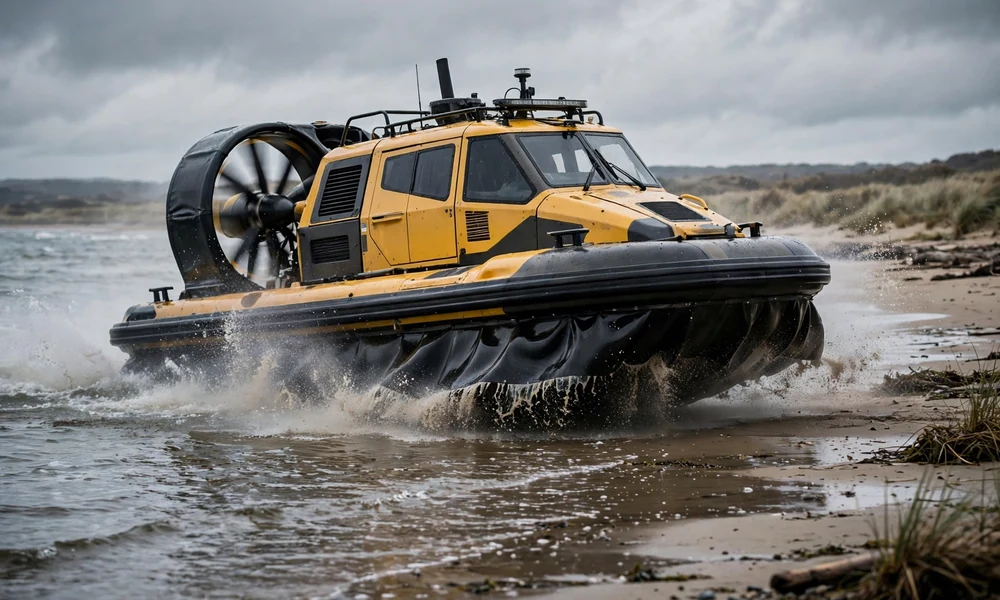
It does not look like a boat, and it does not behave like one. It glides across the mud flats at low tide, hums over a beach, crosses from water to land without slowing down, and leaves no wake at all. Underneath it there is no hull in the water, only a cushion of air held in place by a skirt of rubberised fabric, and the skirt is the whole secret. Without it, a hovercraft is just a noisy fan on a flat board. With it, the craft can float on air over almost anything.
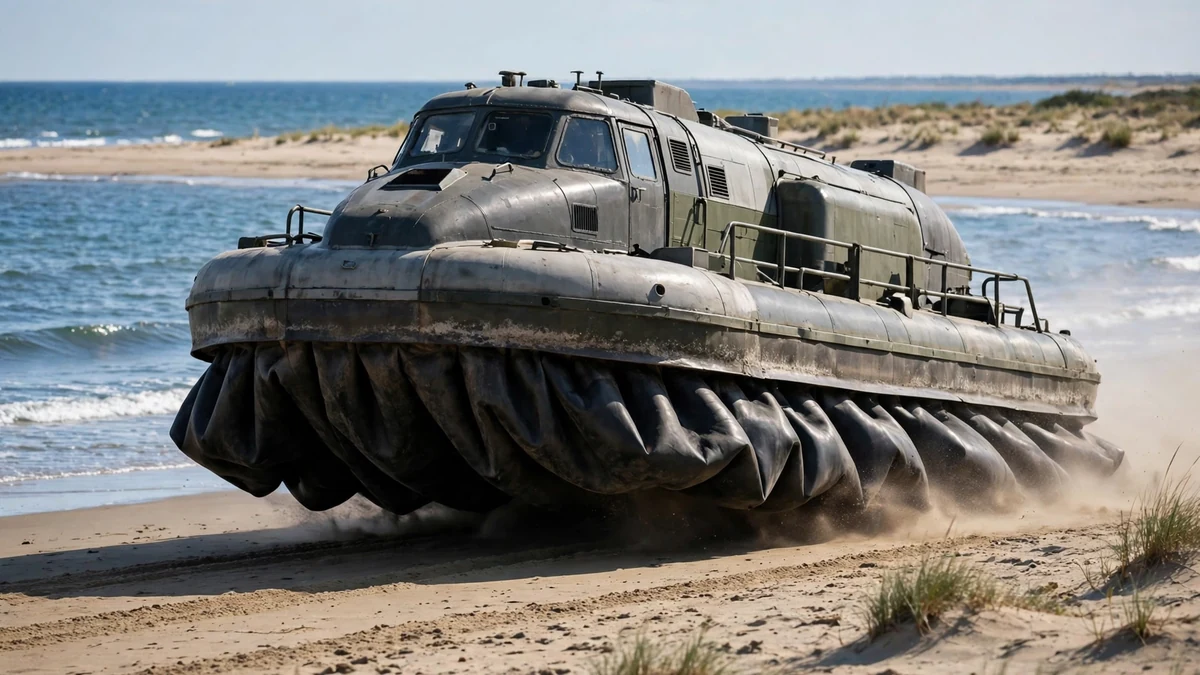
The skirt does the most work on a hovercraft and takes the most punishment. It is dragged over sand, rocks, ice and concrete, bent and twisted by every wave, and the first thing to wear out. It is not one piece of rubber but a system of shaped bags and fingers, filled with air, designed to leak in exactly the right way. This is how it works.
How It Works
Step 1: Lifting the craft on a cushion of air
A lift fan, usually driven by the same engine as the propellers, blows air down into the space under the hull. The air is trapped by the skirt, and the pressure underneath rises until it lifts the whole craft off the surface. The pressure is not large, only a few kilopascals, but it acts over the whole area of the hull, enough to lift tens of tonnes. Once the craft is up on its cushion, the only contact with the ground is the skirt itself, dragging lightly along the surface.
Step 2: The bag that holds the air in
The upper part of the skirt is a bag: a continuous ring of coated fabric attached to the edge of the hull, inflated by the lift fan. The bag is shaped so that it bulges outwards and downwards, forming the walls of the air cushion. It is made from layers of nylon or polyester fabric coated with neoprene rubber, which is flexible, tough and resistant to salt water and fuel. It seals the cushion so the air does not escape too fast, and acts as a spring, flexing as the craft rises and falls over waves and bumps.
Step 3: The fingers that do the dragging
Below the bag hangs a row of fingers, also called segments: separate flaps of the same coated fabric, each attached to the bag and hanging down to the surface. The fingers are the wearing part. When the craft crosses a rock or a wave crest, the fingers bend back and let it pass, then spring forward again. If one finger is torn, the crew can unbolt it and replace it on its own. The fingers are shaped to leak a little air at their tips, which lubricates the contact and keeps the friction low.

Step 4: Steering on a cushion
A hovercraft has no rudder in the water and no wheels on the ground, so it steers with air alone. Behind the lift system, large propellers push the craft forward, and rudders mounted in the propeller slipstream turn it, much like the tail of an aircraft. At low speed the craft can be hard to control, because it is floating on a frictionless cushion and will keep sliding in the direction it was going. The skirt makes this possible by keeping the cushion sealed even as the craft banks and pitches.
Step 5: Crossing from water to land
The moment a hovercraft crosses the shoreline is the hardest test of the skirt. The fingers that were dragging in the water suddenly meet sand, concrete or grass, and the cushion pressure changes as the surface beneath it changes. The bag flexes to absorb the transition, and the craft rises slightly as the ground rises beneath it. A conventional boat would run aground; a hovercraft barely notices, which is why hovercraft are used as ferries across tidal flats and as military landing craft. The hull that carries all of this is built to take the same kind of punishment as a ship’s hull, as in how an icebreaker hull is made.
Step 6: Keeping the cushion sealed in waves
In rough water the skirt has to follow the surface of every wave. The bag deforms, the fingers lift and fall, and the cushion air leaks out in gusts, then is replaced by the lift fan. The skirt is designed so the air always escapes in a controlled way, mostly through the gaps between the fingers, and never in one big rush that would drop the craft onto the water. Pilots learn to slow down before a big wave, because a skirt slammed flat against a wave crest can be torn.
Step 7: Repairing and replacing the skirt
A hovercraft skirt is a consumable. The fingers wear through, the bag is abraded, and seams are pulled apart by the constant flexing. Crews carry spare fingers aboard, and a damaged finger can be changed in under an hour with simple tools. A full skirt replacement is a bigger job, done in a workshop. The cost of a skirt is a large part of a hovercraft’s running costs, which is why operators protect it: they avoid rocky beaches and inspect the skirt after every run.
Specs
| Specification | Typical figure |
|---|---|
| Cushion pressure | About 1 to 5 kilopascals, depending on craft weight |
| Skirt material | Nylon or polyester fabric coated with neoprene rubber |
| Skirt type | Bag and finger, the standard modern design |
| Hover height | About 0.3 to 1 metre above the surface |
| Lift fan power | About a third of total engine power on many craft |
| Large ferry capacity | Up to about 400 passengers and 60 cars on the biggest craft |
| Top speed | About 60 to 70 knots for a large hovercraft |
| Wave capability | About 1 to 3 metres, depending on craft size |
| Skirt life | Fingers months to a year; a full bag several years |
| Surfaces crossed | Water, sand, mud, ice, grass and concrete |
Price
Hovercraft prices vary enormously with size. As an estimate, a small recreational hovercraft costs roughly $10,000 to $50,000, a commercial passenger hovercraft roughly $1 million to $5 million, and a large military landing craft tens of millions of dollars. The skirt is a significant part of the running cost: a set of replacement fingers for a large craft can cost tens of thousands of dollars. These are estimates, and the final figure depends on the builder, the engines and the payload.
A Rare Fact
The largest hovercraft ever built, the SR.N4, carried cars and passengers across the English Channel for thirty years, and its skirt was so big that a single finger was taller than a person. The last SR.N4 retired in 2000, but today’s hovercraft all use the same bag-and-finger skirt it pioneered. The keel beneath a yacht’s hull does a different job, keeping a vessel upright in the water, as in how a yacht keel is made.
From a beach to a mud flat to a frozen river, the hovercraft skirt makes the impossible routine. It is not glamorous, it wears out, and it is made of fabric and rubber, yet without it the most advanced hovercraft in the world would be stuck on the shore. Air, fabric and a clever leak: that is what lets a machine ride on nothing at all. The hull it hangs from is built to survive the same rough treatment, as in how a container ship hull works.


