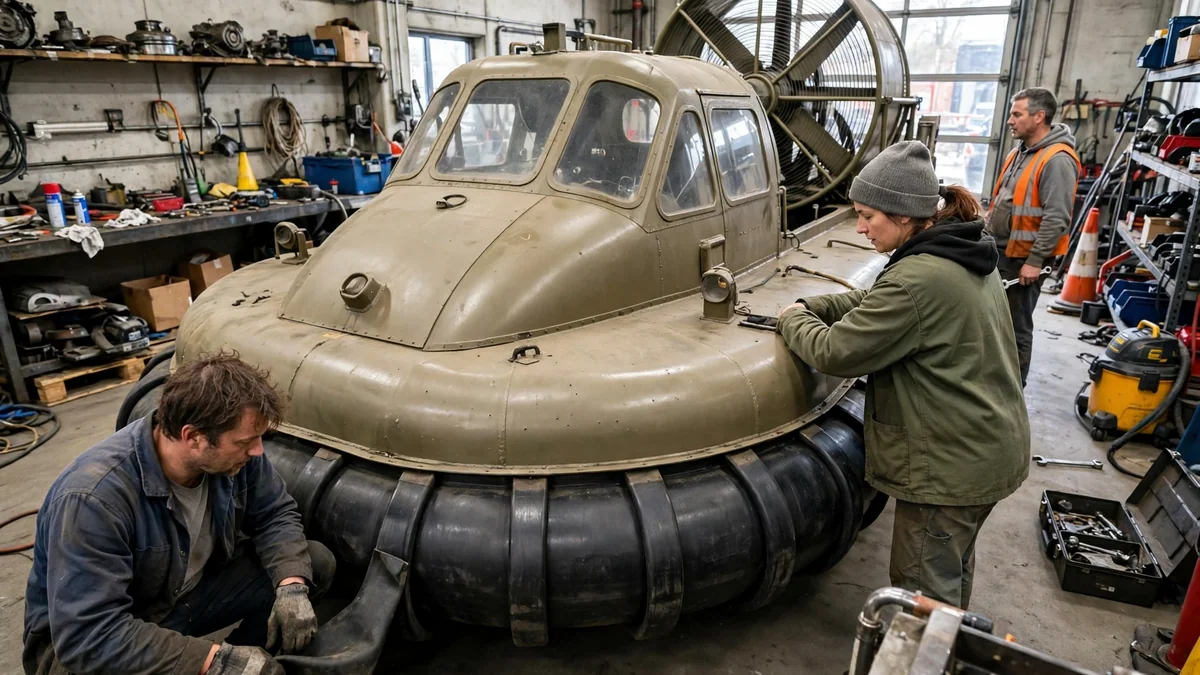
The first thing you notice about a hovercraft in the workshop is that it does not look like a boat, and it does not look like an aircraft either. It sits on the floor on a great black rubber ring, and the workers around it are cutting fabric, stitching seams, and fitting the flexible skirt that is the whole reason the machine works at all. Without that skirt, a hovercraft is just a very odd vehicle with a fan on the back. With it, the craft can float on a cushion of air and glide over water, mud, sand, and ice.
The skirt is the hovercraft’s most humble part and its most important one. It is a flexible wall of rubberised fabric that traps the air underneath the craft, letting it ride a few centimetres above the surface. It must be tough enough to drag over rocks, flexible enough to bend around waves, and light enough not to weigh the craft down. This is the story of the factory that builds the hovercraft skirt: the production line, the tolerances, and the tests every unit must pass.
Inside the Hovercraft Skirt Factory
A hovercraft skirt comes in two main designs. The older bag skirt is a single inflated tube around the edge of the craft. The more common modern design is the finger skirt, made of many separate fingers of fabric hanging down around the edge, each one able to flex independently. Most large hovercraft use a combination: a bag at the top and fingers below it. The factory builds both, and the production line is organised around fabric: cutting tables, sewing machines, and bonding presses, with a testing area where finished skirts are inflated and checked before they leave.
1. Choosing the fabric
The skirt starts as rolls of fabric, and the choice of fabric decides everything. The base is usually a woven nylon or polyester, chosen for strength and tear resistance, and it is coated on both sides with rubber, usually neoprene, which makes it airtight, waterproof, and resistant to oil and abrasion. The factory checks every roll when it arrives: thickness, weight, and tear strength are all measured, because a weak roll will make a weak skirt. A typical skirt fabric is less than two millimetres thick, yet it must survive being dragged across a beach at speed.
2. Cutting the panels
The fabric is laid out on a long cutting table, and the panels are marked and cut to patterns. For a finger skirt, each finger is a shaped panel, wider at the top and narrower at the bottom. For a bag skirt, the panels are long strips that will be joined into a tube. Cutting is done by hand or by a computer-controlled cutter, and patterns are nested to waste as little fabric as possible. Every panel is labelled with its position on the skirt, because the fingers are not all the same size, and a finger fitted in the wrong place will not hang right.
3. Stitching and bonding
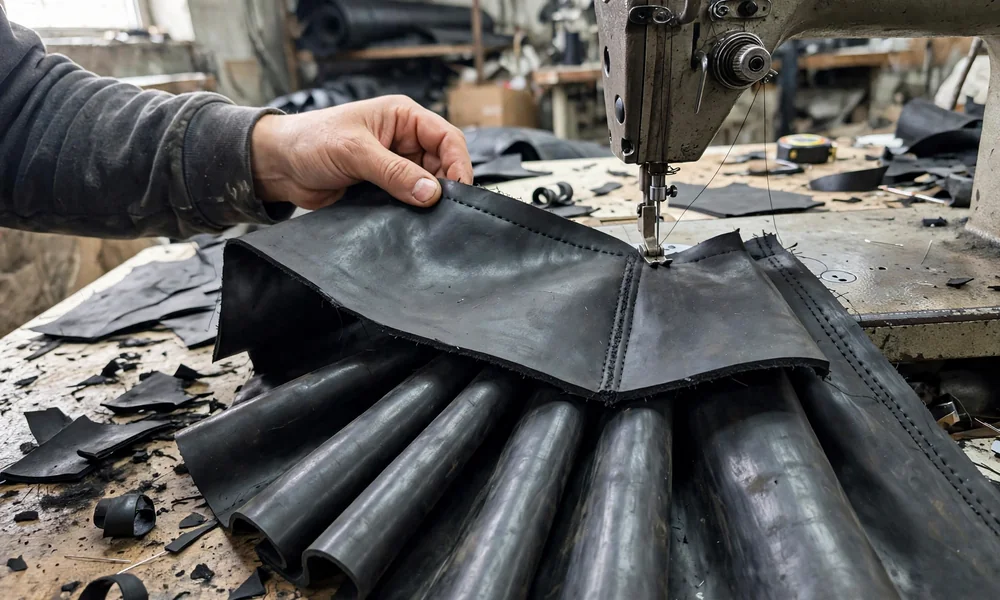
The panels are joined by stitching, bonding, or both. Heavy-duty sewing machines stitch the seams with strong synthetic thread, and then the seams are sealed with rubber cement or heat-bonded tape, so air cannot leak through the needle holes. Some factories use radio-frequency welding, which fuses the rubber coating together without thread at all. Whichever method is used, the seam must be as strong as the fabric itself, because the seam is where a skirt usually fails first. Workers pull-test sample seams regularly.
4. Adding attachments and wear strips
A finished skirt panel is not just fabric. Attachment points are added: reinforced eyelets, straps, and bolt ropes that will fix the skirt to the hovercraft’s hull, and wear strips, extra layers of tough rubber, on the parts that will drag on the ground. The fingers get their own fittings, and the bag skirt gets its air feed holes, where the lift fan’s air will enter. Each attachment is a potential weak point, so each one is reinforced with extra layers of fabric, stitched and bonded in place.
5. Assembling the skirt
The panels are assembled into the complete skirt, usually in sections, on a large floor or frame. The fingers are attached to the bag or to the attachment rail in their numbered order, and the whole assembly is checked for size and shape against a template of the hovercraft’s hull. A passenger hovercraft skirt can be tens of metres around, and assembling it takes a team working together. The way the finished skirt works in service is explained in how a hovercraft skirt works, where the cushion of air and the flexing fingers are described step by step.

6. Inflation and leak testing
Before a skirt leaves the factory, it is inflated and tested. The skirt is laid out, inflated, and checked for leaks, weak seams, and fingers that do not hang evenly. Leaks are found with soapy water, which bubbles where air escapes, and are patched and retested. The pressure is measured, the shape is checked, and the skirt is flexed by hand to make sure the fingers move freely and return to shape. A skirt that fails the test does not leave the factory.
7. Fitting and sea trials
The final test happens on the craft itself. The skirt is fitted to the hovercraft, the lift fan is started, and the craft is run over land and water: across a beach, over a swell, through a turn. Engineers watch how the skirt behaves: does it flex smoothly, does it wear evenly, does it keep the cushion sealed? Any problem is noted and the skirt is adjusted. The first time a new skirt is fitted is also described in how the hovercraft skirt is made, where the whole process is told from the cutting table to the first run.
Hovercraft Skirt Production Specifications
| Feature | Typical Value |
|---|---|
| Fabric base | Woven nylon or polyester, rubber coated both sides |
| Fabric thickness | Typically 1–2 mm |
| Skirt types | Bag skirt, finger skirt, or a bag-and-finger combination |
| Seam strength | Tested to match the fabric strength |
| Cushion pressure | Low, typically a few hundred pascals above atmospheric |
| Hover height | Typically 15–30 cm above the surface |
| Skirt lifespan | Months to a few years, depending on use and surface |
| Production time | Days to weeks for a large skirt, depending on size |
Those figures are typical for a medium-sized passenger or work hovercraft, and the full numbers are set out in hovercraft skirt specs explained. Small recreational craft use lighter fabric and simpler skirts, while the largest hovercraft, which can carry cars and lorries, use skirts built to the same principles on a much bigger scale.
What a Hovercraft Skirt Costs
A hovercraft skirt is a consumable, and its price reflects that. As an estimate, a replacement finger skirt for a small recreational hovercraft costs from around $2,000 to $5,000, while a full skirt set for a large passenger hovercraft costs from around $50,000 to $150,000, depending on its size and the fabric used. Individual fingers can be replaced one at a time, which keeps running costs down.
A Rare Fact
Here is a detail that surprises people who have never ridden in a hovercraft: the skirt is designed to wear out, and the fingers are meant to be sacrificial. When a hovercraft crosses a beach, the fingers drag on the sand and shingle, and they are slowly worn away, a little on every trip. The design accepts this: the fingers are cheap, easy to replace, and they protect the expensive bag and hull above them. Some operators measure finger wear like tyre tread, replacing fingers on a schedule before they get too short.