Imagine sealing yourself inside a steel tube with a hundred other people, diving hundreds of metres below the surface, and staying there for weeks. There is no window to open. The air you breathe on day one is, in a very real sense, the air you will still be breathing on day thirty, cleaned, topped up, and watched over by machines that never sleep. That is the quiet miracle of a submarine’s air system, one of the most carefully engineered life-support systems ever built.
A submarine crew does not think about air the way we do on land. On land, air is free and endless. Underwater, air is a budget. Every breath a sailor takes removes oxygen and adds carbon dioxide, every machine adds heat, and every battery charge releases a little hydrogen. Left alone, the air inside a submarine would become unbreathable in hours. This guide explains the submarine air system in plain English: the numbers that matter, what they mean, and how they compare.
Submarine Air System Specifications
| Feature | Typical Value |
|---|---|
| Crew oxygen use | About 0.5 litres of oxygen per person per minute at rest |
| Oxygen level kept at | 19–23 percent of the air, close to the 21 percent on land |
| Carbon dioxide limit | Below 1 percent, with alarms well before that |
| High-pressure air storage | 200–300 bar in steel air banks |
| Air bank capacity | Several thousand litres of stored compressed air |
| Oxygen generation | Electrolysis of water, or chemical oxygen candles as backup |
| Carbon dioxide removal | Scrubbers using amine or lithium hydroxide canisters |
| Air changes | Continuous circulation and filtration, 24 hours a day |
The rest of this guide explains what each number means in practice.
Oxygen: How Much a Crew Needs
A resting adult uses roughly half a litre of oxygen every minute. That sounds small until you multiply it: a crew of one hundred uses fifty litres a minute, three thousand litres an hour, seventy-two thousand litres a day. A submarine cannot carry that much oxygen as gas in bottles alone, so it makes oxygen as it goes. Most modern submarines split water into oxygen and hydrogen using electricity, in a machine called an electrolyser. The oxygen goes into the boat’s air; the hydrogen is vented safely overboard. As a backup, submarines carry chemical oxygen candles, canisters that release oxygen when heated, which need no power at all. The oxygen level is held close to the 21 percent we breathe on land, and sensors all over the boat watch it constantly.
Carbon Dioxide: The Gas That Builds Up Fastest
Carbon dioxide is the air system’s biggest daily problem. Every breath adds it, and at just 1 percent of the air it gives people headaches, at 2 percent it causes confusion, and beyond that it becomes dangerous. The system removes it with scrubbers, machines that pass the boat’s air over a chemical that absorbs carbon dioxide. Large submarines use amine scrubbers, which can be regenerated and reused, while smaller boats and emergencies use lithium hydroxide canisters, which absorb the gas once and are then thrown away. The scrubbers run all the time, and the level is shown on panels the crew checks constantly.
High-Pressure Air: The Boat’s Stored Breath
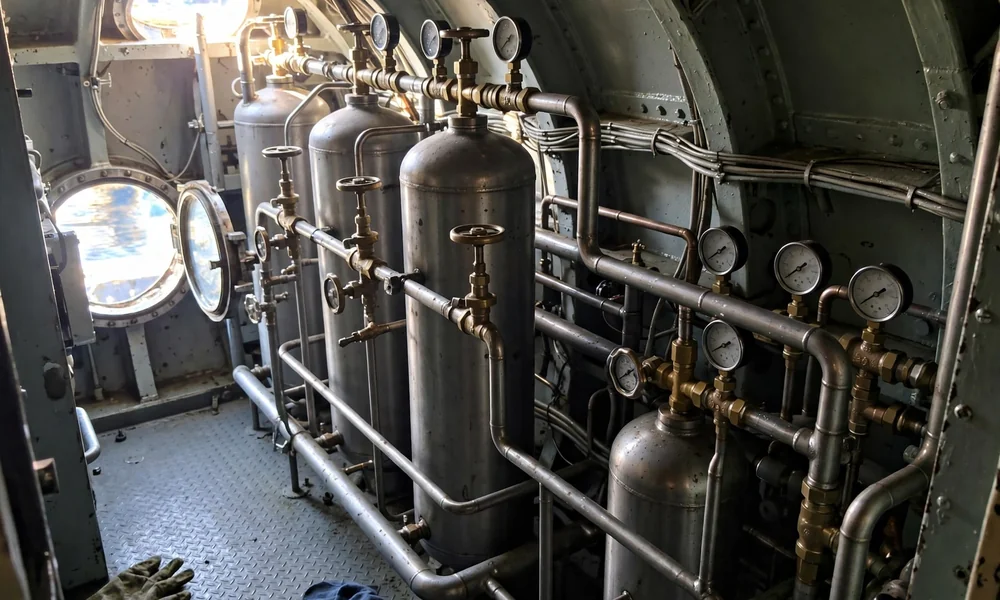
Alongside the oxygen system, a submarine carries banks of high-pressure air, stored at 200 to 300 bar in thick steel bottles. This air has several jobs. It blows the ballast tanks when the boat needs to surface quickly, it starts the diesel engines, it powers tools, and it can top up the breathing air in an emergency. The compressors that fill these banks are among the hardest-working machines on the boat, and they are noisy, hot, and closely watched. The relationship between stored air and the boat’s ability to surface is so close that the air banks are treated as part of the safety system, and the same careful approach to pressure vessels shows up in the boat’s other tanks, described in submarine ballast tanks engineering, where steel, pressure, and seawater meet.
Cleaning the Air: More Than Oxygen and Carbon Dioxide
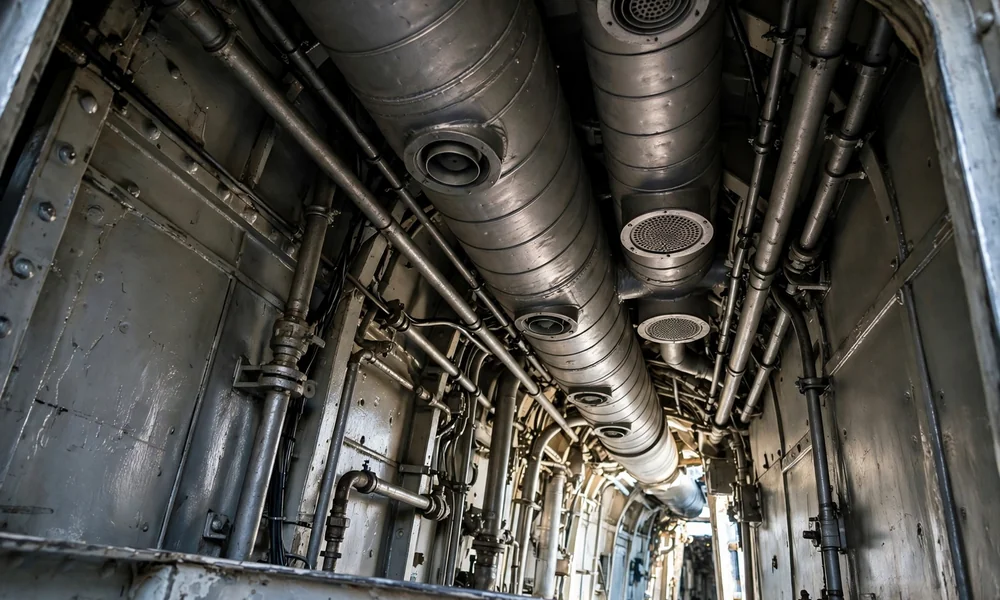
People are not the only source of bad air. Cooking, batteries, machinery, and even the crew’s own bodies add contaminants: carbon monoxide, hydrogen from battery charging, cooking smells, and tiny particles of oil. The air system deals with all of them. Carbon monoxide is removed by catalytic burners, which turn it into harmless carbon dioxide. Hydrogen is monitored by dedicated sensors, because it is flammable, and the ventilation keeps it well below its danger level. Filters catch particles, and charcoal filters absorb smells.
Pressure and Depth: Why the Boat’s Air Stays at One Atmosphere
One question people always ask is whether the air pressure inside a submarine rises as it dives. The answer is no, and the reason is the pressure hull, the strong steel tube that holds back the sea. Inside the hull, the pressure stays close to normal atmospheric pressure, about 1 bar, whatever the depth outside. That is what makes long dives possible: the crew’s bodies never have to adapt to high pressure, and there is no decompression to worry about when the boat surfaces. The pressure hull is the most important structure on the boat, and its construction is covered in how the submarine pressure hull is made, where thick steel, careful welding, and round shapes hold back the weight of the ocean.
What Happens When Something Goes Wrong
Submariners train for air emergencies the way airline crews train for engine failures: by rehearsing them until the response is automatic. If oxygen generation stops, the boat has stored oxygen and chemical candles to buy time. If a scrubber fails, a spare takes over. If smoke or a toxic gas is detected, the crew puts on emergency breathing masks fed from a separate system, and the affected compartment is sealed off. Sensors, alarms, and drills are layered so that no single failure leaves the crew without air. The whole system is built and tested in factories like the one described in inside submarine air system production, where every valve, gauge, and pipe is tested before it is fitted to a boat.
How the Numbers Compare
To put the submarine’s air system in perspective, compare it with an airliner. An airliner changes its cabin air completely every two to three minutes, using fresh air from outside. A submarine cannot do that; it must recycle the same air for weeks, removing only what is harmful and adding only what is missing. A space station faces the same problem, and uses very similar equipment: electrolysers, scrubbers, and sensors, on a smaller scale. The submarine’s system is heavier and more rugged, because it must survive shock, vibration, and months at sea, but the chemistry is the same.
What a Submarine Air System Costs
A submarine’s air system is a small part of a very expensive boat, but it is not cheap on its own. As an estimate, the complete air handling, oxygen generation, and scrubbing installation for a modern conventional submarine costs from around $5 million to $20 million, depending on the boat’s size and the sophistication of its equipment. The electrolyser alone can cost over a million dollars.
A Rare Fact
Here is a detail that surprises even engineers: the air inside a submarine can be so carefully controlled that the crew’s sense of smell adapts and then resets when they come home. Submariners returning from a long patrol often say the outside world smells overwhelmingly strong for the first few days, from cut grass to car exhaust, because their noses have spent weeks in air with almost no outside smells in it. The boat’s charcoal filters remove odours so thoroughly that the crew forgets what fresh air smells like.