Picture a hypercar braking from 200 miles per hour. In under five seconds, a disc no bigger than a dinner plate must turn the car’s enormous speed into heat — enough heat to make the disc glow orange — and then cool down and do it all again at the next corner. The pads squeezing that disc press with the force of several tonnes. If the disc cracks, warps, or fades, there is no second chance.
That disc is made of carbon ceramic, a material born in aerospace and refined for racing. It is lighter than steel, barely wears, and shrugs off temperatures that would melt ordinary brakes. A single set can outlast the car itself. But making one is a marathon: the process takes weeks, involves furnaces hotter than a volcano’s core, and finishes with machining so precise it is measured in microns.
Few factories in the world can make a carbon ceramic brake disc, and fewer still can make one good enough for a hypercar. Each disc passes through a dozen hands and a dozen furnaces before it ever meets a wheel. This is how a hypercar brake disc is made.

How It’s Made
Step 1: Weaving the carbon fibre preform
The disc begins not as metal, but as cloth. Carbon fibre fabric is cut into rings and layered, dozens of plies deep, in the shape of the finished disc. Short carbon fibres are needled through the layers to lock them together, creating a soft, felt-like preform that already has the disc’s outline. The weave matters: the fibres must run in directions that will carry the braking loads, and the density must be even all the way around, or the disc will wear unevenly. At this stage the preform is light enough to lift with one hand — and fragile enough to dent with a thumb.
Step 2: Baking the preform into carbon-carbon
Next, the preform is placed in a furnace and heated to well over 1,000 degrees Celsius in an oxygen-free atmosphere. This process, called pyrolysis, burns away the binders and leaves pure carbon, fusing the fibres into a solid carbon-carbon disc. It is hard, black, and already heat-resistant, but it is also porous — full of tiny voids that would make it weak and crumbly under braking. The disc that comes out of the furnace looks finished, but it is only halfway there. The carbon ceramic process shares its roots with how carbon ceramic brakes are made, where the same furnace work turns fibre into a braking surface.
Step 3: Infiltrating the disc with silicon
The porous carbon disc is then infiltrated with molten silicon in a second furnace, heated to around 1,400 degrees Celsius. The silicon seeps into every void and reacts with the carbon to form silicon carbide — a ceramic so hard it is used to cut steel. This is the step that gives the disc its name and its magic: the finished material is part carbon fibre, part ceramic, combining the toughness of fibre with the heat resistance and hardness of ceramic. The disc is then cooled slowly over many hours, since cooling too fast would crack it.
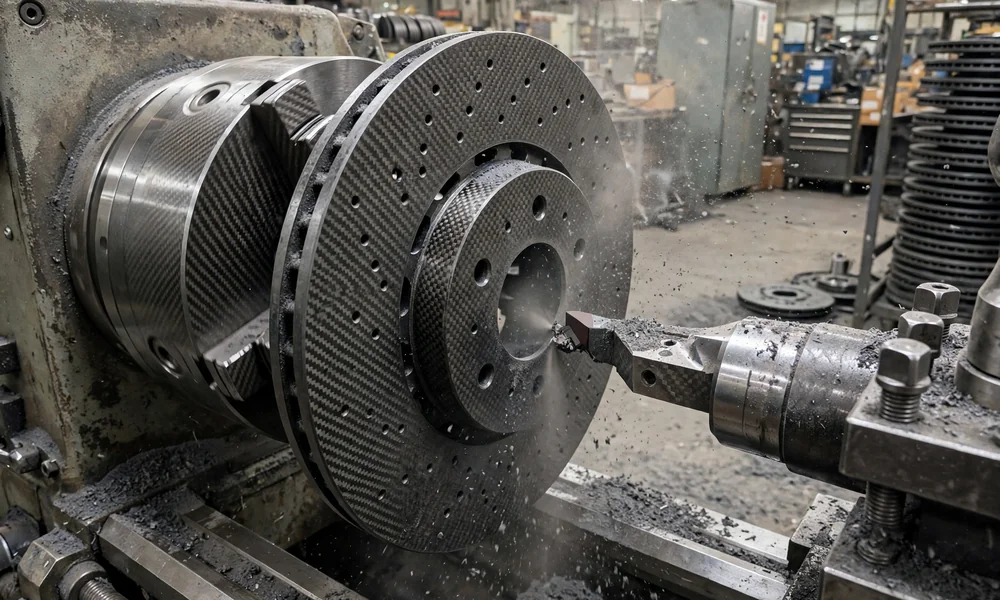
Step 4: Machining the disc to its final shape
Once cooled, the disc is machined to its final dimensions. Diamond-tipped tools cut the mounting holes, the ventilation slots, and the outer profile, because ordinary cutting tools are destroyed by silicon carbide within seconds. The friction surface is ground flat to within a few microns, so the brake pads meet it evenly across the whole face. The familiar drilled holes and grooves are cut at this stage too: they sweep away gas and dust from the pads and help the disc cool. Machining a single disc can take hours, and the diamond tooling is replaced constantly.
Step 5: Fitting the metal bell and balancing
A brake disc does not bolt straight to the wheel. Its centre is a separate aluminium bell, or hat, which joins the ceramic ring with floating bobbins — small metal pins that let the disc expand as it heats without warping. Technicians fit the bell by hand, torquing each bobbin to an exact figure, then balance the assembly on a spin rig. Even a tiny imbalance would shake the car violently at 200 miles per hour. The finished disc is weighed and measured one last time: a typical hypercar front disc is around 390 to 410 millimetres across and weighs about six kilograms, roughly half the weight of a steel disc the same size. The engineering behind it is covered in hypercar brake disc materials.
Step 6: Heat cycling and final inspection
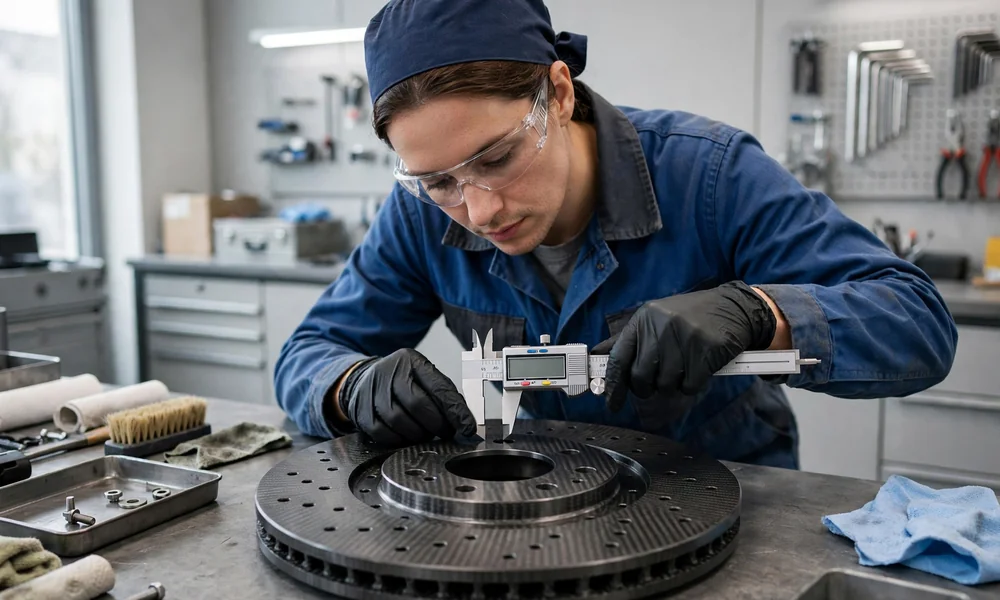
Before it leaves the factory, every disc is heat-cycled — warmed and cooled repeatedly to settle the material — and then inspected. Engineers check the surface with dye tests that reveal hairline cracks, measure the thickness at dozens of points, and X-ray the disc to look for voids hidden inside. A disc with a flaw is scrapped, however far through the process it got. Only discs that pass every test are stamped, boxed, and sent to the carmaker, where they will be paired with pads designed specifically for them.
| Main material | Carbon fibre reinforced silicon carbide, known as carbon ceramic |
| Typical diameter | About 390 to 410 millimetres at the front, slightly smaller at the rear |
| Typical weight | About 6 kilograms per disc, roughly half a steel disc |
| Peak temperature | More than 1,000 degrees Celsius during hard braking |
| Manufacturing time | Several weeks from fibre preform to finished disc |
| Surface finish | Ground flat to within a few microns |
| Mounting | Aluminium bell with floating bobbins to allow heat expansion |
| Service life | Can last the lifetime of the car under road use |
What Does a Hypercar Brake Disc Cost?
A carbon ceramic brake disc is one of the most expensive consumables on a hypercar. A single front disc is estimated at roughly $4,000 to $7,000, and a full set of four, with pads, can cost $20,000 to $30,000 or more. The price reflects weeks of furnace time, diamond tooling, and a high scrap rate. Under normal road use, the discs barely wear at all, so the cost is spread over years. On the track, though, pads wear fast and discs take far more punishment — which is why racing teams budget for them like fuel. The full cost picture is laid out in why the hypercar brake disc is so expensive.
A Rare Fact
Carbon brakes were first developed for aircraft and the Space Shuttle, where stopping a landing jet demanded materials that steel could never provide. Formula 1 adopted them in the 1970s, and for years they were so fragile when cold that drivers had to warm them gently before they would work at all. Early carbon discs could shatter if a driver braked hard on a cold lap. Today’s carbon ceramic discs are the great-grandchildren of that aerospace experiment — a material invented to stop spacecraft, now stopping cars on the school run.
The brake disc will never be the part a hypercar owner shows off. It hides behind the wheel, black and unglamorous. But every time the car sheds 150 miles per hour before a corner and the pedal stays firm, that disc is turning speed into heat at temperatures hotter than lava — and asking for nothing in return. It is the hardest-working part on the car, and one of the hardest to make.


