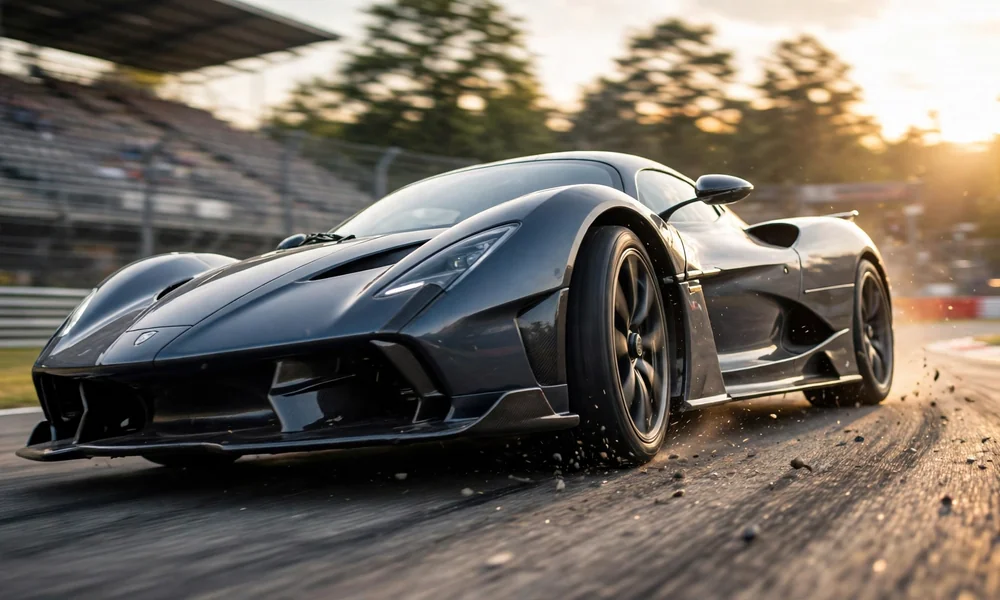
Picture a hypercar at 300 kilometres an hour, kissing the kerb of a fast corner. The body wants to roll, the inside wheel wants to lift, the nose wants to dive, and the driver wants none of it. In the time it takes to blink, the car has read the road and decided what each wheel should do. The hero of that moment is not the engine. It is the suspension — a system that thinks faster than the road can surprise it.
Ordinary suspension is a compromise: soft enough to be comfortable, firm enough to handle. A hypercar refuses the compromise. Its suspension must keep a car that weighs over a tonne and produces more downforce than its own weight glued to the tarmac, absorb kerbs at racing speed, and still let the driver feel what the tyres are doing. It does this with a combination of racing-bred geometry, computer-controlled dampers, and hydraulics that can raise or lower the entire car in a second. The result is a machine that negotiates with the road, corner by corner, millisecond by millisecond.
The story starts in Formula 1, where suspension is not a comfort feature but a weapon. Every trick a hypercar uses — pushrods, inboard dampers, active control — was first proven on a racetrack, then tamed for the road.
How It Works
Step 1: Reading the road a thousand times a second
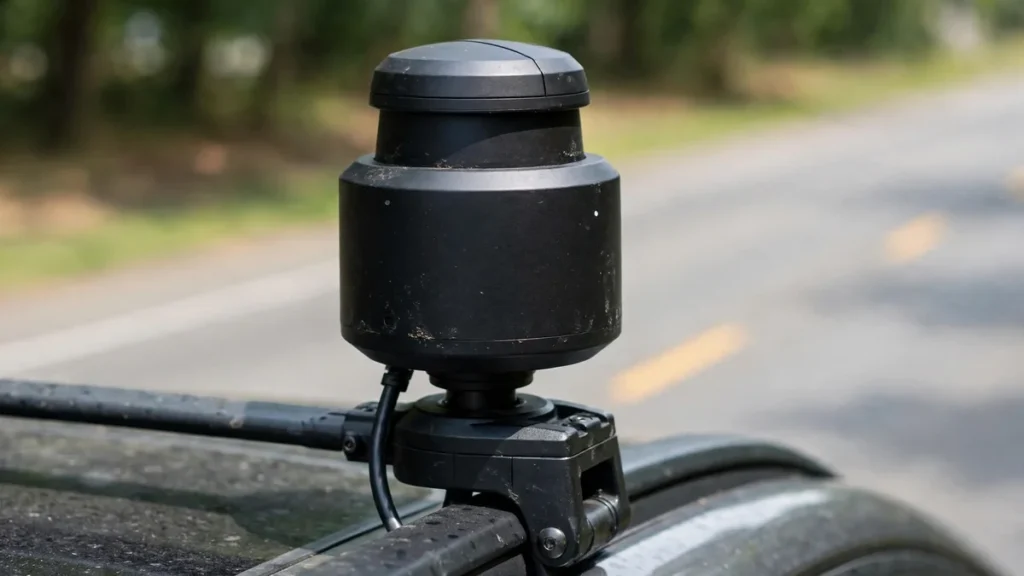
Before the suspension can react, it has to know. Sensors at each wheel measure how far the suspension is compressed, how fast it is moving, and how much load the tyre is carrying. Accelerometers in the body measure pitch, roll, and heave. Steering angle, throttle, brake pressure, and speed all feed the same picture. A central computer samples these signals hundreds of times a second, building a live model of what the car is doing and what the road is about to do. It is the same philosophy behind active aerodynamics: sense everything, then act on it before the driver notices.
Step 2: The pushrod and the wishbones
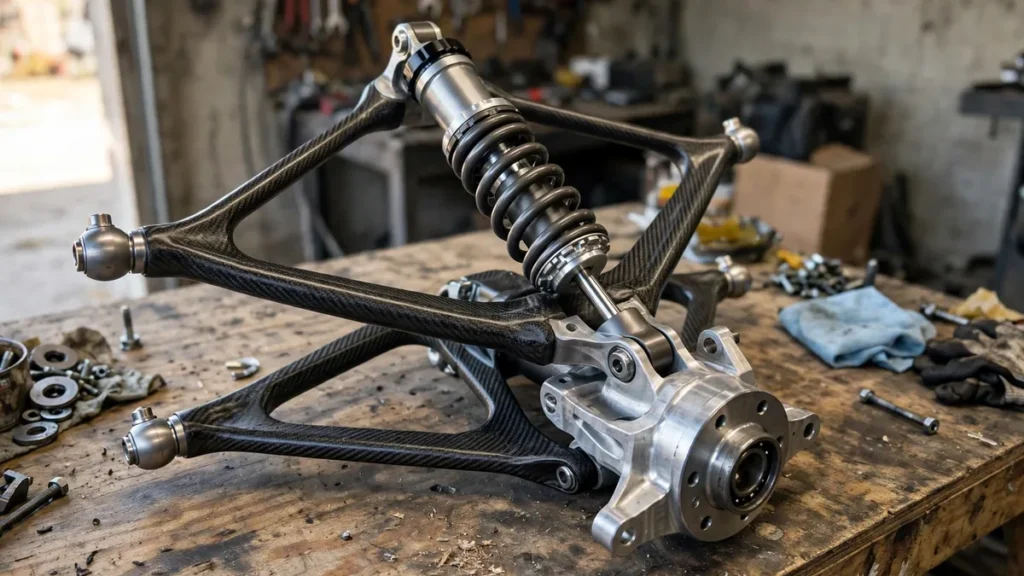
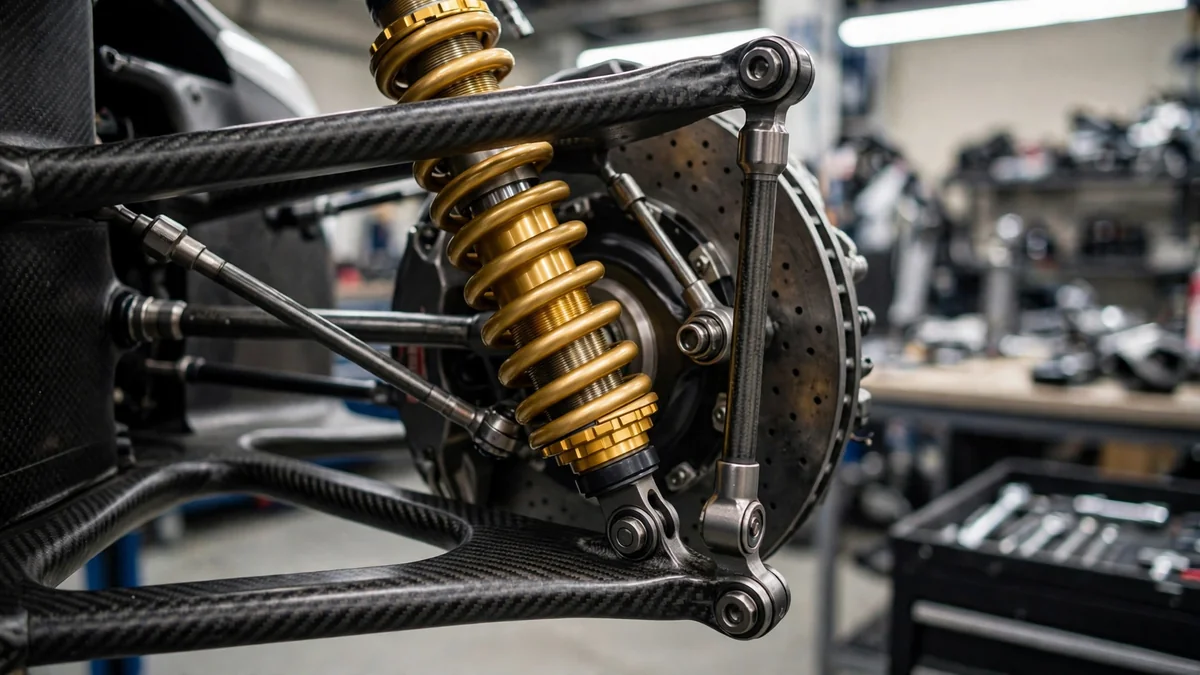
The visible hardware starts with the wishbones — the paired carbon-fibre arms that locate each wheel and let it move up and down while keeping it pointed in the right direction. In a hypercar, the spring and damper do not sit on the wheel at all. Instead, a slender pushrod runs from the wheel up into the body, where it works an inboard rocker that compresses the spring and damper. Moving the heavy damper inside the car lowers unsprung weight, so the tyre can follow bumps more faithfully. It also keeps airflow around the wheel clean, which matters when the bodywork generates downforce.
Step 3: Springs that hold up a tonne at 300 kilometres an hour
The springs carry the car’s weight and store the energy of every bump. Hypercar springs are short, stiff, and made from high-grade steel or titanium, wound to exact rates measured in newtons per millimetre. Too soft and the car rolls and dives; too stiff and the tyres skip across bumps instead of gripping. Because aerodynamic downforce grows with speed, the springs must cope with a car that effectively gets heavier the faster it goes — a car producing a tonne of downforce at top speed needs springs that can hold up two tonnes. The springs mount to the carbon monocoque chassis, a structure so rigid the suspension can work without the body flexing and muddying the response.
Step 4: Dampers that think in milliseconds
Springs alone would bounce forever, so dampers control them. A damper is a piston moving through oil: push it fast and the oil resists, turning motion into heat. In a hypercar the damper is adaptive, with valves that open and close under electronic control to change stiffness in milliseconds — softer over a bump, firmer in a corner, all without the driver touching anything. Some systems read the road ahead and pre-adjust before the wheel even reaches the bump. The fastest can react in a few thousandths of a second, quick enough to catch a wheel about to leave the ground and press it back down.
Step 5: Hydraulics that lift, lower, and link the corners
Many hypercars add a hydraulic system that connects the corners of the car. Instead of a traditional anti-roll bar, hydraulic lines link the left and right dampers, so the car can resist roll in a corner while still letting each wheel move freely over a bump — the best of both worlds. The same hydraulics can raise the nose to clear a speed bump and lower the whole car at speed, shrinking the gap to the road and boosting downforce. It is suspension as a shape-shifter: a comfortable road car at the kerb, a racing car on the straight.
Step 6: Shedding heat, lap after lap
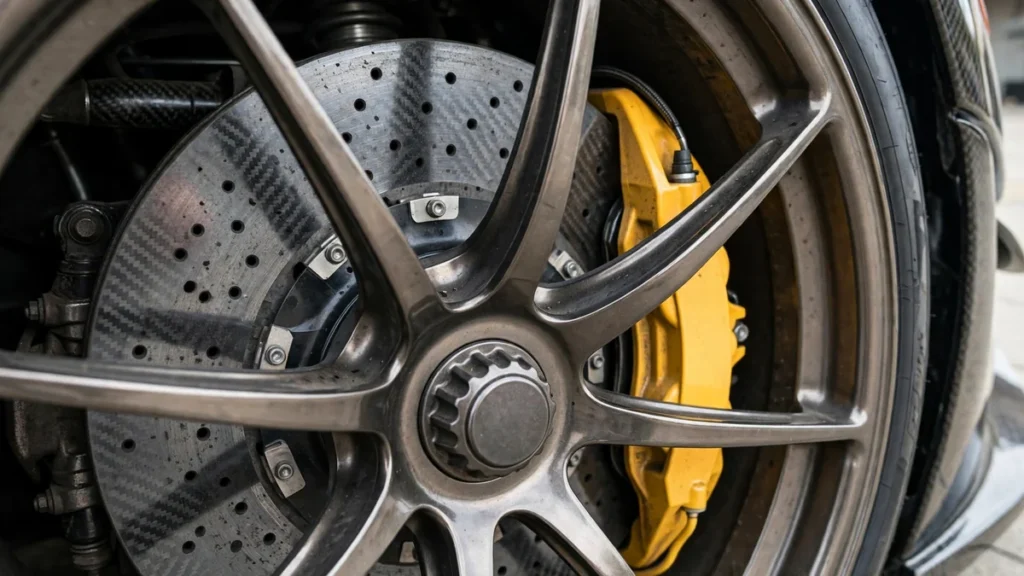
All that damping work turns motion into heat, and on a racetrack the dampers can get hot enough to change how the oil flows. Hypercar engineers treat damper cooling as seriously as engine cooling, routing airflow to the suspension and choosing oils that stay consistent at temperature. It is the same discipline as keeping performance cool under sustained load elsewhere in the car: a suspension that fades after three laps is no use to anyone. After every session, engineers download the data and tune the car for the next run.
Hypercar Suspension Specs
| Specification | Typical range |
|---|---|
| Layout | Double wishbone, pushrod-actuated, inboard dampers |
| Damper response time | As fast as a few milliseconds |
| Ride-height adjustment | Hydraulic lift of roughly 30 to 50 millimetres |
| Spring material | High-grade steel or titanium coil springs |
| Anti-roll control | Hydraulically linked dampers instead of a fixed bar |
| Wheel control | Four-wheel independent, with per-corner adjustment |
| Downforce supported | Over 1,000 kilograms at top speed in the fastest cars |
| Unsprung weight goal | As low as possible — carbon wishbones, titanium hardware |
What Does a Hypercar Suspension Cost?
There is no off-the-shelf price for a hypercar suspension, because each one is designed for a single model and built in tiny numbers. A set of top-level adaptive dampers alone is estimated at roughly $10,000 to $25,000, and a complete pushrod suspension system with hydraulics and electronics is estimated at $50,000 to $100,000 or more. These are estimates only, and they exclude development costs — wind-tunnel time, simulation, and thousands of test kilometres. The real price is buried in the car’s seven-figure sticker, and the suspension is a large part of why that sticker exists.
A Rare Fact
Active suspension was once so powerful that Formula 1 banned it. In 1992 and 1993, the Williams team’s computer-controlled suspension kept the car perfectly level through every corner, and the team dominated the sport so completely that the rulemakers outlawed active suspension for 1994. The technology never died — it simply moved to the road. Every hypercar that raises its nose for a speed bump and firms its dampers for a corner is running a descendant of the system that was too good for racing.

A hypercar’s suspension is easy to overlook because it never asks for attention. It does not roar like the engine or shine like the bodywork. But every lap time and every moment a driver trusts the car at the limit rests on four small patches of rubber, and the thinking metal that keeps them on the road.