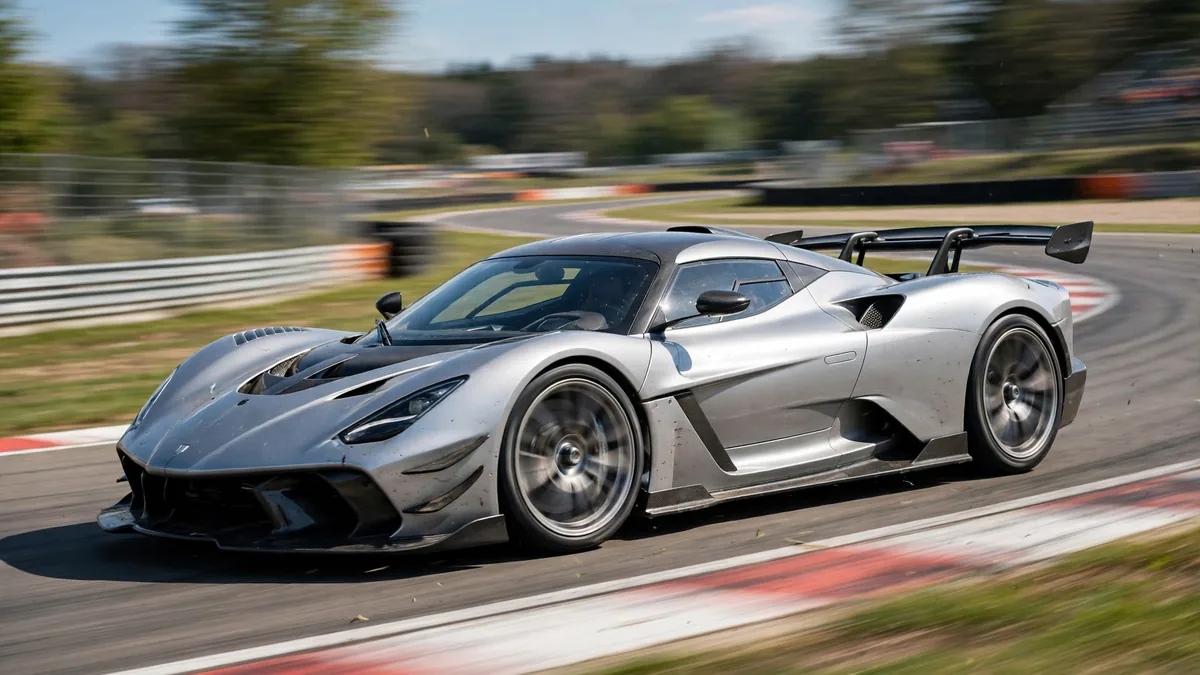
Look at a hypercar and you are looking at a wind tunnel with wheels. Every curve, vent, and wing on its body exists to do one of two jobs: push the car into the road, or let the air slip past with as little resistance as possible. At 300 kilometres per hour the air is no longer something the car moves through. It is a force the car must manage, and the body is the tool that manages it. Get it right and the car grips the road harder the faster it goes.
This is why hypercar bodies look so strange. The huge rear wings, the deep front splitters, the tunnels underneath, and the flaps that open and close on their own are not decoration. They are a system, designed in wind tunnels and supercomputers over thousands of hours, and tested at speeds no road car was ever meant to reach. A hypercar needs downforce measured in tonnes, while still reaching 350 kilometres per hour.
The trick is that downforce and speed are enemies. A big wing presses the car down but also drags it back, so the fastest hypercars use wings that move, floors that suck the car to the road, and bodywork that turns the air itself into a tool. Here is how it works.
How It Works
Step 1: Splitting the air at the nose
Everything starts at the front of the car, where a low splitter juts out beneath the nose and divides the air into two streams. The air that goes over the car is shaped by the bonnet and the windscreen, while the air that goes underneath is channelled through a flat floor. The splitter’s job is to make that division clean, because turbulent air underneath the car creates lift, and lift is the enemy. The front of the car is kept as low as legally possible so that as little air as possible sneaks underneath.
Step 2: Sucking the car down with venturi tunnels
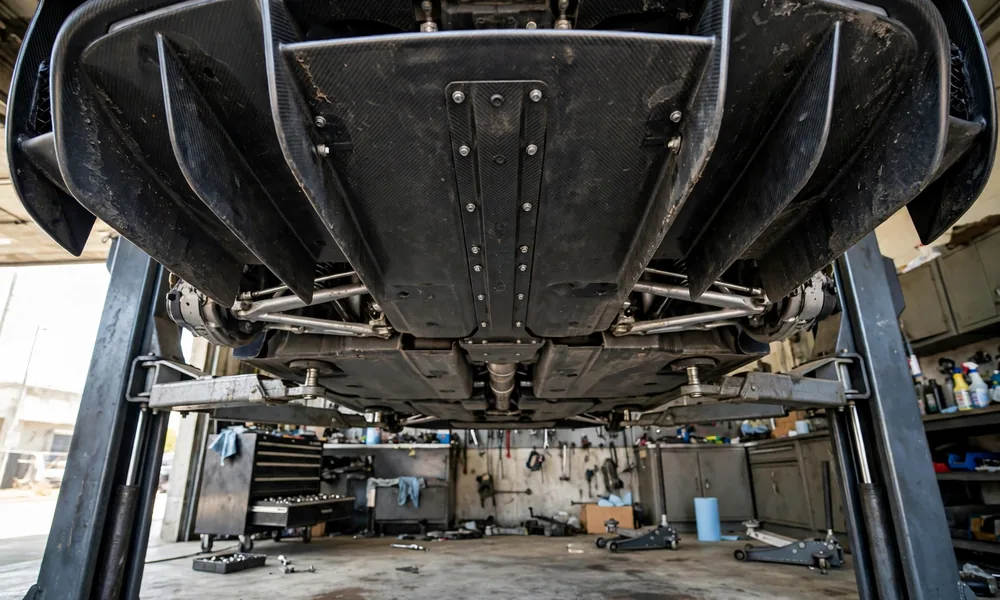
Underneath the car, the floor is shaped into venturi tunnels, wide channels that narrow and then widen again. As air rushes through the narrow part it speeds up, and faster air has lower pressure, so the low pressure underneath the car sucks it down toward the road. This is ground effect, the same principle that made Formula One cars so fast in the late 1970s, and it is far more efficient than a wing because it creates downforce with very little drag. On the most extreme road cars the tunnels are so large that the cabin has to be squeezed into a pod between them.
Step 3: Working the air with a rear diffuser
At the back of the car, the flat floor rises into a diffuser, a shaped ramp that lets the fast-moving air underneath expand and slow down as it leaves the car. The diffuser is one of the most powerful tools on a hypercar body, because it controls how the air exits and how much suction the venturi tunnels can generate. A well-designed diffuser can produce hundreds of kilograms of downforce on its own, and its shape is tuned in wind tunnels down to the millimetre.
Step 4: Adding a wing that thinks
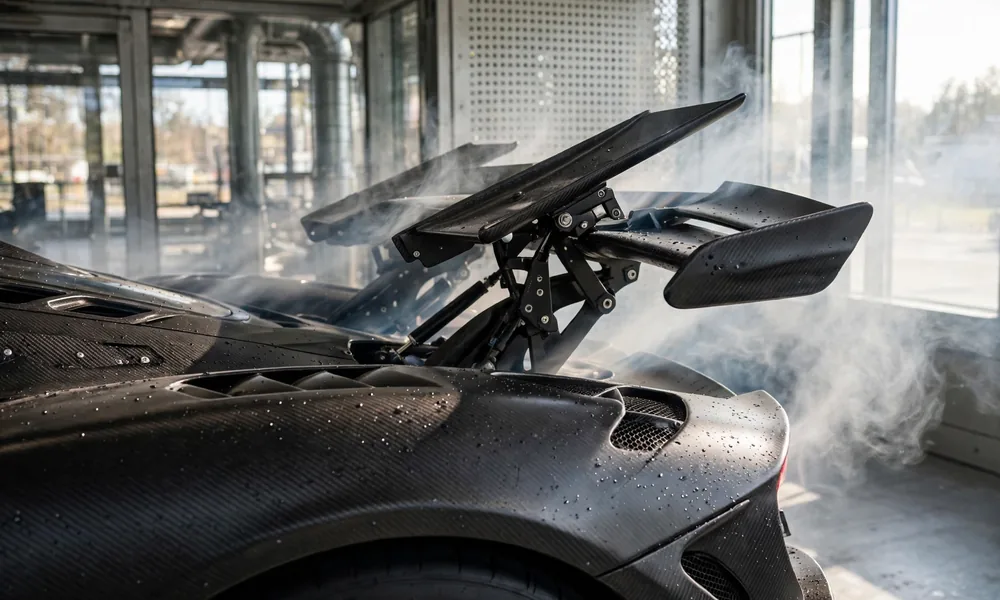
The rear wing is the most visible part of the system, and on a modern hypercar it is rarely fixed. Active wings change their angle many times per second: flat on a straight for top speed, steep under braking to act as an air brake, and somewhere in between through corners. The wing works with the rest of the body rather than against it, and its settings are chosen by the car’s computer based on speed, steering, and braking. The balance between front and rear downforce is critical, and the suspension must cope with the load, which is why the ideas behind how hypercar suspension works are inseparable from the aerodynamics.
Step 5: Building the body from carbon fibre
None of this would work if the body flexed. At 300 kilometres per hour the aerodynamic loads are measured in tonnes, and a body that bends would change the shape of the venturi tunnels and the angle of the wing, destroying the downforce it was meant to create. That is why hypercar bodies are built from carbon fibre, a material that is both lighter than steel and far stiffer. The panels are laid up by hand, cured in autoclaves, and bonded to a carbon monocoque. The material science behind it is the same story told in carbon fibre weave specs explained, where the weave itself is part of the engineering.
Step 6: Balancing downforce against drag
Finally, every hypercar body is a compromise between two numbers: downforce, which presses the car down, and drag, which holds it back. A car built only for corners would have enormous wings and never reach its top speed, while a car built only for speed would have no grip in a bend. Engineers use active aerodynamics to cheat this trade-off, changing the car’s shape as conditions change, and the result is a body that can produce more downforce than the car weighs at top speed, yet still slip through the air fast enough to reach 350 kilometres per hour. The brakes that stop that speed are described in how carbon ceramic brakes work.
Hypercar Aerodynamic Body Specs
| Specification | Typical range |
|---|---|
| Peak downforce | About 1,000 to 1,800 kilograms at top speed |
| Top speed | About 330 to 350 kilometres per hour |
| Body material | Carbon fibre panels on a carbon monocoque |
| Rear wing | Active, angle changes with speed and braking |
| Underbody | Flat floor with venturi tunnels and a rear diffuser |
| Drag coefficient | About 0.30 to 0.40 depending on wing setting |
| Front aero | Splitter, dive planes, and wheel-arch vents |
| Development time | Thousands of wind-tunnel and simulation hours |
| Weight penalty | Active aero hardware adds roughly 20 to 40 kilograms |
What Does This Engineering Cost?
There is no price for an aerodynamic body on its own, because it is never sold separately. But the cars that carry this level of aerodynamics are estimated to cost from around $2 million to $3.5 million, before options and taxes, and a large share of that figure pays for the wind-tunnel time, the carbon-fibre tooling, and the active systems. Prices are estimates only, and the most extreme examples change hands for far more. The body is the most expensive part of the car to develop, and the hardest to copy.
A Rare Fact
The most extreme road car ever built produces so much downforce that it could, in theory, drive upside down on a ceiling. At around 250 kilometres per hour its venturi tunnels already generate more downforce than the car’s own weight, which means the air alone is holding it against the road harder than gravity could. The tunnels that make this possible are so wide that the car’s cabin had to be designed around them, squeezed into a teardrop pod with barely room for two people.
A hypercar body is not a shape. It is a machine made of air, carbon, and mathematics, and it works hardest exactly when the car is going fastest. The next time you see one, look past the paint and the badges, and look at the tunnels, the wing, and the floor. That is where the speed really lives.


