At 300 kilometres an hour, a hypercar engine drinks fuel the way a fire drinks air. The pump is working at full tilt, the injectors are firing hundreds of times a second, and a single gulp of air in the line — one bubble, one moment of starvation — could melt a piston in seconds. The system that prevents that disaster is small, hidden, and ruthlessly engineered. It is the fuel system, and building one for a hypercar is nothing like plumbing a family car.
An ordinary car sips fuel from a simple tank. A hypercar’s fuel system must feed an engine producing four figures of horsepower while the car brakes, corners, and accelerates hard enough to throw fuel from one side of the tank to the other. It must do this for lap after lap, in heat that would boil ordinary petrol, without a single hiccup.
So engineers build it like a racing system: a flexible safety cell instead of a metal tank, multiple pumps, a collector that never runs dry, and lines routed like arteries. Every joint is sealed, every part is tested, and the whole assembly is treated as a piece of life-saving equipment. This is how a hypercar fuel system is made.

How It’s Made
Step 1: Designing the fuel cell around the chassis
The fuel system starts with the car’s packaging. Engineers decide where the fuel will live — usually low and central, between the driver and the engine, where it helps balance the car and sits inside the strongest part of the chassis. The tank is not a box but a shape moulded to fit around suspension parts, electronics, and the monocoque. Computer models simulate fuel sloshing under braking and cornering, because a moving mass of fuel can unsettle a car at the limit. The finished shape is then handed to the bladder makers, and the surrounding structure is built to protect it, much like the carbon chassis described in hypercar chassis production.
Step 2: Building the bladder and safety cell
At the heart of the system is a flexible bladder — a tough, multi-layer bag made from rubberised fabric, often with Kevlar reinforcement. It is built by wrapping layers of coated fabric over a form, bonding the seams, and fitting it with metal plates where the pumps and filler neck attach. The bladder sits inside a rigid container, usually carbon fibre or aluminium, which protects it from punctures. Inside the bladder, foam baffles fill the empty space: they stop fuel from sloshing violently and, crucially, they smother any flame if the cell is ever breached.
Step 3: Fitting the pumps and collector
A hypercar rarely relies on a single pump. Most use two or three: low-pressure lift pumps inside the cell that move fuel into a small collector pot, and one or two high-pressure pumps that feed the engine. The collector is the clever part — a small pot, always kept full, with one-way valves that let fuel in but never let it slosh out. Even if the main cell is nearly empty and the car is cornering hard, the collector still holds enough fuel for the engine. Technicians fit the pumps, filters, and level sensors into the cell through sealed plates, torquing every bolt to a specification and pressure-testing the assembly before it leaves the bench.
Step 4: Routing the lines and fittings
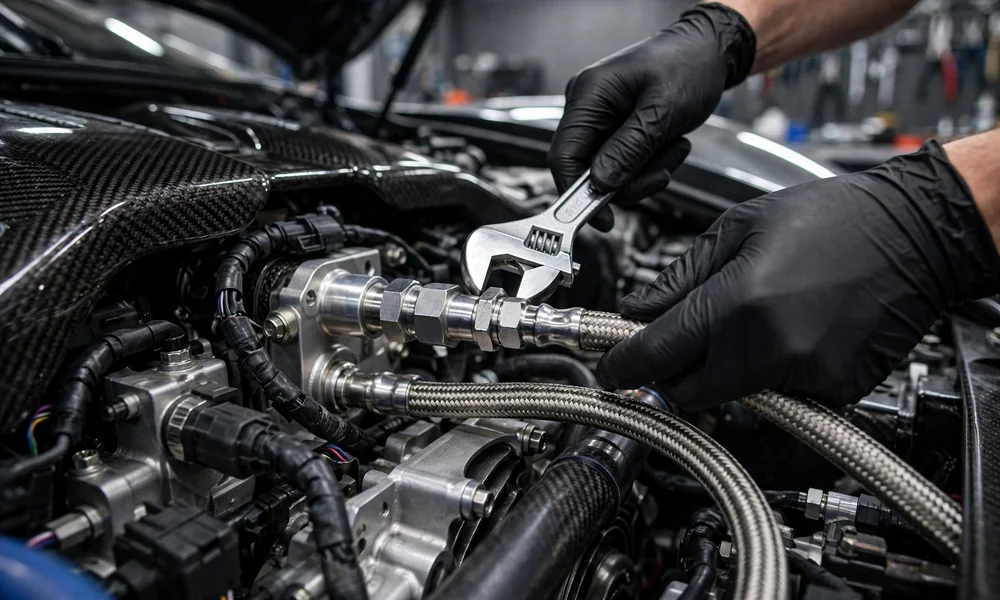
From the cell, fuel travels through lines that look more like aerospace plumbing than car parts. The hoses are braided stainless steel or aramid fibre over a Teflon core, chosen because they resist heat, pressure, and the chemical bite of modern fuels. Each line is cut to length, fitted with crimped connectors, and routed along the chassis away from hot exhausts and moving suspension. Every connection is a potential leak, so the number of joints is kept to a minimum — and every joint is inspected, as carefully as the parts that feed the engine itself, including the mighty hypercar V12 engine it serves.
Step 5: Installing injectors and the high-pressure rail
At the engine, fuel meets the injectors. Modern hypercars use direct injection, spraying fuel straight into the combustion chamber at pressures of several hundred bar. The fuel rail — a precision-machined tube, often stainless steel — distributes fuel evenly to each injector, while a pressure regulator and sensors keep the pressure constant no matter what the engine is doing. The injectors themselves are tiny marvels, with nozzles machined to micron tolerances that atomise fuel into a fine mist.
Step 6: Wiring the controls and testing the whole system
The final step is the brain. An electronic control unit reads fuel pressure, temperature, and level, and commands the pumps to speed up or slow down as demand changes. It also watches for trouble: a pressure drop means a leak, and the system can shut the pumps down in a crash, triggered by the same sensors that fire the airbags. Testing is exhaustive. The assembled system is pressure-tested with inert fluid, run on a bench rig that simulates cornering loads, and finally tested in the car on a dynamometer, where engineers watch fuel pressure hold steady while the engine screams through its rev range. Only then is the car allowed on the road — a process as exacting as the one behind the Bugatti W16 engine.
| Tank type | Flexible bladder in a rigid carbon-fibre or aluminium cell |
| Typical capacity | About 80 to 110 litres, depending on the model |
| Fuel pumps | Two or three — lift pumps plus high-pressure pumps |
| Injection pressure | Several hundred bar for direct injection |
| Fuel lines | Braided steel or aramid over a Teflon core |
| Anti-slosh | Foam baffles and a collector pot with one-way valves |
| Safety features | Crash-triggered pump shut-off and flame-smothering foam |
| Service interval | Bladder inspection and replacement on a strict schedule |
What Does a Hypercar Fuel System Cost?
A hypercar fuel system is not sold as a spare part, so there is no showroom price. The fuel cell alone, with its bladder, pumps, and collector, is estimated at roughly $10,000 to $25,000, and a complete system — lines, rails, injectors, sensors, and control electronics — is estimated at $30,000 to $60,000 or more. These are estimates only, and they exclude development and the cost of the crash testing that proves the cell is safe. Owners also pay for maintenance: the bladder has a limited life and must eventually be replaced, a job that can take days because the cell sits deep inside the car.
A Rare Fact
Fuel-cell bladders come from aviation and motor racing, where they have saved countless lives. The technology was first used in military aircraft in the 1940s and 1950s, after engineers realised that a flexible bag would not rupture the way a metal tank did when hit. Formula 1 made them mandatory in the 1970s, and road-going hypercars inherited them from the racetrack. The foam inside a modern fuel cell is the same idea that keeps a fighter jet’s tanks from exploding — shrunk down to fit behind a driver’s seat.

A hypercar’s fuel system never gets the glory. There are no posters of it, no exhaust note to admire, no badge on the bodywork. But every lap record and every top-speed run depends on it delivering the exact right amount of fuel, at the exact right pressure, at the exact right moment — while the car is being thrown around at forces that would empty an ordinary tank.


