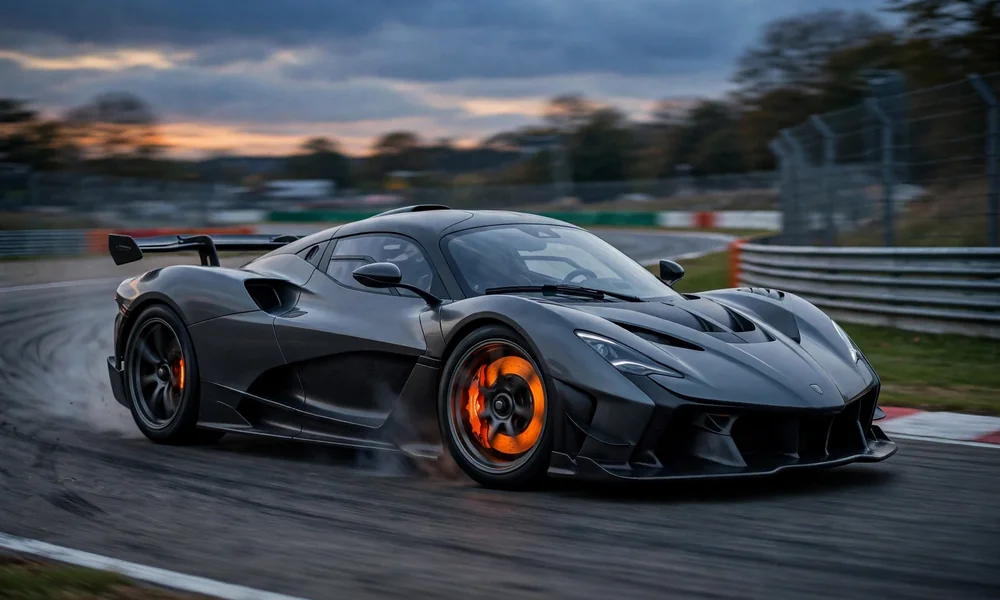
At the end of a long straight, a hypercar is doing the speed of a small aircraft, and the only thing that can stop it is a disc the size of a dinner plate. The driver presses the pedal, the calliper squeezes, and in four seconds the car sheds enough energy to power a house for a day, all of it turned into heat inside the disc. A steel disc would fade, warp and give up. A carbon-ceramic disc glows orange and asks for more.
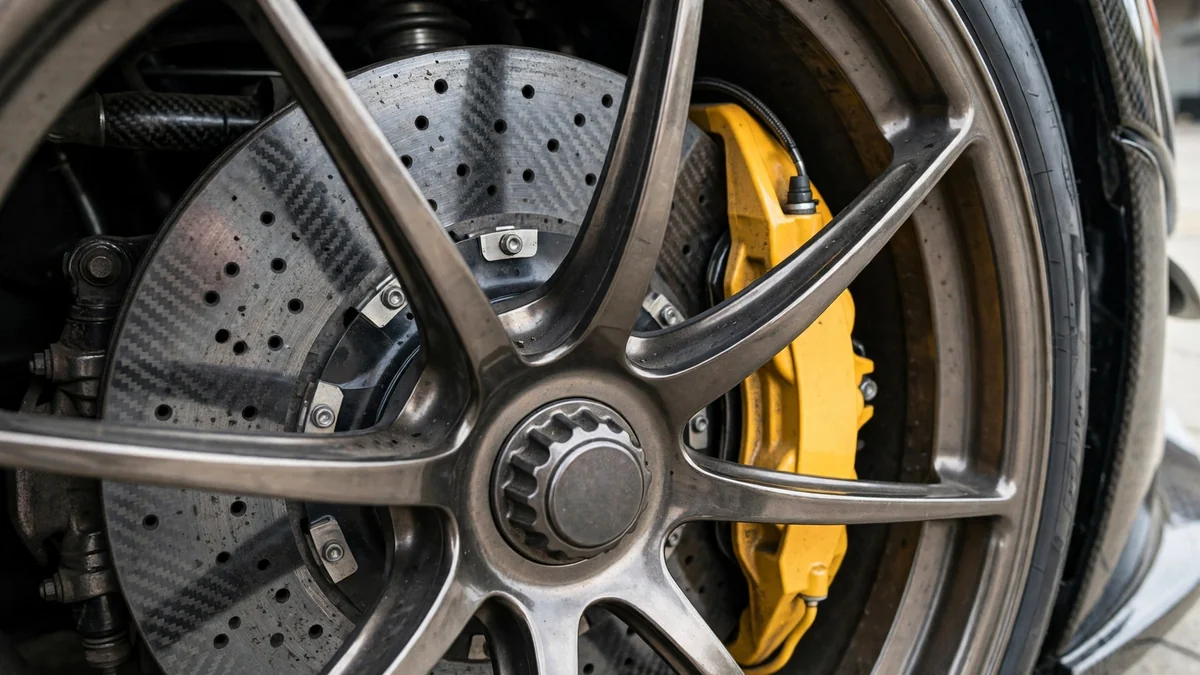
A carbon-ceramic brake is not a better steel brake. It is a different material altogether: carbon fibres locked inside a ceramic matrix, built up layer by layer, baked for days at temperatures that would melt aluminium, and machined to tolerances a watchmaker would respect. The disc looks simple, a dark ring with holes in it.
Why It Costs So Much
The price of a carbon-ceramic brake is the price of time in a furnace. The materials themselves are not cheap, but the real cost is the weeks of slow, careful processing that turn loose carbon fibre into a disc that can survive a thousand degrees without fading. Six things drive the price, and the disc cannot be made without any of them.
1. Carbon fibre, laid by hand
The disc begins as carbon fibre cloth, cut and laid into the shape of a disc, layer upon layer, with the fibres running in different directions so the disc is strong in every direction it will be loaded. The layup is done by hand, because the shape is complex and the fibre orientation matters. A misplaced layer is a weak spot, and there is no machine that can lay a brake disc preform as reliably as a trained pair of hands. The cloth itself is expensive, and the labour is slow. The materials behind carbon-ceramic brakes explain why the fibre and the resin are chosen for heat rather than for lightness alone.
2. Baking for days, not hours
The resin-soaked preform is baked in a furnace without oxygen, at temperatures over a thousand degrees Celsius, until the resin turns into carbon. The bake takes days, and the disc shrinks and hardens as the resin carbonises. The furnace is expensive to run, the temperature has to be controlled precisely, and a whole batch can be lost to a single error.
3. Densifying, again and again
A single bake leaves the disc porous, so it is put through the process again, and again. Resin is forced into the pores, the disc is baked again, and each cycle makes it denser, harder and stronger. This is the step that makes carbon-ceramic discs so expensive, and it is also the step that makes them so good. Each cycle takes days, and a disc may go through several of them before it is dense enough to use.
4. Converting carbon into ceramic
For a road-going hypercar, the carbon-carbon disc is infiltrated with molten silicon, which reacts with the carbon to form silicon carbide, a ceramic. The result is a carbon-ceramic disc: carbon fibres for toughness, ceramic for hardness and heat resistance, and a surface that grips the brake pads consistently from cold to glowing hot. The chemistry is unforgiving. The silicon has to reach every part of the disc without pooling, and only a few factories have mastered the process at production scale. The silicon infiltration is done in a furnace at extreme temperature, and the margin for error is small.
5. Machining to microns, then drilling
The finished disc is machined flat to within a few microns, drilled with ventilation holes that help cooling and clear away dust, and balanced so it spins perfectly true at high speed. The machining is done with diamond tooling, because the ceramic eats ordinary cutters, and it is slow. The drilling alone takes hours, and every hole is a chance to crack the disc. How carbon-ceramic brakes are made follows the disc through every stage, from cloth to finished ring.
6. Testing that no steel disc ever faces
Every carbon-ceramic disc is tested as if it were going to save a life, because it is. Discs are spun, heated, cooled and measured, and the pads that grip them are matched to the disc as a system. The testing is exhaustive because the disc is asked to work at temperatures where steel has already given up, and a failure at speed is catastrophic. The disc that reaches the car has survived more testing than most of the car’s other parts combined.

What the Numbers Say
| Specification | Carbon-ceramic brake |
|---|---|
| Disc material | Carbon fibre in a silicon carbide ceramic matrix |
| Typical front diameter | 390 to 440 mm on a hypercar |
| Typical disc weight | About 6 to 8 kg, far lighter than steel |
| Peak operating temperature | Over 1,000°C under hard track use |
| Production time | Several weeks, including multiple bake cycles |
| Service life | Often the life of the car under road use |
| Key advantage | No fade at high temperature, huge weight saving |
What It Costs, and Why
A single carbon-ceramic brake disc for a hypercar typically costs an estimated $5,000 to $10,000, and a full set of four can cost an estimated $20,000 to $40,000 or more, before pads and callipers. The price is the production time. Weeks of furnace time, multiple densification cycles, hand layup, diamond machining and a rejection rate that would horrify a mass-market factory all stack up, and the volume is tiny: a few thousand discs a year across the whole industry, not millions.
There is a consolation for the owner. A carbon-ceramic disc lasts far longer than a steel disc, often for the life of the car under road use, so the cost is paid once rather than every few years. The rest of the car is built to the same philosophy, and the disc is part of a system. The materials explain the choice, and the materials behind a hypercar brake disc show why engineers accept the cost: there is simply no cheaper material that survives what this disc survives.
Why the Price Stays High
The price stays high because the process cannot be shortened. Each densification cycle takes days, and skipping a cycle makes a weaker disc. The furnaces are expensive to run, the inspection is exhaustive, and the market is small, so the fixed costs of the factory are spread over a few thousand discs.
There is also a safety argument that keeps standards where they are. A brake disc is the one part of a hypercar that is asked to save the driver’s life, every lap, without exception. The testing, the margins and the rejection of imperfect discs are not waste. They are the product, and the customer is paying for the certainty that the disc will work on the lap when it matters most, not just on the lap when it is easy.
A Rare Fact
Carbon-ceramic brake discs actually work better when they are hot, which is the opposite of steel discs. A steel disc fades as it heats up, but a carbon-ceramic disc grips harder, which is why racing drivers warm their brakes with a few hard stops before they trust them at full speed.