A hypercar can cross a racetrack bump at 180 miles per hour and stay planted, level, and calm, while the driver feels little more than a firm thump through the seat. That composure is not luck. It comes from a suspension system that weighs less than a suitcase, reacts in thousandths of a second, and is built to tolerances a watchmaker would respect.
The suspension of a hypercar is a long way from the steel springs and rubber bushes under a family hatchback. Its wishbones are sculpted from aluminium or carbon fibre, its dampers are filled with fluid that changes thickness when a magnetic field passes through it, and its springs are wound from titanium wire thinner than a pencil. Some systems read the road ahead with cameras and prepare the dampers before the wheel even reaches a bump. Building all of this takes a small team of specialists, a room full of machines, and weeks of careful hand assembly.
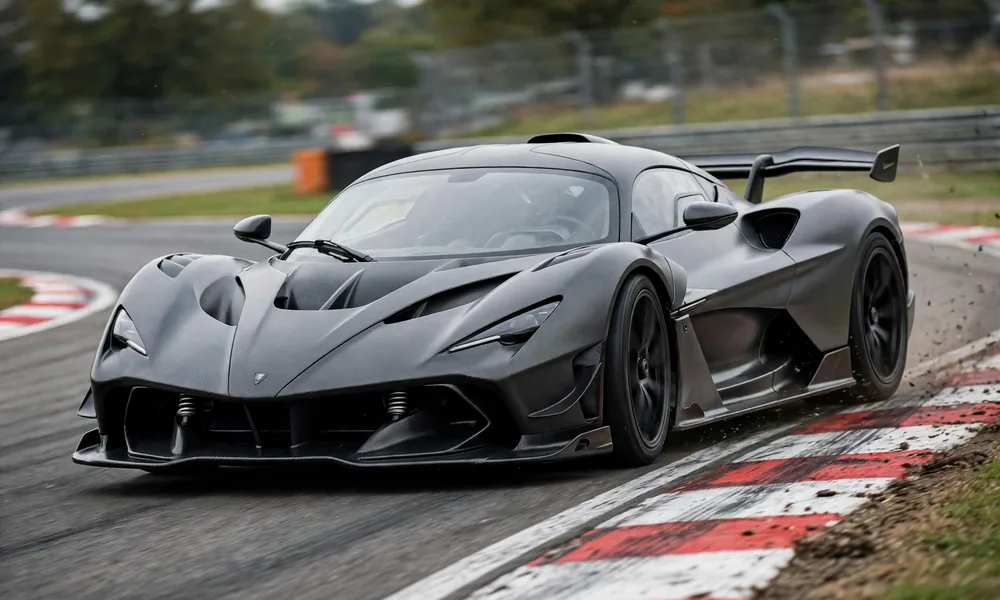
Few components on a hypercar work as hard, or are as invisible, as its suspension. It holds the tyres against the road, keeps the aerodynamic floor at exactly the right height, and absorbs punishment lap after lap without fading. This is how a hypercar suspension is made.

How It’s Made
Step 1: Designing the geometry and choosing the materials
Every suspension begins on a computer, long before any metal is cut. Engineers model the car’s weight, its aerodynamic downforce, and the loads each corner will see at full speed, then shape the wishbones so the tyre stays flat on the road through every corner. The upper and lower wishbones are usually forged from aerospace aluminium, while the most extreme cars use carbon fibre arms that are lighter still. Springs are wound from titanium or high-strength steel, and the damper bodies are machined from aluminium billet. The principles behind the system are explained in how hypercar suspension works, which covers what each part does once the car is moving.
Step 2: Forging and machining the wishbones
The wishbones start as solid billets of aluminium alloy, heated until they glow and pressed in a forging die under thousands of tonnes of force. Forging lines up the metal’s grain along the shape of the arm, making it far stronger than a part cut from a flat plate. After forging, each arm goes to a five-axis milling machine, where cutters carve away everything that is not needed, leaving a sculpted shape with ribs and pockets that save weight without losing strength. A single wishbone can spend hours on the mill, and the finished arm is checked against its digital model to within a fraction of a millimetre.
Step 3: Winding and heat-treating the springs
While the arms are machined, the springs are wound. A bar of titanium or spring steel is heated and coiled around a mandrel into a precise helix, with the spacing between coils set to give the exact stiffness the engineers specified. The spring is then heat-treated in a furnace, quenched, and tempered to lock in its strength, a process that must be controlled to the degree or the spring will sag or snap. Each spring is tested on a rig that compresses it thousands of times, measuring its rate at every point of travel.

Step 4: Building the dampers
The dampers are the most intricate part of the system. A damper body is machined from aluminium, honed smooth inside, and fitted with a piston carrying tiny shim stacks — thin washers of spring steel that flex to control how oil flows through the piston as it moves. In adaptive dampers, the oil contains iron particles, and an electromagnetic coil changes the fluid’s thickness in milliseconds, stiffening or softening the ride on command. Technicians assemble each damper by hand in a clean room, filling it with oil under vacuum so no air bubbles remain, because a single bubble would make the damping uneven.
Step 5: Assembling the corner and fitting the pushrods
With the parts made, the suspension corner is assembled. The wishbones are bolted to the chassis through spherical bearings, which replace rubber bushes so there is no flex or delay in the car’s responses. The pushrod connects the lower wishbone to a rocker, which in turn drives the spring and damper mounted inside the body. The upright, which carries the wheel bearing and brake disc, is fitted last, and the whole corner is checked for free movement — it should swing smoothly through its full travel with no binding or play at all. The active systems that control these dampers are covered in hypercar active suspension specs.
Step 6: Setting up, testing, and track validation
The finished suspension is set up on a rig that measures ride height, camber, toe, and corner weights, with the car loaded exactly as it will run. Engineers adjust the spring platforms in tiny increments until all four corners carry their share of the weight. Then the car goes to the track, where data loggers record damper travel, tyre temperatures, and body movement over hundreds of laps. Only when the data shows the car is stable, fast, and repeatable is the suspension signed off. The brakes that share these corners are made to equally exacting standards, as shown in how a hypercar brake disc is made.
| Main materials | Forged aluminium wishbones, titanium or steel springs, aluminium damper bodies |
| Wishbone construction | Forged then five-axis machined, checked to a fraction of a millimetre |
| Spring material | Titanium or high-strength spring steel, heat-treated and rate-matched in pairs |
| Damper type | Adaptive dampers with magnetorheological fluid or shim-stack pistons |
| Damper response time | Milliseconds, adjusting stiffness as the car moves |
| Bearings | Spherical bearings instead of rubber bushes, for zero flex |
| Manufacturing time | Several weeks from forging to track validation |
| Typical corner weight | A complete corner weighs only a few kilograms |
What Does a Hypercar Suspension Cost?
A full hypercar suspension is one of the most expensive systems on the car. A single adaptive damper is estimated at roughly $5,000 to $10,000, and a complete set of four corners, with wishbones, springs, dampers, and uprights, is estimated at $40,000 to $80,000 or more. The price reflects forged and machined parts, hand assembly, and hours of rig and track testing. Owners accept the cost because the suspension is what lets a 1,000-horsepower car be driven at its limit without biting back.
A Rare Fact
Some hypercars use a suspension idea taken directly from Formula 1: the springs and dampers do not sit at the wheels at all, but lie flat inside the body and are worked by pushrods and rockers. The layout saves space, keeps weight low, and lets air flow cleanly around the car. The system that does this is the same one keeping the car glued to the road at 200 miles per hour — a machine that is, at once, a shock absorber, a computer, and a piece of sculpture.
The suspension will never be the part a hypercar owner photographs. It hides behind the wheels, dark and oily, doing its work in silence.


