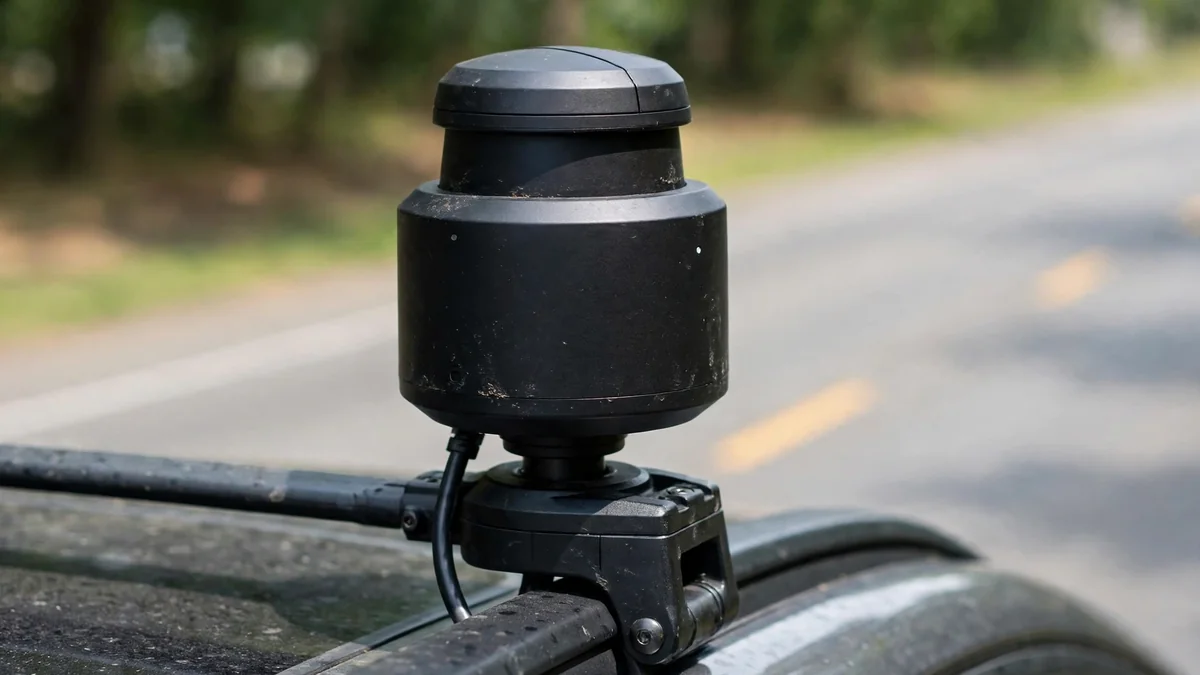
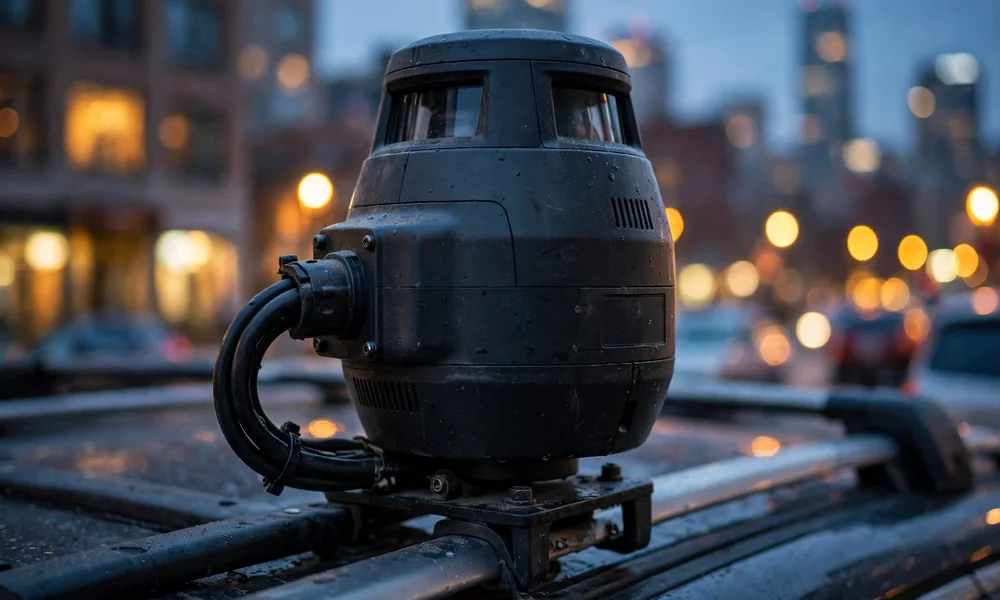
Drive through a city at night in a car that can see in the dark, and the thing doing the seeing is smaller than a shoebox, spinning or staring silently from the roof. It fires millions of pulses of laser light every second, times their return to a billionth of a second, and builds a three-dimensional map of the world accurate to a centimetre. It is called a LiDAR sensor, and it is one of the most expensive components on any self-driving car.
The price surprises people because the sensor looks so modest. What you are paying for is precision at a scale that is hard to believe: optics aligned to microns, lasers that pulse billions of times without drifting, and electronics that measure time so finely that a nanosecond of error moves a car by thirty centimetres. Building that precision, and proving it survives heat, cold, rain and a decade of vibration, is where the money goes.
Why It Costs So Much
The cost of a LiDAR sensor is the cost of measuring light. The sensor has to send out a pulse, catch the tiny fraction of it that bounces back, and time the round trip precisely enough to place an object to within a few centimetres at a hundred metres. Everything in the sensor serves that one measurement, and every part of it has to be better than the last generation. Six things drive the price, and none of them is the plastic housing.
1. Lasers that must never drift
The heart of a LiDAR sensor is its laser, usually an infrared diode or a fibre laser, firing pulses that last a few nanoseconds. The wavelength has to stay stable as the sensor heats up in summer traffic and cools down on a winter morning, because a drifting wavelength means a drifting measurement. The lasers are made on semiconductor production lines, tested individually, and binned by performance. How a LiDAR sensor works explains the pulse and the timing that turns light into distance.
2. Optics aligned to microns
The laser light leaves the sensor through lenses and mirrors, and the returning light is gathered by a receiver that is, in effect, a tiny telescope. The optics have to be aligned to within microns, and they have to stay aligned while the car vibrates over potholes for a decade. The lenses are coated to pass only the laser’s wavelength and reject sunlight, and the coatings are applied in vacuum chambers, layer by layer.
3. A detector that counts single photons
The returning pulse is faint. At a hundred metres, only a handful of photons come back, and the detector has to notice them against the glare of the sun. Modern LiDAR uses avalanche photodiodes or single-photon detectors, devices that amplify a single photon into a measurable signal. They are expensive to make, sensitive to temperature, and need their own cooling and calibration.
4. Timing electronics measured in picoseconds
Light travels thirty centimetres in a nanosecond, so measuring distance to a few centimetres means measuring time to a fraction of a nanosecond. The timing electronics in a LiDAR sensor run at gigahertz speeds, on circuit boards designed like radio equipment, with shielding, thermal management and clocks that are stable to parts per billion. The chips are specialised, the volumes are small compared with a phone processor, and the design is a closely guarded secret.
5. Scanning the world, mechanically or not
A single laser beam measures one point. To map a whole scene, the sensor has to scan, either by spinning a mirror, by steering the beam with a micro-mirror, or by flashing the whole scene at once. Mechanical spinning sensors are precise but have moving parts that wear, and they need bearings and motors that survive a decade of rotation. Solid-state sensors have no moving parts but need arrays of thousands of tiny emitters, each one working perfectly. Inside LiDAR sensor production shows how the scanner, the optics and the electronics come together on the line.
6. Testing against the real world
A LiDAR sensor is not finished when it works on a bench. It has to work in rain, fog, snow, dust and direct sunlight, on a car that is vibrating, braking and turning. Each unit is calibrated against known targets, tested in climate chambers, shaken on vibration tables, and driven through real weather before it is accepted. The test programme is long because the failure mode is not a dead sensor, which is obvious, but a sensor that is slightly wrong, which is not.

What the Numbers Say
| Specification | Automotive LiDAR sensor |
|---|---|
| Typical range | 150 to 300 metres for a long-range unit |
| Distance accuracy | A few centimetres at 100 metres |
| Points per second | Millions, building a full 3D map many times a second |
| Laser wavelength | 905 nm or 1550 nm infrared, eye-safe at road power |
| Field of view | Up to 360 degrees for a spinning unit |
| Operating temperature | About minus 40°C to plus 85°C |
| Typical unit size | Smaller than a shoebox for a roof-mounted unit |
What It Costs, and Why
A long-range automotive LiDAR sensor typically costs an estimated $500 to $1,000 per unit in volume, and an estimated $5,000 to $10,000 or more for an early or low-volume unit, with some of the first spinning sensors costing an estimated $75,000 each. The figures are estimates because prices have fallen steeply as volumes have risen, and they vary widely between spinning, solid-state and flash designs. The newer ones are built on production lines, and the price is falling, but slowly.
The comparison that matters is with the alternatives. Cameras are cheap but cannot measure distance directly, and radar measures distance but cannot see shape. LiDAR does both, and it does it in the dark. The same sensing idea appears in smaller, cheaper forms too, and the LiDAR in a robot vacuum shows what the technology looks like when the range is metres rather than hundreds of metres, and the price follows.
Why the Price Stays High
The price stays high because the requirements are unforgiving and the volumes are still small. A phone camera sells by the billion, so its cost is spread thinly. A long-range automotive LiDAR sells by the hundred thousand, and the development cost of the lasers, the optics and the timing electronics is divided among far fewer units.
There is also the matter of what the sensor is trusted with. A LiDAR unit on a self-driving car is part of the safety case, and a failure can be fatal. The redundancy, the self-checks and the testing are not optional extras. They are the reason the sensor costs what it does, and they are also the reason the price will only fall when the volumes rise enough to pay for the development many times over. Until then, the sensor that sees in the dark will remain one of the most expensive things on the car.
A Rare Fact
LiDAR can see through light rain and dust that blind a camera, but it has a weakness cameras do not: heavy snow and thick fog scatter the laser pulses, and the sensor sees the weather instead of the road.