It is two in the morning on a mountain road in Norway, the kind of night where the fog swallows the headlight beams ten metres ahead. The driver is not watching the road. Nobody is. The car is driving itself, and the only thing standing between it and a cliff edge is a small black box the size of a lunchbox, spinning quietly behind the windscreen, firing pulses of invisible light into the dark and listening for their echo.
That box is a LiDAR sensor, and it is one of the most demanding objects ever mass-produced. It must fire a laser a million times a second, catch a returning signal a billion times weaker than the pulse that left, and measure the time between them to within a few trillionths of a second. It must do all of this while being shaken, frozen, baked in summer sun, and sprayed with salty road water for fifteen years. Building one is less like assembling electronics and more like building a scientific instrument that happens to be sold by the hundred thousand.
The surprising part is how ordinary the factory looks from the outside. No sparks, no molten metal, no roaring presses. Inside, the work happens in cleanrooms, under microscopes, and on test rigs that cost more than the cars the sensors will end up in. Here is how a LiDAR sensor is made, step by step.

How It’s Made
Step 1: Growing the laser and the detector
Everything starts on a wafer, a thin disc of semiconductor material a few inches across. On one wafer, engineers grow the laser diodes that will fire the pulses, usually emitting infrared light at 905 or 1,550 nanometres. On another, they build the detectors, most often avalanche photodiodes, which are sensitive enough to register a handful of returning photons. The wafers are cut into thousands of tiny chips, and each chip is tested while it is still on the wafer. Any die that fails is marked with a dot of ink and thrown away.
Step 2: Mounting the optics
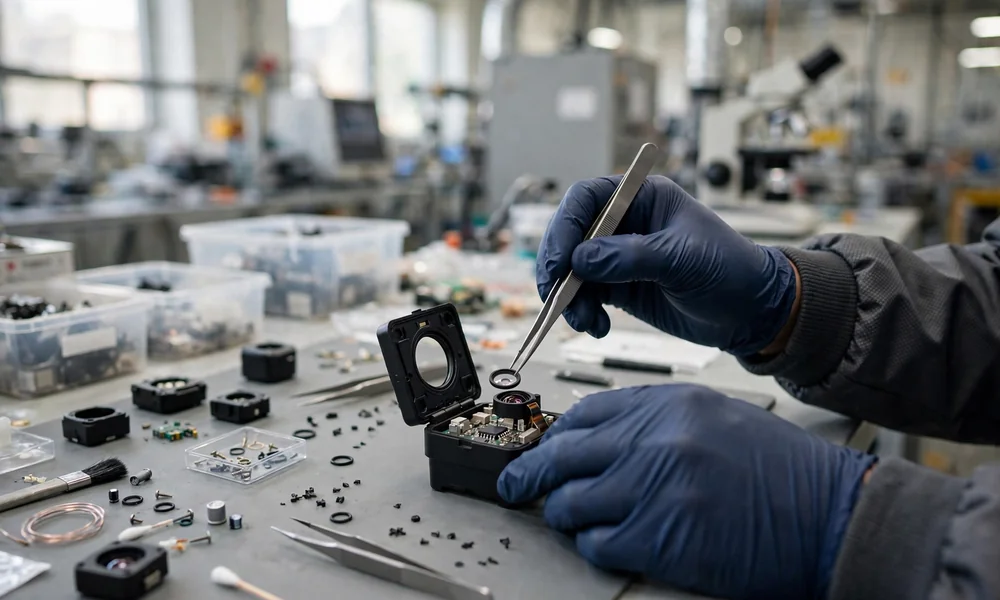
A laser diode on its own is useless without lenses to shape its light. Tiny glass lenses, some no bigger than a grain of rice, are bonded into place above the emitter and the receiver with adhesives that cure under ultraviolet light. The alignment is brutal: move a lens by a few microns and the beam misses its target entirely. Technicians use microscopes and six-axis positioning stages to nudge each lens into place, then lock it down and check the beam pattern on a screen. The same obsession with alignment shows up in the tiny motors that focus a phone camera, as explained in the guide to camera autofocus motor materials.
Step 3: Adding the scanner
One beam pointing in one direction sees almost nothing, so the sensor needs a way to sweep its beam across the world. Older designs spin a mirror assembly through a full 360 degrees, and that mirror must be balanced like a turbine rotor: at thousands of revolutions per minute, the tiniest imbalance would shake the sensor to pieces. Newer solid-state designs steer the beam with a microscopic mirror that tilts back and forth thousands of times a second, or flash the whole scene at once.
Step 4: Sealing the housing
Once the optics and scanner are in place, the whole assembly goes into its housing, usually a cast or machined aluminium shell. The housing is a piece of engineering in its own right: it must keep out water and dust, shed heat from the laser, and survive a decade of vibration without letting a single lens shift. Gaskets are fitted, the lid is torqued down to a precise figure, and the sealed unit is pressure-tested.
Step 5: Calibration against the known world
A sealed sensor is still a dumb sensor until it is calibrated. Each unit is placed on a test rig in front of targets at precisely known distances: white boards, black boards, and shapes that mimic a pedestrian or a car. The sensor fires, the rig compares what the sensor reports with what is actually there, and the difference is burned into the sensor’s memory as a correction table. This is the slowest and most expensive part of the build, because every single unit must be calibrated individually. The demand for precision here is in the same league as the fingerprint sensor materials that must read a fingertip through glass.
Step 6: Torture testing
Before a sensor is allowed near a car, it is tortured. It is frozen to minus 40 degrees, baked to 85 degrees, shaken on a vibration table that mimics a decade of rough roads, and sprayed with water while it runs. It is dropped, thermally shocked, and run continuously for days. Only units that pass every test without drifting out of calibration are boxed up. Once a unit has survived, it is ready to be fitted to a car, where it will spend its life doing the same job it did on the test rig, only faster, and for real. To see what all this precision is for, read how a LiDAR sensor works.
LiDAR Sensor Specs
| Specification | Typical range |
|---|---|
| Laser wavelength | 905 nm or 1,550 nm infrared |
| Maximum range | Up to around 250 metres |
| Points per second | About 1 to 2 million |
| Field of view | 360 degrees spinning, or about 120 degrees solid-state |
| Distance accuracy | Within about 2 to 3 centimetres |
| Frame rate | 10 to 20 scans per second |
| Power consumption | Roughly 10 to 25 watts |
| Operating temperature | About minus 40 to plus 85 degrees Celsius |
What Does a LiDAR Sensor Cost?
LiDAR used to be the most expensive part of a self-driving car. Early spinning units cost around $75,000 each, more than the car they sat on. Mass production and solid-state designs have changed the picture dramatically. Today, automotive LiDAR units are estimated to cost roughly $500 to $1,000 each in volume, with simpler short-range units estimated lower still. Prices are estimates only and vary widely by range, resolution, and order size. The fall in price is the single biggest reason LiDAR has moved from experimental robot cars into production vehicles you can buy.
A Rare Fact
Laser ranging is older than the self-driving car by half a century. The first laser ranging systems appeared in the early 1960s, only a few years after the invention of the laser itself, and one of their earliest jobs was measuring the distance to the Moon. Reflectors left on the lunar surface by Apollo astronauts are still ranged by laser today, with pulses timed so precisely that scientists can track the Moon drifting about 3.8 centimetres further from Earth every year.
A LiDAR sensor does not see the way we see. It counts light, millions of times a second, and from those counts builds a world precise enough to drive through in the dark. That is its quiet genius: while the rest of the car guesses, the LiDAR measures.


