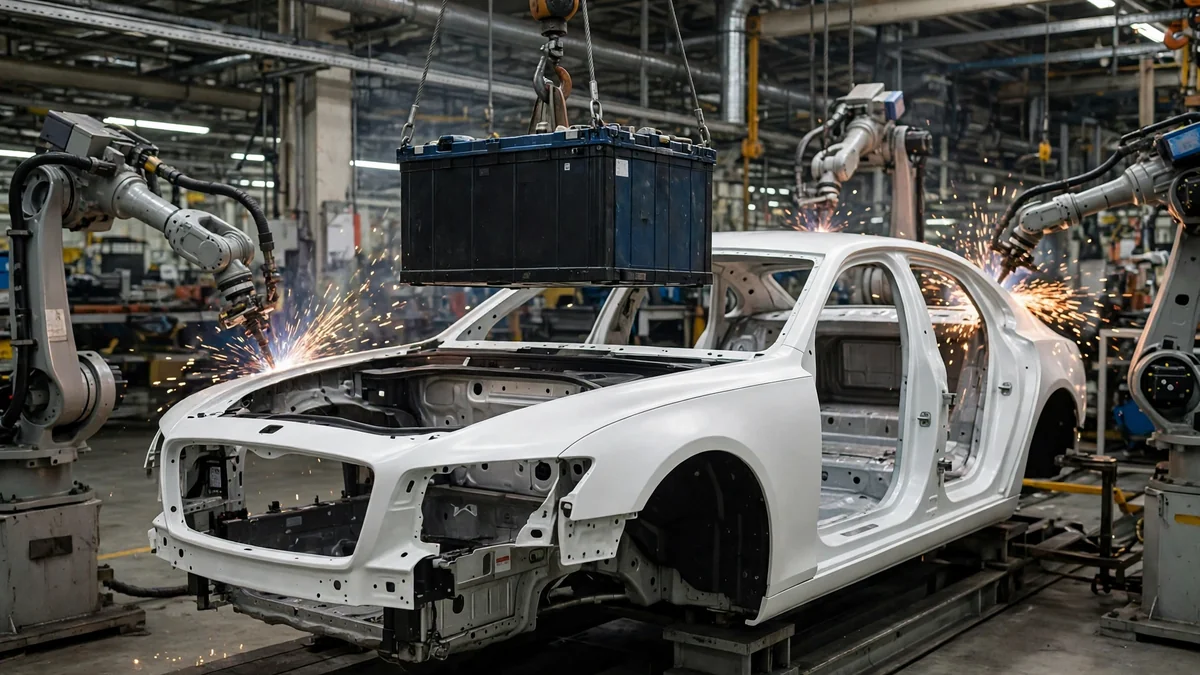
The body shell moves slowly along the line, white and unpainted, its doors missing and its interior bare metal. Robots swing around it, welding in bursts of sparks, while above, a gantry lowers a battery pack into the floor. What is missing is just as telling: no steering column waiting to be fitted, no dashboard full of dials, and no place for a driver to sit. This car is being built to drive itself.
A luxury autonomous car is a self-driving vehicle finished to the standard of a chauffeur-driven limousine. It is made on a production line like any modern car, but the build adds a second machine on top of the first: the sensor and computing system that lets the car see the road, decide what to do, and drive without a human hand on the wheel.
How a Luxury Autonomous Car Is Made, Step by Step
Step 1: The body shell is built and the battery is fitted
Building begins with the body shell, pressed from steel and aluminium panels and welded together by robots. The floor is the most important part, because it carries the battery pack. The pack is a flat slab of hundreds of battery cells, sealed in a crash-proof case, and it is lifted into the floor from below and bolted into place. The same battery-in-the-floor thinking shapes the build of a luxury electric car, and a low, heavy battery gives the car a low centre of gravity and leaves room for a spacious cabin above. The shell is then painted, usually in deep, dark colours with several coats of clear lacquer, because a luxury car is judged by its shine.
Step 2: The electric motors and chassis go in
With the shell painted, the electric motors are fitted, one on each axle, giving four-wheel drive with no driveshaft down the middle. The suspension is fitted next: air springs that raise or lower the car and soften the ride over bad roads, and regenerative brakes that recover energy as the car slows. Steering is by wire in the most advanced cars, with no mechanical link between the steering wheel and the wheels, so the computer can steer by itself and the wheel in the cabin is mainly there for the passenger to hold.
Step 3: The sensors are mounted and calibrated
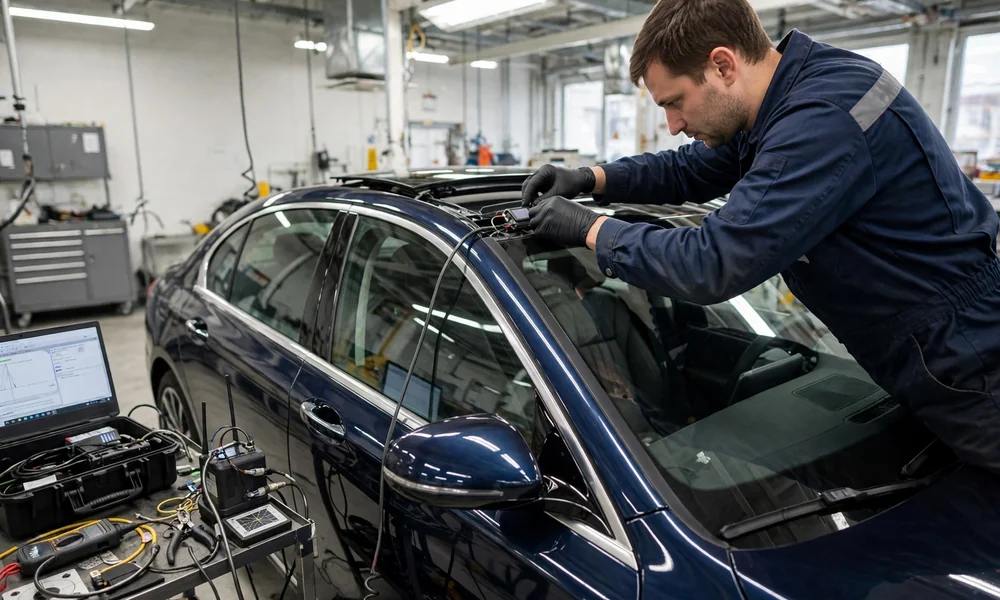
The sensor set is what makes the car autonomous, and fitting it is slow, precise work. Lidar units are mounted in the roofline or behind the grille, measuring distance by bouncing laser light off everything around the car. Cameras are fitted behind the windscreen, in the mirrors and at the rear, and radar units sit behind the bumpers, seeing through rain and fog where cameras cannot. Each sensor is mounted to the millimetre and calibrated on a rig, because a camera a fraction of a degree out can misjudge a car a hundred metres away.
Step 4: The computer brain is installed
Without a computer to make sense of them, the sensors are useless, and the computer in a luxury autonomous car is one of the most powerful pieces of hardware ever fitted to a vehicle. It is a liquid-cooled unit, usually under the floor or in the boot, running software that fuses the camera, lidar and radar pictures into one model of the world. It decides where the road goes, where the other cars are and what to do next, dozens of times a second. The system is built with redundancy, so if one computer fails a second can take over and the car can still bring itself safely to a stop.
Step 5: The cabin is finished in luxury
With the machine built, the cabin is fitted out for passengers who will not be driving. The seats are wide, leather, heated and cooled, and they can recline or swivel to face each other. With no need for a traditional dashboard, the front of the cabin becomes a living room: a large screen for films, a fold-out table, wood trim and soft lighting. The car is quieter than a petrol car, so the insulation is lighter, but the finishing is heavier. Everything the passenger touches is meant to feel expensive, because in an autonomous car the cabin is the whole point of the journey, and the rear-seat thinking borrows from the chauffeur-driven car described in the guide to how a luxury limousine works.
Step 6: Software is loaded and the car learns the road
The car is not finished when the hardware is in. The driving software is loaded, and the car is taken to a test track and then to real roads, where engineers watch it drive and compare its decisions with a human driver’s. The software is updated constantly, the car learning from every mile, with new versions sent over the air after it leaves the factory. The way the finished car behaves on the road is described in the guide to how a luxury autonomous car works, and the build is only complete when the car can handle its roads without a human taking over.
Step 7: Testing, safety checks and sign-off
Before delivery, the car goes through days of testing: on a track, in a rain chamber, and on public roads with a safety driver on board, with every sensor checked against known targets. The brakes, steering and computer are tested for failure, to make sure the car can stop safely if anything goes wrong. The interior is inspected, the paint is checked under bright lights, and the car is washed and charged. Only then is it handed to its owner, with a handover that spends more time on the software and the cabin than on the driving.
Specifications at a Glance
| Feature | Typical Luxury Autonomous Car |
|---|---|
| Powertrain | Dual electric motors, four-wheel drive |
| Power | 500 to 750 horsepower |
| Battery | 100 to 120 kilowatt-hours |
| Range | 500 to 650 kilometres |
| Acceleration | 0 to 100 km/h in about 3.5 seconds |
| Sensors | Lidar, cameras, radar, ultrasonic |
| Autonomy | Level 3 to Level 4, driver optional |
| Seats | Four, leather, heated and cooled |
What a Luxury Autonomous Car Costs
As an estimate, a luxury autonomous car might cost roughly $120,000 to $200,000, with the sensor and computing system adding a large share on top of the luxury cabin and the big battery. The most capable cars, with full sensor suites and the highest level of autonomy, could cost an estimated $250,000 or more. Those are estimates, and the running costs are lower than for a petrol car: electricity is cheaper than fuel, the motors need little servicing, and there is no chauffeur to pay. The main cost after purchase is the software subscription, which keeps the driving system updated.
A Rare Fact
The first self-driving car was not built by a car company at all. In the 1980s, researchers at Carnegie Mellon University built a van called NavLab that could steer itself along a road, using cameras and a computer that filled most of the vehicle. It drove at walking pace, with a human watching every second, but it proved the idea worked. The first car to drive itself across a country was a Mercedes test vehicle in 1995, which drove from Munich to Copenhagen with the computer steering most of the way. The luxury autonomous car on the road today is the great-grandchild of those experiments, and its computer is smaller than a suitcase.
A luxury autonomous car is built like two machines at once: a quiet electric limousine and a computer that never blinks. The result is a car that can take its owner across a city while the owner reads, works, or simply watches the world go by through the window.


