In a quiet hall on the edge of a German industrial town, a car takes shape without a single drop of petrol ever touching it. There is no engine block to lower into the bay, no exhaust to thread beneath the floor, no fuel tank to bolt into place. Instead, a flat battery pack arrives on a trolley, a pair of electric motors sit waiting on a stand, and the body that will cover them gleams under the lights like a piece of sculpture. The workers here move slowly and deliberately, because a luxury electric car is not assembled so much as it is composed.
A luxury electric car differs from an ordinary one long before the badge goes on. The cabin is quieter, the materials are richer, and the engineering is tuned for smoothness rather than speed alone. Yet the real difference is underneath, in the way the car is built around its battery from the very first step. What follows is how one is made, from the first weld of its aluminium shell to the day it rolls silently out of the factory doors.

How a Luxury Electric Car Is Made
Step 1: Building the aluminium body shell
Everything starts with the body shell, pressed and welded from aluminium rather than steel. Aluminium is lighter, which matters enormously when the battery alone weighs half a tonne, and it resists corrosion, which matters when the car is expected to last decades. Robots stamp the panels, but the final fit is checked by hand, with technicians running their fingers along the shut lines of the doors and bonnet to feel for gaps a machine might miss. The shell is then baked in an oven, painted in several coats, and polished until the reflection in the paint is as sharp as a mirror. A luxury finish takes twice as many paint stages as a mass-market car.
Step 2: Assembling the battery pack
While the body is painted, the battery pack is built in a separate clean room. Hundreds of pouch or cylindrical cells are grouped into modules, and the modules are bolted into a sealed aluminium tray that will become the floor of the car. Cooling channels run between the modules, carrying a fluid that keeps every cell at the same temperature, because a battery that is hot on one side and cold on the other ages unevenly. The pack is wired with sensors that watch each module, tested for leaks under pressure, and charged and discharged once before it ever meets a car. In a luxury car the pack is larger than in most electric vehicles, often holding 100 kilowatt-hours or more, and it is the single most expensive part of the whole machine.
Step 3: Fitting the motors and drivetrain
The electric motors are small for the power they make, each one about the size of a watermelon, and they are mounted on the front and rear axles. Unlike a petrol engine, an electric motor has almost no moving parts inside it, just a rotor spinning inside a stator, and it is bolted into place with a precision that would shame a watchmaker. The inverter, which turns the battery’s direct current into the alternating current the motors need, sits nearby, cooled by the same fluid loop as the battery. There is no gearbox in the usual sense, just a single reduction gear, and no driveshaft running down the middle of the car, which is why the floor can stay completely flat.
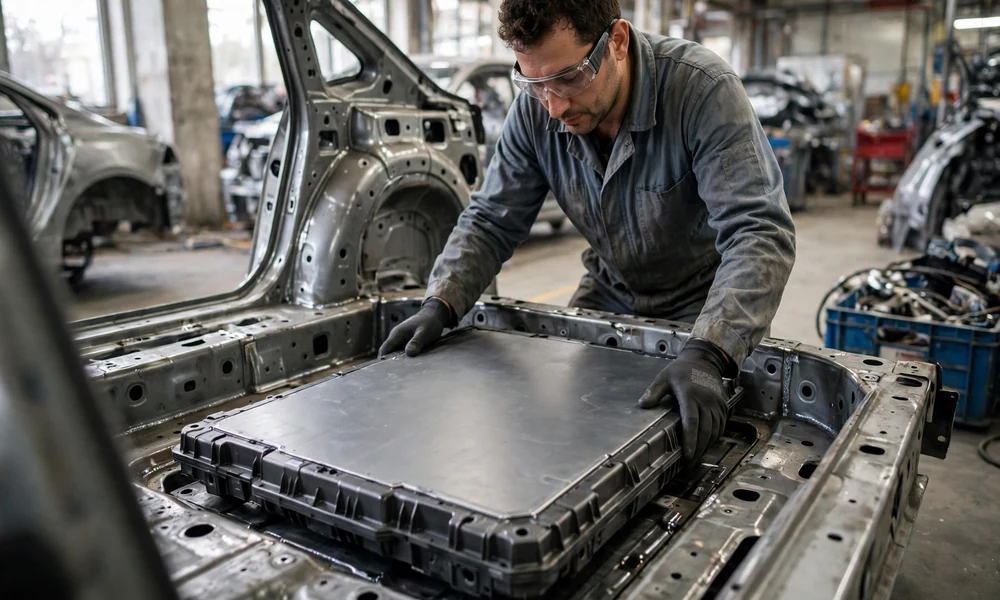
Step 4: Marrying the body to the skateboard
The moment the factory calls the marriage is when the painted body is lowered onto the rolling chassis, the flat skateboard platform that carries the battery, motors, suspension, and steering. The two meet on a lift, and a team of workers guides them together while bolts are torqued in a precise sequence, because a body that is tightened unevenly will creak for the rest of its life. Once joined, the car finally looks like a car, and the wiring looms are connected: hundreds of cables linking the battery to the motors, the motors to the screens, and the screens to the sensors in every corner of the body. A single loose connector here can shut the whole car down, so each one is clicked, pulled, and checked twice.
Step 5: Trimming the cabin
The cabin is where the luxury shows, and it is fitted entirely by hand. Seats are trimmed in leather that has been inspected hide by hide, stitched with thread chosen to match, and fitted over foam shaped to the body. Wood veneers are cut from a single tree so the grain matches from door to dashboard, and metal trim is polished until it reflects without glare. The dashboard carries a wide screen, but the important controls still have real switches, because a luxury car is meant to be operated by touch as well as by sight. Sound-deadening material goes into the doors, the floor, and the roof, and the windows are laminated with an acoustic layer, so that at speed the loudest sound inside is the tyres on the road.
Step 6: Testing, charging, and the first silent drive
Before any customer sees the car, it is put through a gauntlet. The battery is charged to full and discharged on a rolling road, the motors are run at every speed, and the car is driven through a water tunnel to check that every seal holds. Then it goes to a test track, where a driver checks the steering, the brakes, and the way the car settles over bumps, listening for rattles that no machine can hear. The software is loaded last, with the driver-assistance systems calibrated on a flat, marked floor. Finally the car is washed, polished, and charged to eighty percent, the level it is handed over at, and it rolls out of the factory in near silence, the only sound the soft hum of its tyres.
Specifications
| Feature | Typical luxury electric car |
|---|---|
| Battery capacity | 100 to 120 kWh |
| Power | 400 to 750 hp, dual motor |
| Range | 500 to 650 km |
| 0 to 100 km per hour | 3.5 to 4.5 seconds |
| Charging | 10 to 80 percent in about 20 minutes |
| Body | Aluminium shell, flat battery floor |
| Seats | Four or five, leather trimmed |
How Much Does a Luxury Electric Car Cost?
A luxury electric car typically costs an estimated $100,000 to $180,000, depending on the battery size, the power, and the level of cabin finish. A well-equipped model from a mainstream luxury brand sits near the lower end, while a flagship saloon with a larger battery, air suspension, and a fully bespoke interior can reach the top of the range. Running costs are lower than a petrol equivalent, since electricity is cheaper than fuel and the drivetrain has far fewer parts to wear out, but the battery is the reason the purchase price stays high.
A Rare Fact
The first electric cars predate the petrol car by decades, and the earliest luxury electric cars were built for royalty and the very wealthy in the 1890s. The modern luxury electric car is a return to that idea, not a new one, and the luxury electric car on the road today uses the same basic principle as those early machines, a battery driving a motor, refined by a century of engineering. A luxury electric hypercar takes the same recipe to an extreme, while the humble EV battery pack at the heart of every one of them is now built with the same care once reserved for a watch movement.


