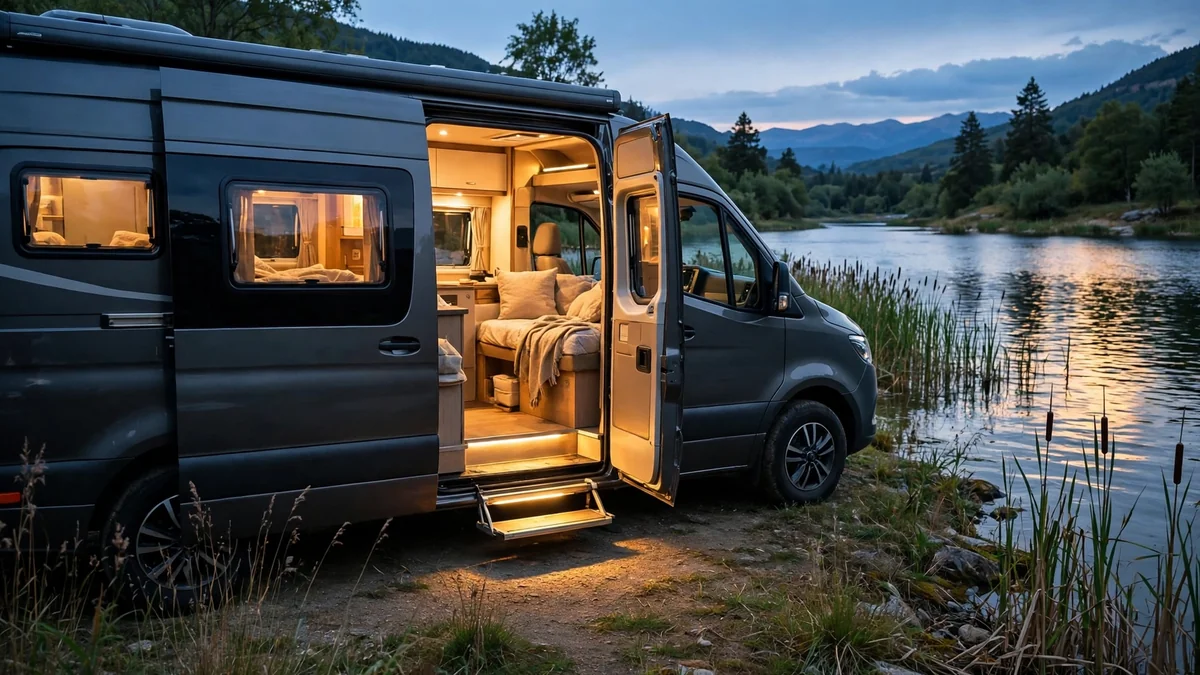
Parked beside a quiet lake at dusk, a camper van looks like it is simply resting. Inside, though, a small power station is quietly working: a battery is feeding the lights, a heater is warming the air, and a pump is keeping water ready at the tap.
A luxury camper van works as a self-contained home, with systems for power, water, heating and cooking that all fit inside a vehicle no bigger than a delivery van. This is how a luxury camper van works, from the battery under the seat to the tap in the kitchen.
Step 1: Power comes from the battery bank
Everything in a luxury camper van runs on electricity, and it starts with the leisure battery bank, usually a set of lithium batteries tucked under a seat or in a floor locker. The batteries are charged in three ways: by the engine alternator while driving, by solar panels on the roof when parked, and by a mains hook-up at a campsite when one is available. A charge controller decides which source to use and protects the batteries from overcharging.
The batteries feed a 12-volt system for the lights, the water pump and the heater fan, and an inverter turns some of that power into mains electricity for the sockets, so a laptop or a kettle can run just as it would at home.
Step 2: Water is stored, pumped and heated
Water is carried in a fresh tank under the floor, usually holding 80 to 120 litres, and a small electric pump pushes it through pipes to the kitchen tap and the shower. The pump only runs when a tap is open, switching itself on and off by pressure, and a filter keeps the water clean.
Hot water comes from a small boiler, heated by gas, diesel or electricity, which warms the tank in minutes. The shower uses a mixer tap like a home bathroom, and the water that comes out is hot enough to be comfortable but never scalding, because a thermostat limits it. The whole water system is described in the same patient detail in the guide to how a luxury camper van is made, where the tanks and pipes are fitted before the furniture closes over them.
Step 3: Heating keeps the van warm through the night
Heating comes from a diesel or gas heater, a small unit hidden in a locker that burns a little fuel and blows warm air through ducts to the living area and the bed. The heater is controlled by a thermostat on the wall, so the van stays at the same temperature all night, and it sips fuel so slowly that a full tank can heat the van for a week.
The van is insulated to keep that heat in, with insulation packed between the steel ribs of the walls and the roof, and a vapour barrier to stop condensation forming on the cold metal.
Step 4: The kitchen, bed and living space work together
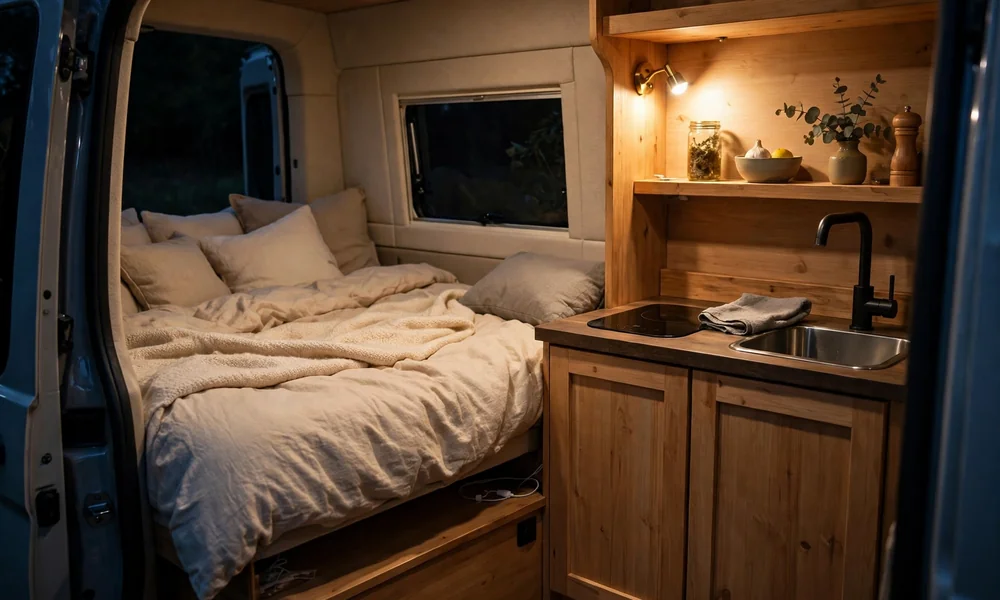
The kitchen is small but complete: a two-burner hob, a sink, a compressor fridge and a worktop that doubles as a table. The fridge runs on the leisure batteries, day and night, and it is the hungriest appliance in the van, so the battery bank is sized with the fridge in mind. The hob runs on gas from a small bottle in a sealed locker, vented to the outside for safety.
The bed is often the cleverest part of the van, folding out from a sofa or sliding together from two benches, with a proper mattress rather than a slab of foam. During the day the same space is a lounge, with seats that face each other across the table, and at night it becomes a bedroom in a few minutes. The same clever use of a small space shows in the guide to how a luxury RV is made, where a bigger vehicle uses the same folding and sliding tricks on a grander scale.

Step 5: Driving, parking and levelling the van
On the road, a luxury camper van drives like a large car, with a turbo diesel engine, power steering and cruise control, though its weight means it brakes and corners more gently than a car.
When the van stops for the night, the driver levels it, either with ramps under the wheels or with small jacks, so the bed is flat and the fridge works properly, since a fridge that leans too far will not cool. The side door opens onto an awning, and a table and chairs come out of a locker, turning a parking spot into a campsite. The bigger cousin of the camper van is described in the guide to how a luxury motorhome is made, where the same parking and levelling routine is done with a vehicle twice the size.
Step 6: Staying off the grid, night after night
A luxury camper van is designed to stay away from campsites for days at a time, and the systems are balanced to make that possible. The solar panels top up the batteries during the day, the water tank lasts two or three days with careful use, and the toilet, usually a small cassette unit, is emptied at a disposal point rather than anywhere near a watercourse.
The owner learns to read the control panel like a fuel gauge, watching the battery level in the evening and deciding whether to run the heater all night or to plug in at a campsite. A van that is used well can spend a week in the wild, and return to civilisation with its batteries full, its tanks empty and its owners ready to do it all again.
The spec sheet at a glance
| Specification | Typical luxury figure |
|---|---|
| Base van | Tall long-wheelbase panel van |
| Length | 5.9 to 6.4 metres |
| Leisure battery | 200 to 400 amp-hours lithium |
| Solar | 200 to 400 watts on the roof |
| Inverter | 2,000 watts, mains sockets |
| Water | 80 to 120 litres fresh tank |
| Heating | Diesel heater, thermostat controlled |
| Kitchen | Two-burner hob, sink, fridge |
| Sleeps | Two adults, four with pop-top |
| Engine | 2.0 litre turbo diesel |
| Off-grid time | Three to seven days |
| Build time | Four to eight weeks |
What it costs, and a rare fact
A luxury camper van costs an estimated $110,000 to $220,000 to buy, depending on the base van, the battery and solar setup, and how much of the interior is hand-built timber. Running it costs far less than a hotel, though, and many owners reckon the van pays for itself in holidays over a few years.
Here is the rare fact the brochure never mentions. A luxury camper van is weighed on a bridge before handover, because the furniture, batteries and water add so much weight that the finished van can be close to its legal limit. If it is even slightly over, the builders have to take weight out, sometimes by swapping solid wood for lighter panels, so the van that leaves the workshop is balanced to the kilogram, a house that has been put on a diet before its first journey.