Stand on the deck at anchor and the yacht feels like a house that happens to float. The air conditioning hums softly, the lights are warm, the water in the shower runs hot, and music drifts from speakers hidden in the ceiling. Nothing moves. Nothing rattles. Below your feet, out of sight, two diesel engines the size of small cars are idling, generators are making electricity, and pumps are moving water, fuel and air through a maze of pipes. The calm on deck is not an accident. It is engineering.
A luxury motor yacht is a small town that must run itself. It carries its own power station, its own water plant, its own waste system and its own navigation, and all of it must work in the middle of the sea, far from any help, in weather that can turn in an hour. The crew runs it from a bridge that looks like the cockpit of an aircraft, and from an engine room that looks like a factory floor.
Most owners never see any of it. They see the saloon, the cabins and the sun deck, and that is exactly how it should be. This is how a luxury motor yacht works, from the engines in the bilge to the anchor on the bow.

How a Luxury Motor Yacht Works
Step 1: The engines turn fuel into motion
The yacht’s power starts in the engine room, where two large diesel engines turn fuel into turning shafts. Each engine is connected to a propeller through a gearbox that lets the crew change speed and direction, and the engines are mounted on steel seatings with rubber mounts that soak up vibration before it reaches the cabins. The engines are cooled by seawater, pumped in through the hull and out again, and their exhaust runs up through the funnel. A yacht’s engines are built to run for days at a time, and they are serviced like the engines of a small ship, because at sea there is no breakdown service. The numbers behind that power are worth a look, as our guide to luxury motor yacht specs, explained shows.
Step 2: Generators make the electricity
While the main engines push the yacht, separate generators make the electricity for everything else. Two or three diesel generators, smaller than the main engines, run in rotation so that one can always be serviced while another carries the load. They feed the lights, the air conditioning, the galley, the navigation equipment and the water makers, and their power is cleaned and steadied so that sensitive electronics never see a spike.
Step 3: Stabilisers keep the deck level
A yacht at sea rolls, and the stabilisers are what stop the rolling. Fins extend from the hull below the waterline, and as the yacht rolls one way, the fins twist the other, pushing the hull back level. At anchor, a different system takes over: gyroscopes spinning inside the hull resist the roll the way a spinning top resists falling over. The result is a deck that stays still enough for a glass of wine to sit unspilled in a gentle sea, and the crew checks the stabilisers before every voyage, because a fin stuck at the wrong angle can fight the helm.
Step 4: The water makers turn sea into fresh water
Fresh water on a yacht comes from the sea itself. A water maker forces seawater through fine membranes at high pressure, leaving the salt behind and producing drinking water, while the brine is pumped back overboard. The system makes hundreds of litres an hour, enough for showers, cooking and laundry, and the water is stored in tanks, tested for taste and purity, and heated by the engines’ waste heat. The same careful building that put the hull together also put these systems in, as our guide to how a luxury motor yacht is made shows.

Step 5: Navigation, radar and the bridge
The yacht is steered from the bridge, where the captain watches radar, charts, depth sounders and satellite positioning on screens that show the sea for miles around. The autopilot holds a course, the radar watches for other vessels in fog, and the depth sounder warns of shallow water. The bridge talks to the engine room through controls that set engine speed and propeller pitch, and to the crew through an internal network.
Step 6: Thrusters, anchors and coming alongside
At slow speed a yacht is hard to steer, so bow and stern thrusters, small propellers set sideways in tunnels through the hull, push the bow and stern sideways to slide the yacht into a berth. The anchor is lowered by a windlass that can lift tonnes of chain, and the chain is marked so the crew knows how much is out. When the yacht is moored, the crew connects to shore power and water, the generators are shut down, and the yacht runs quietly on the marina’s supply. The whole dance of arriving and leaving is practised until it looks effortless, which is the point.
Step 7: Waste, safety and the daily routine
Below deck, the yacht also manages its own waste. Black water is treated and stored, grey water is filtered, and rubbish is sorted and kept until the yacht reaches a port that can take it. Fire detectors, bilge pumps and life rafts are checked daily, and the crew runs drills so that everyone knows what to do if something goes wrong. That daily routine is one reason a yacht costs what it does to keep, as our guide to why a luxury motor yacht is so expensive explains.
Luxury Motor Yacht Specs
| Specification | Typical range |
|---|---|
| Length | About 24 to 50 metres |
| Engines | Two diesels, about 1,000 to 3,000 hp each |
| Top speed | About 18 to 28 knots |
| Generators | Two or three, about 40 to 100 kW each |
| Water maker | About 500 to 2,000 litres per hour |
| Fuel capacity | About 15,000 to 60,000 litres |
| Guests | About 8 to 12, plus crew of 5 to 10 |
| Cruising range | About 2,000 to 4,000 nautical miles |
What Does a Luxury Motor Yacht Cost to Run?
Running a luxury motor yacht is estimated to cost roughly $500,000 to $2 million a year, including crew, fuel, maintenance and berthing, while a single week of cruising is estimated at $50,000 to $200,000 in fuel and supplies alone. A full engine service is estimated at $50,000 to $150,000. Prices are estimates only and vary by size, crew and itinerary.
A Rare Fact
The stabiliser fins on a luxury motor yacht can be as large as a dining table, yet they fold flat against the hull when the yacht is at speed, and extend only when the sea gets rough. Some yachts carry a gyroscope so heavy that it weighs as much as a small car, spinning silently below deck, holding the yacht level while the sea does its worst.
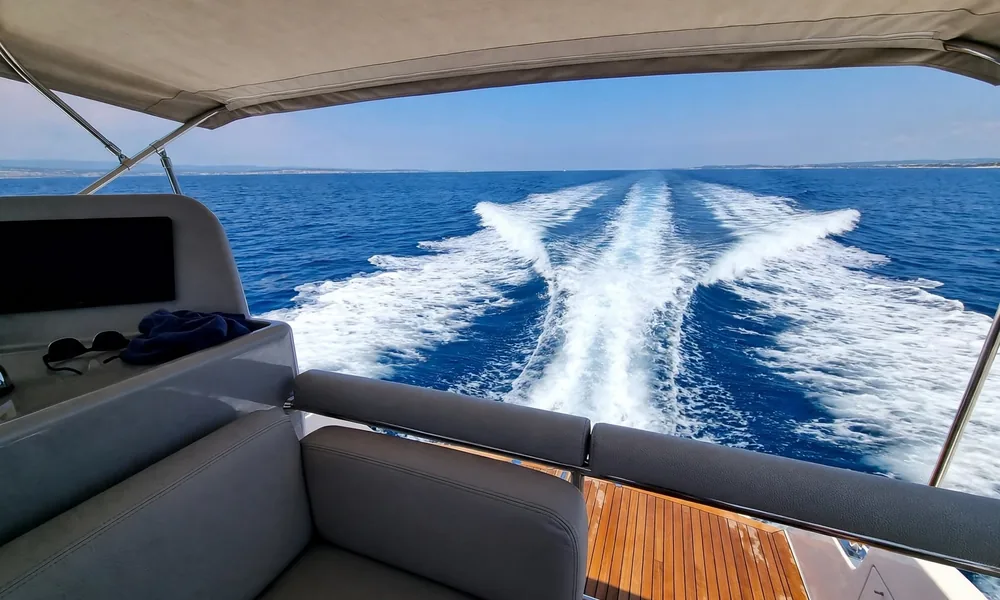
A luxury motor yacht works the way a good hotel works: the guests see the calm, and the machinery stays out of sight. The engines push, the generators light, the stabilisers steady, and the water makers fill the tanks, all while the deck stays still and the coffee stays hot. When the anchor comes up and the yacht turns for open water, the whole small town below deck wakes at once, and the horizon is the only thing left to sail towards.


