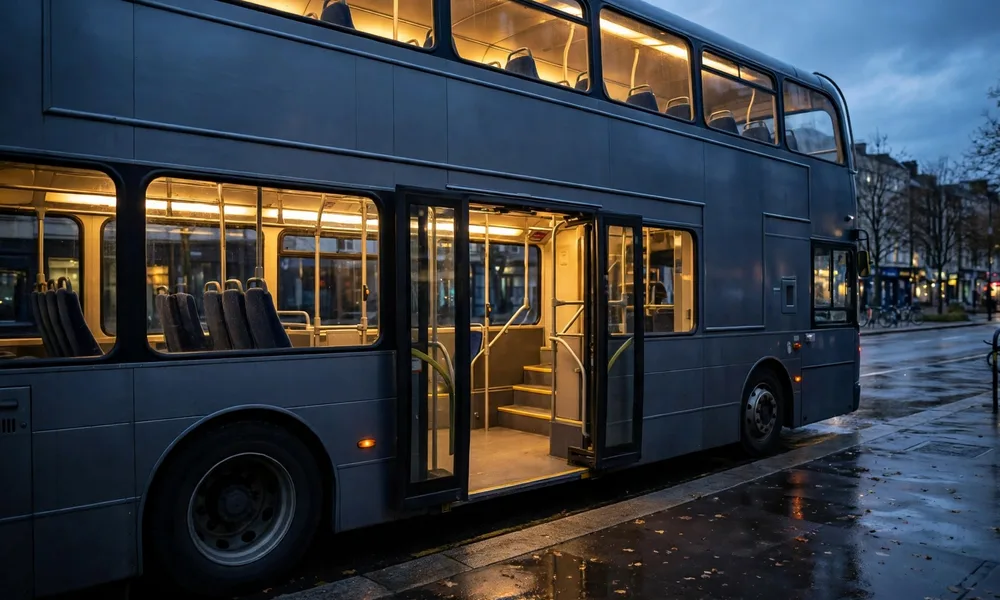
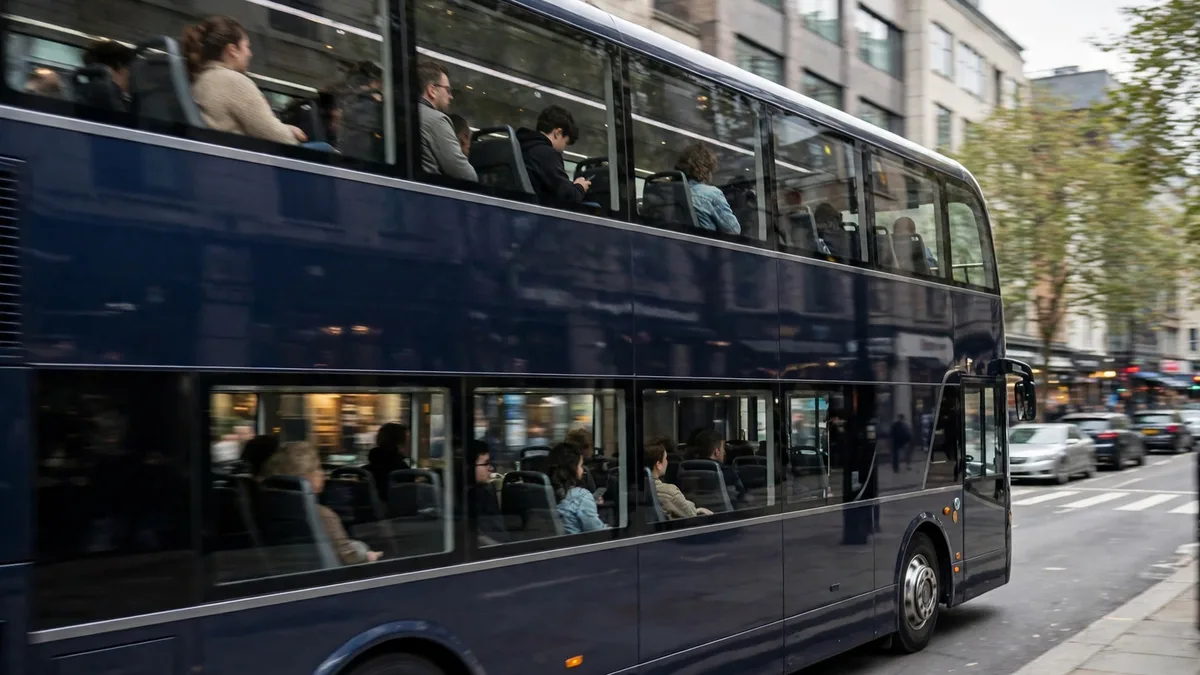
The bus pulls away from the kerb, and upstairs, a passenger settles into a window seat with a view over the whole street: rooftops, shop signs, the tops of trees, a city seen from a height no car can offer. Downstairs, the driver guides twelve metres of bus through traffic built for cars half its length. A luxury double-decker bus is two vehicles in one: a comfortable lounge on top, and a hard-working machine underneath, and the two halves have to agree on every bump, every turn and every stop.
Step 1: Two decks on one strong chassis
A double-decker bus begins with its chassis, a long frame of steel that must carry the weight of two floors of passengers without bending. The frame is built low, so the bus can kneel at the kerb. On top of it sits the body, usually aluminium panels on a steel skeleton, with a staircase in the middle and a floor between the decks that must be strong enough to walk on and light enough not to tip the bus over.
Height is the hard limit. A double-decker must fit under bridges, so most are built to around four and a half metres tall, and every centimetre of that height is planned: the lower deck floor, the upper deck headroom, the roof, and the air conditioning on top. The body is assembled with the frame turned on its side, so workers can reach the upper deck.
Step 2: The engine, and the push from behind
Most double-decker buses are driven from the back, with the engine sitting low at the rear, pushing the bus forward through the rear axle. The engine is usually a large diesel, or increasingly a hybrid or a full electric motor, and it is tuned for torque rather than speed, because a bus spends its life pulling away from stops with a full load. A diesel bus engine can run for a million kilometres.
The gearbox is automatic, with gears chosen by a computer that watches the speed, the load and the hill ahead. Some buses now use electric drive, with a battery under the floor and a motor at the axle, and these are quieter and smoother, though they need charging overnight. A luxury ferry crosses water the same way, as the guide to how a luxury ferry works describes, carrying people in comfort while the machinery works out of sight below.
Step 3: Steering and suspension for twelve metres of bus
Steering a double-decker takes more than a wheel. The front axle turns on a power-assisted system, with hydraulics doing the heavy work, and the steering is geared so the driver can turn the big wheel with one hand. The bus has a turning circle wider than a car, and the driver judges every corner by the mirrors, because the back of the bus swings wide in the opposite direction.
The suspension is air, not steel springs: bags of air under the body that the driver can raise or lower, kneeling the bus at the kerb so passengers step on easily. The air bags also smooth the ride, so the upstairs passengers do not feel every bump in the road. Anti-roll bars keep the tall body level in corners.
Step 4: Doors, stairs and the flow of people
A double-decker bus is a machine for moving people quickly, and the doors are where that happens. Most have two doors, one at the front for boarding and one in the middle for leaving, and the driver opens them with a button. The steps are low and wide, with a yellow edge and a handrail, and the floor by the door is flat, so a wheelchair or a pushchair can roll straight on.
The staircase is the bus’s signature, a narrow flight of steps with a handrail and a low ceiling, built to be climbed while the bus is moving. The steps are fitted with a non-slip surface. The upper deck seats are arranged to give every passenger a window, and the front seats upstairs, right above the driver, are the ones everyone wants, because the view is the best in the bus.
Step 5: Air, light and a comfortable ride
Upstairs and downstairs, the bus has to keep dozens of people comfortable, and that takes a big air conditioning system. The unit sits on the roof, cooling the air and pushing it through ducts along the ceiling, and it must work in summer heat with the doors opening at every stop. The windows are large and tinted, letting in light while keeping out the glare.
The seats themselves are the luxury part: high-backed, padded, with armrests and a little legroom, closer to a coach than a city bus. A limousine carries a few people in the same kind of comfort, as the guide to how a luxury limousine works describes, while the bus carries fifty. The floor is covered in a hard-wearing surface that can be cleaned in minutes at the end of the day.
Step 6: The driver’s cab and the safety systems
The driver sits low at the front, behind a large curved windscreen, with a dashboard built around them: speed, fuel, doors, lights, and a screen showing the cameras that watch the doors and the blind spots. The seat is sprung and adjustable, the steering wheel tilts, and the mirrors are heated, because a driver who cannot see cannot drive safely.
Behind the cab, the safety systems work quietly. The bus has anti-lock brakes, stability control that stops it tipping, and a speed limiter that keeps it inside the law. Some buses brake by themselves if a pedestrian steps out. A minivan carries a family with the same kind of care, as the guide to how a luxury minivan works describes, while the bus carries a whole street. When the day ends, the bus returns to the depot, is fuelled, cleaned and checked, ready for the morning rush.

Specifications
| Detail | Specification |
|---|---|
| Length | Around 11 to 13 metres |
| Height | Around 4.4 metres |
| Passenger capacity | Around 70 to 90 passengers |
| Engine | Diesel, hybrid or full electric |
| Power | Around 250 to 370 horsepower |
| Gearbox | Automatic, 6 speeds |
| Suspension | Air suspension, kneeling function |
| Weight | Around 12 to 18 tonnes |
What it costs
The estimated price of a new luxury double-decker bus is around 500,000 to 1,000,000 dollars, and that figure is an estimate only, because the cost depends on the engine, the interior and the order size. The chassis and the body account for most of the price, followed by the engine and the air conditioning. An electric version costs more to buy but less to run, and a bus company buys them by the dozen, so the price of one bus is only part of a much larger order.
A rare fact
Few people know that the first double-decker buses were pulled by horses, with passengers climbing an open staircase to an upper deck with no roof at all, and they rode in the rain. The motor bus kept the two decks and added a roof, then glass, then heating, and the modern double-decker is the great-grandchild of that horse bus. London’s red double-deckers are the most famous, but the design now runs in cities from Hong Kong to Berlin, carrying millions of people a day, upstairs and down.