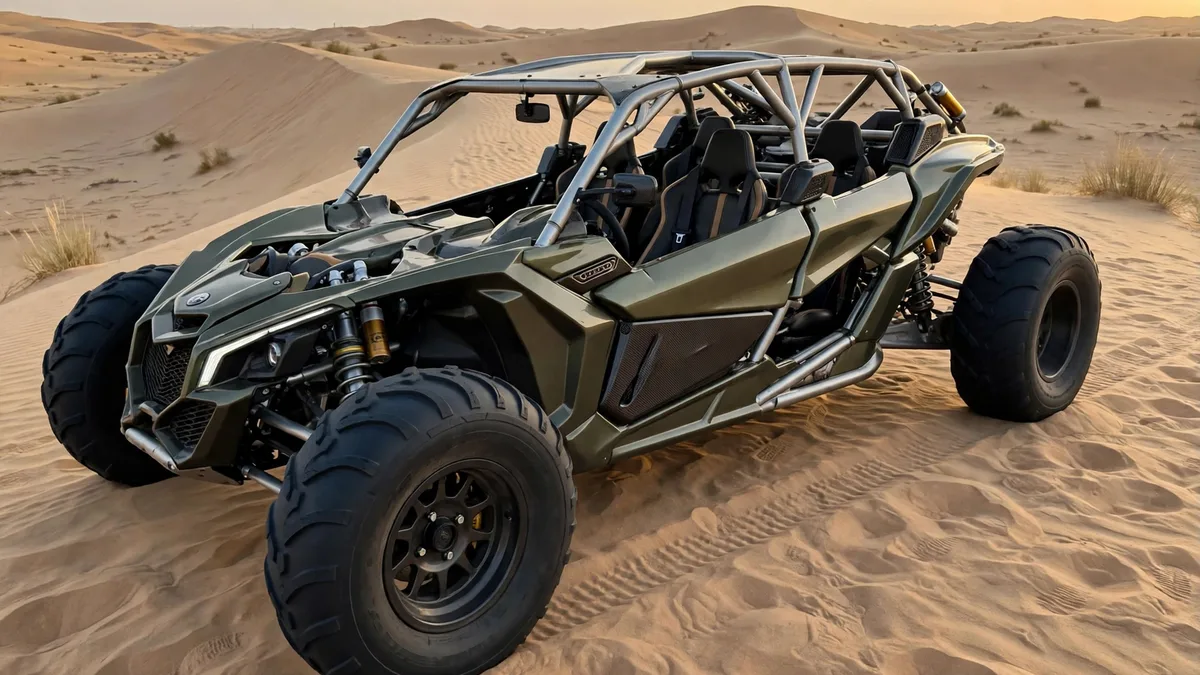
The buggy sits at the bottom of a dune that looks, from here, like a wall. Its tyres are the size of oil drums, its roll cage is bare to the sky, and its engine sits behind the seats, exposed like a dare. The driver turns the key, the flat-four behind him clears its throat, and he does not charge at the dune. He eases forward, the tyres bite, the front lifts a little, and the buggy floats up the face of sand as if the slope were flat.
That lightness is the whole story of how a luxury dune buggy works. It begins with a frame that weighs almost nothing, and it ends with suspension that can swallow a landing from a dune crest at speed. From the tyres to the steering, this is how it all works, system by system, across the sand.
Step 1: The light frame carries everything
Under everything sits a tubular steel or chromoly space frame, welded by hand and triangulated so that every tube carries load. There is no heavy body to hide mistakes, which is why the frame is the single most expensive part of many buggies to build well. It must be stiff enough to keep the suspension geometry honest at speed, yet light enough to keep the whole machine at 650 to 950 kilograms dry, roughly the weight of a small car with the power of a sports car.
That weight is the buggy’s whole argument. At under a tonne, it carries 250 to 450 horsepower in the body of a go-kart, a power-to-weight figure of 300 to 550 horsepower per tonne. On sand, weight is everything: the lighter the machine, the less it sinks, and the less it sinks, the less power it wastes dragging itself out of its own ruts. The numbers behind all of this, weight, power, suspension travel and tyres, are decoded in the guide to luxury dune buggy specs, explained, where each figure on the sheet is given its meaning.
Step 2: The rear engine pushes where the grip is
Most luxury buggies use a turbocharged petrol engine mounted behind the seats, where its weight sits over the driven wheels for traction. Outputs of 250 to 450 horsepower are normal, and some builders offer more than 500 in limited runs. But the headline number is less important than the torque curve. Sand driving is a constant negotiation between grip and wheelspin, and an engine that delivers its torque smoothly from low revs lets the driver feather the throttle across a dune crest instead of spinning the tyres into a hole.
Step 3: The long-travel suspension swallows the desert
Each wheel moves on long arms that keep the tyre flat on the ground even when the buggy is leaning hard, and the whole system is built to take punishment that would bend an ordinary car’s suspension in minutes. The finest builders will tell you they spend more time on dampers than on engines, because a dune is not a drag strip: the crest of a tall dune can hide a drop of ten metres or more, and the buggy that lands cleanly and keeps its momentum is the one that wins. The same obsession with chassis engineering shows up in the toughest road machines, and it is set out in the guide to how a luxury off-roader works, where the same question is answered with weight instead of lightness.

Step 4: The paddle tyres bite the sand
The tyres are the buggy’s contact patch with a surface that is always moving. Paddle tyres, with scoops moulded across the tread, bite into soft sand and throw it backwards like a paddle wheel, giving drive where a normal tread would spin. All-terrain tyres trade some of that bite for the ability to cross rock and hard-packed tracks between dunes. Most luxury buggies run 33 to 37 inches of tyre, and owners often carry two sets, paddles for the dunes and all-terrains for everything else.
Step 5: Steering, brakes and staying in control
Steering a buggy on sand is a different skill from steering on tarmac. The front tyres are narrower than the rears, so they steer without ploughing, and the steering is quick and light, built to catch a slide before it becomes a spin. The driver steers with the throttle as much as with the wheel: a touch more power swings the back out, a lift tucks it back in, and the buggy dances across the dune face in a way no road car ever could.
The brakes are discs on all four wheels, sized for a machine that weighs under a tonne and rarely needs to stop in a hurry, because on sand the drag of the tyres does half the work. The handbrake is a proper lever, not a button, because a driver who has parked on a dune face wants to know it will hold. The closest cousin in the rough stuff is the quad bike, and its way of working is set out in the guide to how a luxury ATV works, where four small wheels and a light frame answer the same question at a smaller scale.
Step 6: The cockpit, the cage and the end of the day
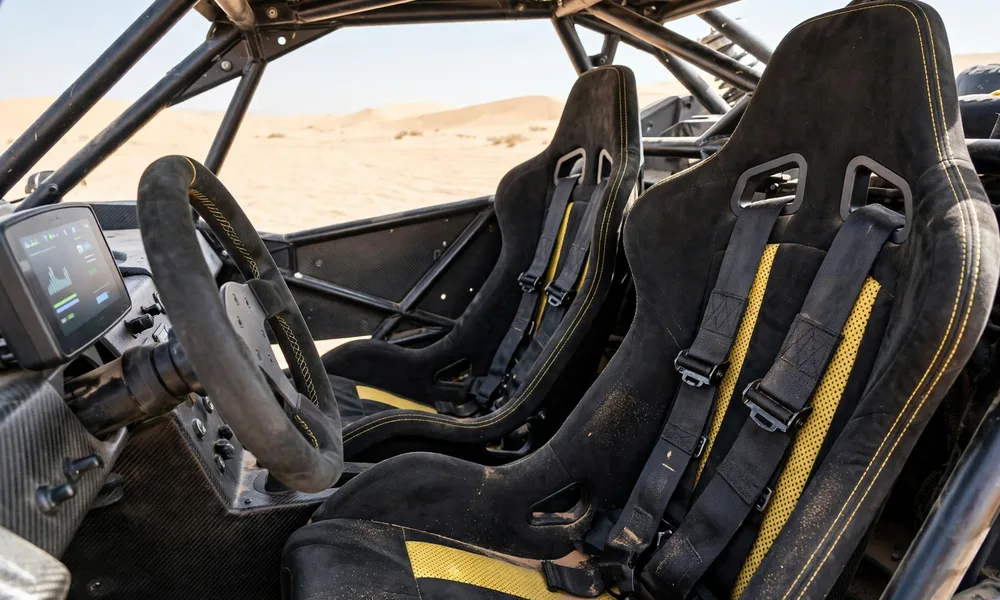
Inside, the spec sheet turns to survival. Four- or five-point harnesses, a full roll cage, and racing seats with head restraints are standard, not options. The cage is designed to protect the occupants if the buggy rolls down a dune, a real risk when a crest hides a steep far side.
At a glance
| System | What it does | Why it matters |
|---|---|---|
| Frame | Tubular steel space frame, 650 to 950 kg | Light enough to float on sand |
| Engine | Turbo petrol, 250 to 450 horsepower, rear-mounted | Weight over the driven wheels for grip |
| Suspension | 400 to 550 mm travel, coil-overs | Swallows landings from dune crests |
| Tyres | 33 to 37 inch paddle or all-terrain | Bite the sand instead of spinning in it |
| Steering | Quick, light, throttle-steered | Catches a slide before it becomes a spin |
| Safety | Roll cage, harnesses, fire suppression | A roll down a dune is survivable |
A luxury dune buggy typically costs an estimated $120,000 to $350,000, with bespoke, hand-built machines climbing past that. The money goes mostly into the frame, the suspension and the engine, the three systems that decide whether the buggy is fast or merely loud. A cheap buggy with a big engine is a common mistake; a good buggy with a modest engine will outrun it across real dunes all day.
A rare fact: the fastest dune buggies in the world are rarely the most powerful ones. At the great desert races, the winning machines are usually the lightest and the best suspended, because a dune is not a drag strip. The crest of a tall dune can hide a drop of ten metres or more, and the buggy that lands cleanly, keeps its momentum and climbs the next face without stopping is the one that wins. Power only helps if the chassis can use it, which is why the finest builders spend more time on dampers than on engines.
So the next time a buggy floats up a dune face that looks like a wall, remember what is happening underneath: a light frame, a rear engine pushing where the grip is, suspension swallowing the ground, and paddle tyres throwing sand backwards. A luxury dune buggy is not a car that happens to go off road.


