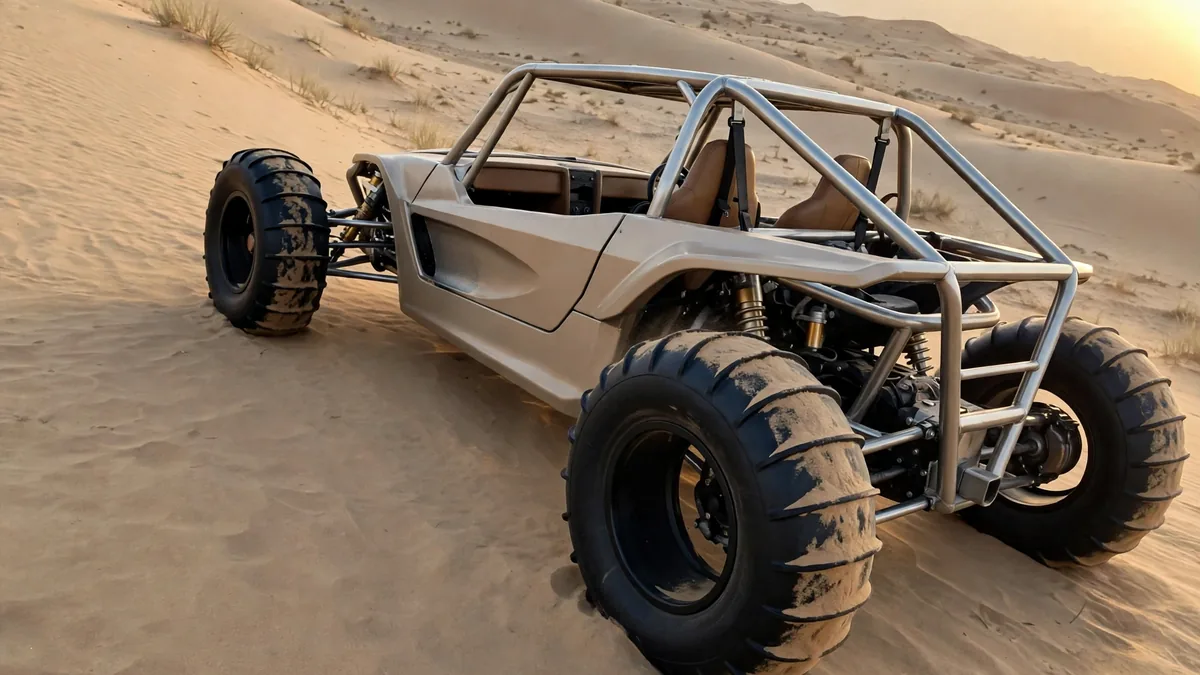
The first thing you notice about a luxury dune buggy is how wrong it looks standing still. It sits low and wide on tyres the size of oil drums, its roll cage bare to the sky, its engine exposed like a dare. Parked on a showroom floor it looks unfinished, almost crude. Then the driver turns the key, the flat-four or turbocharged V6 behind the seats clears its throat, and the whole machine seems to lean forward, impatient. A dune buggy is not a car that happens to go off road. It is a machine built around a single idea: that sand, taken at speed, is the purest playground a driver can buy.
The original buggies of the 1960s were jokes that got serious — cut-down Volkswagen Beetles with fibreglass tubs, built in garages for beach weekends. The luxury versions of today keep the spirit but none of the improvisation. A modern luxury dune buggy is engineered from a blank sheet, tested in deserts from Dubai to Baja, and priced like a sports car. Its spec sheet reads like a contradiction: featherweight construction, huge suspension travel, and an engine powerful enough to climb a dune face that looks, from the bottom, like a wall.
Understanding those numbers is the key to understanding the machine. A dune buggy is not judged by top speed or leather trim. It is judged by how it behaves when the ground disappears beneath it.
The numbers that matter
Before the details, here is the shape of a typical high-end luxury dune buggy — the figures a buyer actually compares before signing anything.
| Specification | Typical luxury figure |
|---|---|
| Engine | 2.0–3.5 litre turbocharged petrol, 250–450 hp |
| Weight | 650–950 kg dry |
| Power-to-weight | 300–550 hp per tonne |
| Drive | Rear-wheel or four-wheel drive |
| Suspension travel | 400–550 mm front and rear |
| Ground clearance | 350–450 mm |
| Tyres | 33–37 inch paddle or all-terrain |
| Fuel capacity | 60–120 litres |
| Top speed | 160–200 km/h on sand |
| Price | Estimate: $120,000–$350,000 |
The figure that does the most work is the weight. At under a tonne, a luxury buggy carries roughly the power of a sports car in the body of a go-kart. That is why it can float across soft sand where a two-tonne SUV would dig itself in within seconds. Flotation is everything in the dunes: the lighter the machine, the less it sinks, and the less it sinks, the less power it wastes dragging itself out of its own ruts.
Engine: power you can actually use
Most luxury buggies use a turbocharged petrol engine mounted behind the seats, where its weight sits over the driven wheels for traction. Outputs of 250 to 450 horsepower are normal, and some builders offer more than 500 in limited runs. But the headline number is less important than the torque curve. Sand driving is a constant negotiation between grip and wheelspin, and an engine that delivers its torque smoothly from low revs lets the driver feather the throttle across a dune crest instead of spinning the tyres into a hole.
Chassis and suspension: the real engineering
The chassis is a tubular steel or chromoly space frame, welded by hand and triangulated so that every tube carries load. There is no heavy monocoque body to hide mistakes, which is why the frame is the single most expensive part of many buggies to build well. It must be stiff enough to keep the suspension geometry honest at speed, yet light enough to keep the whole machine under a tonne.
Suspension travel of 400 to 550 millimetres is what separates a luxury buggy from a dressed-up golf cart. Long-travel coil-over dampers, often with remote reservoirs and three-way adjustment, let each wheel follow the ground independently as the buggy crosses whoops and dune ridges at 100 km/h. The dampers are tuned for sand: soft on compression to absorb a landing from a dune crest, firm on rebound to stop the buggy bouncing itself into the air again.
That obsession with chassis engineering is shared with the biggest luxury SUVs, though the solutions are opposite: where a luxury SUV is made to carry weight in comfort, a buggy is made to shed it. The two machines start from the same question — how do you move people across rough ground in comfort — and answer it from opposite ends.

Tyres, steering and brakes
The tyres are the buggy’s contact patch with a surface that is always moving. Paddle tyres, with scoops moulded across the tread, bite into soft sand and throw it backwards like a paddle wheel, giving drive where a normal tread would spin. All-terrain tyres trade some of that bite for the ability to cross rock and hard-packed tracks between dunes. Most luxury buggies run 33 to 37 inches of tyre, and owners often carry two sets — paddles for the dunes, all-terrains for everything else.
Cockpit and safety
Inside, the spec sheet turns to survival. Four- or five-point harnesses, a full roll cage, and racing seats with head restraints are standard, not options. The cage is designed to protect the occupants if the buggy rolls down a dune — a real risk when a crest hides a steep far side. Fire suppression systems, fuel cells instead of plain tanks, and battery cut-off switches are common on the best builds.
Comfort has caught up with safety. Heated and ventilated seats, a small windscreen, a sound system that can be heard over the engine, and even air conditioning appear on the most luxurious builds. The dashboard is usually a single digital display showing speed, revs, temperatures, tyre pressures and a GPS map of the dunes. It is a sparse cockpit, but everything in it earns its place. The same philosophy — every gram justified — shows up in the tiniest luxury machines too, and the luxury golf cart’s spec sheet reads like a miniature version of this one.

Price: what the money buys
Prices for a luxury dune buggy start at an estimate of around $120,000 for a well-built production model and climb past an estimate of $350,000 for a bespoke, hand-built machine with a larger engine, long-travel suspension and a full luxury interior. The money goes mostly into the frame, the suspension and the engine — the three systems that decide whether the buggy is fast or merely loud. A cheap buggy with a big engine is a common mistake; a good buggy with a modest engine will outrun it across real dunes all day.
A rare fact
Here is something the spec sheet never mentions: the fastest dune buggies in the world are rarely the most powerful ones. At the great desert races, the winning machines are usually the lightest and the best suspended, because a dune is not a drag strip. The crest of a tall dune can hide a drop of ten metres or more, and the buggy that lands cleanly, keeps its momentum and climbs the next face without stopping is the one that wins. Power only helps if the chassis can use it, which is why the finest builders will tell you they spend more time on dampers than on engines.
A luxury dune buggy, read properly, is a lesson in priorities. Weight before power, suspension before speed, and a frame that can take a landing before any of it. The numbers are not decoration. They are the machine’s argument for itself, and they explain why a vehicle that looks unfinished standing still is one of the most complete driving experiences money can buy. Like the luxury coupe’s specifications, the buggy’s figures only make sense when you know what they are for.


