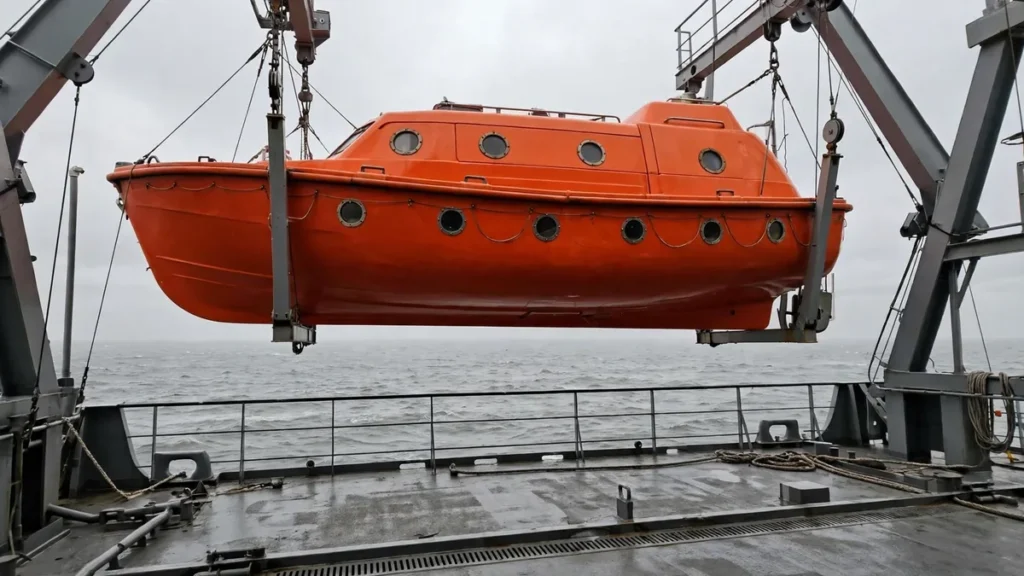
On the side of a superyacht, tucked under a white cover and held by two steel arms, hangs a small orange boat that nobody on board ever wants to use. A guest walking the deck stopped beside it one morning and read the little plate screwed to its side: six metres, thirty people, forty horsepower, six knots, twenty-four hours.
That plate is the spec sheet, and on a luxury lifeboat it is the only description that matters, because the boat is built for one day, the worst day a yacht can have. This guide explains each figure in plain words.

The spec sheet at a glance
| Specification | Typical luxury figure | What it tells you |
|---|---|---|
| Length | 5–9 metres | How long the boat is, and how many it carries |
| Capacity | 20–50 people | How many guests and crew it must hold |
| Hull material | Glass-reinforced plastic, foam buoyancy | Why it floats even when it is full of water |
| Engine | Compact diesel, 25–50 hp | What pushes it, and how reliably it starts |
| Speed | Around 6 knots | How fast it moves away from danger |
| Range | At least 24 hours at slow speed | How long it can keep going until rescue |
| Self-righting | Yes | Whether it comes back upright after capsizing |
| Launch | Davit and winch, single-lever release | How fast it gets into the water |
| Weight | 2–5 tonnes | How heavy it is, and what the davits must hold |
| Equipment | Flares, radio, water, rations | What keeps people alive until rescue arrives |
Length and capacity: sized for everyone on board
Length, usually five to nine metres, decides the capacity, and the capacity is the number the whole boat is built around. A luxury yacht’s lifeboat is sized for every person on board, guests and crew together, with a little room to spare, The hull is moulded from glass-reinforced plastic, laid up in layers in a female mould, with foam buoyancy built into the walls and under the floor, so the boat floats high even if it is swamped. The way that hull is shaped, fitted and tested is set out in how a luxury lifeboat is made, where the orange paint, the seats and the davits are all decided by the question of what happens when everything else has gone wrong.
Engine: small, simple and certain to start
The engine is a compact diesel of twenty-five to fifty horsepower, bolted low in the centre of the hull, where its weight helps the boat right itself if it capsizes. It is a simple, rugged unit, chosen not for speed but because it will start after months of sitting still, and it drives a single propeller through a shaft protected by a skeg, so a floating rope or a piece of wreckage is less likely to stop it.
Speed and range: slow, and long enough
Speed, around six knots, sounds slow, and it is, because a lifeboat is not built to outrun anything. The range is at least twenty-four hours at slow speed, and the engine is run until the fuel is gone during testing to prove it.
Self-righting: the number that is a yes or a no
Self-righting is the only figure on the sheet that is not a number at all, just a yes, and it is the most important one. The hull has a low centre of gravity and a rounded top, so if a wave rolls it over, it comes back upright on its own, a trick that depends on the weight of the engine and the buoyancy foam being placed exactly right. The same insistence on a boat that works when everything has gone wrong shapes the lifeboats on the biggest ships too, as the guide to how a cruise ship lifeboat is made shows, where the same self-righting hull is built at a far larger scale.
Launch: the davits, the hooks and the seconds that count
Launch is described on the sheet as a davit and winch with a single-lever release, and those few words hide the most carefully engineered part of the whole system. The release gear is the clever part: a single lever frees both hooks at once, so the boat drops evenly instead of tipping, and it is designed so it cannot be tripped by accident while the boat is still hanging. The way a full ship’s lifeboats are launched and handled is set out in how cruise ship lifeboats work, where the same race against the clock is run with far more people and far heavier boats.
Weight and equipment: what the davits hold, and what the boat carries
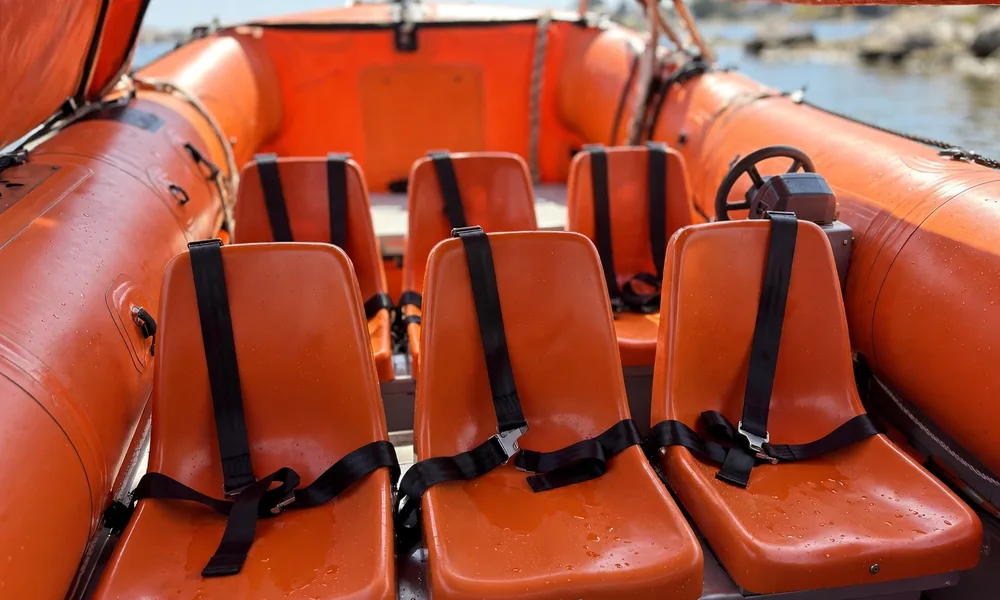
Weight, usually two to five tonnes, decides what the davits must hold and how the yacht’s structure is built around them. The boat is heavy because it is solid: a thick moulded hull, foam buoyancy, a diesel engine, steel davits and a full load of equipment. That equipment is the last line on the sheet, and it reads like a small survival station: flares and a smoke signal for attracting attention, a radar reflector so ships can see the boat, a first aid kit, drinking water and emergency rations, a bailer and a sea anchor, and a handheld radio with a spare battery. The canopy overhead keeps out spray and rain, and small windows let the coxswain see ahead. None of it is comfortable, and none of it is meant to be.
What it costs
The estimated price of a new luxury lifeboat, with its davits and release gear, is around $80,000 to $250,000, and that figure is an estimate only, because the cost depends on the capacity, the engine and the launch system. The hull and the davits account for most of the price, followed by the engine and the survival equipment. A yacht carries at least two, so the real cost of the lifeboat fit is usually double the price of one boat.

A rare fact
Few people know that some luxury lifeboats are fitted with a sprinkler system that sprays water over their own hull. It sounds like a strange thing to fit to a boat, until you picture the moment it is for: a yacht on fire, with burning fuel spreading across the water around it, and the lifeboat having to pass through the flames to get clear. The sprinklers draw seawater and spray it over the canopy and the hull, keeping the outside cool and the flames from catching hold, while the people inside sit under a curtain of water.
So the next time you walk past an orange boat hanging on the side of a yacht, read the plate on its side like a list of promises, and check the promises that matter: the capacity against the people on board, the yes after self-righting, the single lever on the release, and the twenty-four hours behind the range. A luxury lifeboat is built for one day, and its spec sheet, read properly, is the closest thing to an honest description it will ever give you.