A luxury electric catamaran does not look like a normal yacht when it is being built. In the yard you see two long, slim hulls standing apart, with a wide open gap between them where the bridge deck will go. It looks more like a bridge waiting for its road than a boat waiting for its cabins.
That gap is the whole idea. Two hulls give the boat stability without a heavy keel, and the wide deck between them gives the owner more living space than a single-hull yacht of the same length. Building it means joining two hulls, a deck, and an electric drive into one quiet machine. This is how a luxury electric catamaran is made.

Step 1: Two hulls from the mould
The build starts with the two hulls, and they are made as a matching pair. Each hull is laid up in its own mould from carbon fibre and foam core, with extra reinforcement where the crossbeams will join. The yard builds them side by side so the laminators can keep the weight and thickness identical, because a catamaran with one hull heavier than the other will sit crooked in the water.
Once cured, the hulls are lifted from their moulds and checked for fairness, the smoothness of the curve that decides how cleanly the boat moves. The hulls are narrow by design, which keeps drag low, but that also means there is little room inside them, so most of the living space will sit above, on the bridge deck.
Step 2: The crossbeams and bridge deck
With the hulls ready, the yard joins them with crossbeams, the structural heart of any catamaran. The beams are bonded and bolted into reinforced sockets in each hull, and they carry the loads that try to twist the two hulls in opposite directions in a seaway. Getting this joint right is the most demanding structural job in the whole build, and the yard tests it with load cells before the deck goes on.
The bridge deck is then lowered onto the beams, spanning the gap between the hulls. It holds the saloon, the galley, and the main living area, and it is built high enough that waves can pass underneath without slamming into it. What a luxury expedition catamaran is describes the same twin-hull layout on a boat built for remote waters, and the structure here is the same idea, finished to a higher standard.
Step 3: Electric motors and battery rooms
Each hull gets its own electric motor, usually mounted near the stern and driving a propeller or a saildrive leg. Twin motors give the catamaran its famous manoeuvrability: run one forward and one in reverse and the boat turns almost in its own length, which makes docking in a crowded marina far easier than on a single-engine yacht.
The batteries are split between the two hulls to keep the weight balanced. Lithium modules sit low in each hull, in sealed compartments with cooling and fire protection, and they are wired together through the crossbeams. The yard tests the insulation of every cable that crosses from one hull to the other, because a fault in that run is hard to reach once the interior is fitted.
Step 4: Charging, solar, and the power system
A luxury electric catamaran gathers power from several sources, and the yard wires them all into one system. Shore power charges the batteries in a marina, and many owners add solar panels across the hard-top roof of the saloon, where the wide deck gives room for a large array. Some builds add small hydrogenerators on the propellers, which make power while the boat sails.
The power system is managed from a single display at the helm. It shows the charge in each battery bank, the power coming in from the panels, and the range left at the current speed. The crew learns to read it the way a diesel skipper reads a fuel gauge. The best electric catamaran brands, ranked compares the builders who offer this kind of system, and the differences between them often come down to how well the power management is integrated.
Step 5: The luxury interior goes in
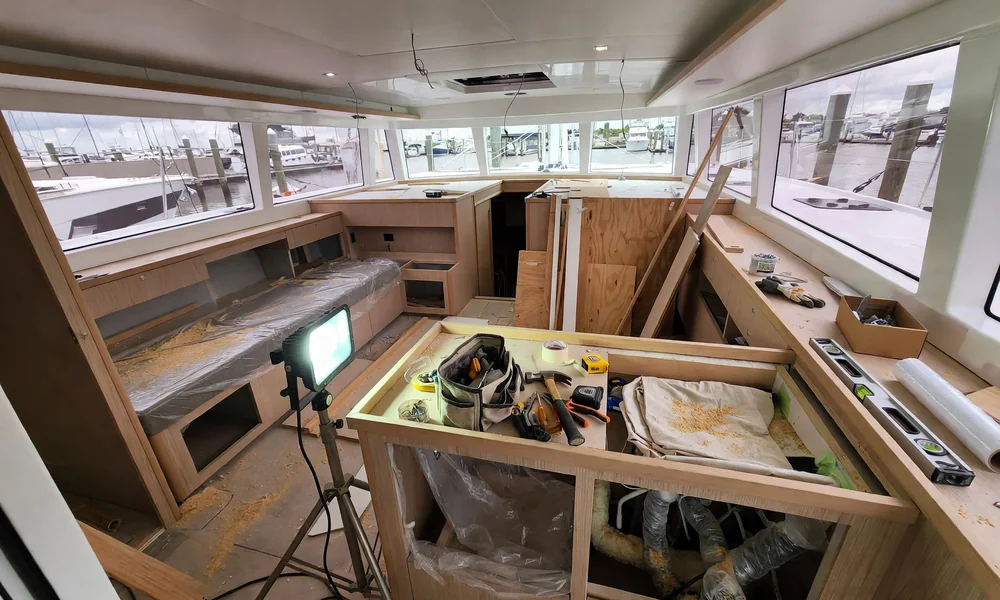
Once the structure and the drive are complete, the interior is fitted across the bridge deck. The saloon is wide and bright, with panoramic windows and a galley that opens onto the cockpit, so the inside and outside feel like one space. Cabins sit in the two hulls below, each with its own bathroom, and the joinery is light wood and pale fabric to keep the weight down.
The cockpit is fitted as the outdoor living room, with a dining table, sun pads, and a davit for the tender on the aft beam.
Step 6: Launch, sea trials, and handover
Launching a catamaran is a wide-load operation. The boat is lifted by a travel hoist that spans both hulls, carried to the water, and lowered in gently. The crew checks the waterline at once: the boat should sit level, with both hulls drawing the same depth, and any list is corrected by moving ballast or equipment before the trials begin.
The sea trials test everything the yard built. The engineers run the boat at cruising speed and at full power, record the energy use, and check the range on a single charge. They test the twin-motor turning, the charging from shore power, and the solar input on a sunny day. Only when the numbers match the design, and the owner has walked every cabin, does the yard hand the boat over. Why a luxury electric catamaran is so expensive shows where the money goes, from the twin carbon hulls to the battery banks and the wide bridge-deck interior.
Specifications
| Detail | Specification |
|---|---|
| Length | Around 16 to 20 metres |
| Beam | Around 8 to 10 metres |
| Battery bank | Around 150 to 300 kilowatt-hours |
| Electric motors | Two motors, around 50 kilowatts each |
| Cruising speed | Around 7 to 9 knots on electric power |
| Range on battery | Around 30 to 60 nautical miles |
| Guests | Around 8 guests and 2 crew |
| Hull material | Carbon fibre with foam core |
Price
The estimated price of a new luxury electric catamaran is around 3 million dollars, and that figure is an estimate only, because the cost depends on length, battery size, and the standard of the interior. The twin hulls and the crossbeam structure account for a large share, followed by the batteries, the motors, and the wide bridge-deck fit-out. A buyer is paying for a stable, spacious yacht that moves in near silence and can anchor for days without running an engine.
A rare fact
Few people know that a catamaran can be steered without a rudder at all. Because it has a motor in each hull, the crew can turn the boat by running the two motors at different speeds, or even in opposite directions. In a tight marina berth, that twin-motor control can be more useful than the rudder itself.
When the trials end and the catamaran motors away from the yard, it leaves behind almost no sound and no smell, just two slim wakes trailing from the twin hulls. That quiet departure is what the whole build was for, and it is why a luxury electric catamaran is made the way it is.


