A luxury expedition catamaran is a twin-hulled yacht built to reach places other yachts cannot, in the kind of comfort that makes the journey itself the point. It has the wide, stable platform of a catamaran, the range and self-sufficiency of an expedition vessel, and an interior finished to the standard of a high-end hotel. It is a boat for crossing oceans to remote islands, anchoring off uninhabited coastlines, and staying out for weeks without needing a marina.
The word expedition does a lot of work in that description. An ordinary luxury catamaran is built for warm, sheltered water: the Mediterranean in summer, the Caribbean in winter, a marina never far away. An expedition catamaran is built for the places beyond that map, with a stronger hull, bigger fuel and water tanks, redundant systems and the equipment to explore once it arrives.

Why two hulls
The catamaran layout is the foundation of the whole idea. Two narrow hulls, joined by a broad bridge deck, give the boat a wide beam and a level deck that a single-hull yacht cannot match. The boat does not heel over in the wind the way a monohull does, so the saloon stays flat, the cabins stay comfortable, and guests can walk around freely even in a seaway. For an expedition, that stability matters twice over: it makes long passages bearable, and it makes working on deck, launching tenders and handling dive gear, far safer.
What a luxury sail catamaran is covers the sailing side of the twin-hull family, where wind power does most of the work and the emphasis is on space and comfort in sheltered cruising grounds.
What makes it an expedition vessel
Expedition capability starts with the hull. The hulls are built heavier than a standard cruising catamaran, with thicker laminates, reinforced bows for pushing through floating debris, and protection around the propellers and rudders. The boat is designed to take a grounding on a sandbank or a bump from a log without serious damage, because in remote water there is no boatyard to call.
Then comes range: far more fuel and fresh water than a coastal cruiser, often enough for a thousand miles or more under power, plus a desalination unit, a large generator and a solar array to make its own water and power. Key systems are doubled, two engines, two generators, two water makers, so that a single failure never ends the trip.
Power, sails or both
Expedition catamarans come in three kinds. Sailing versions carry a full rig and use the wind for long passages, with engines for harbours and calm days. Power versions have no sails at all, relying on large, efficient diesel engines and a hull shape tuned for economical cruising at eight to ten knots. Hybrid versions, the fastest growing group, combine a sailing rig with electric propulsion, batteries and a generator, letting the boat motor silently for short stretches and sail when the wind allows.
What a hybrid electric yacht is explains the hybrid approach in detail, and much of it applies directly to catamarans, where the space between the hulls leaves room for large battery banks a monohull could never fit.

Life aboard
Inside, an expedition catamaran is laid out like a small hotel, but one where every space earns its keep. The bridge deck holds the saloon, the dining area and the galley in one open space, with panoramic windows on three sides. The cabins sit in the hulls, usually four large guest cabins with en-suite bathrooms, plus crew quarters forward. The flybridge, the open deck above the saloon, is the outdoor living room, with seating, a barbecue and the best view on the boat.
The luxury is in the details rather than the scale. Good mattresses, proper showers with real water pressure, air conditioning that works in the tropics, a galley that lets a chef cook properly, and sound insulation that keeps the engines a distant hum. The boat is built to be lived on for weeks, so storage is generous, the lighting is warm, and there is somewhere quiet to sit alone.
The exploration kit
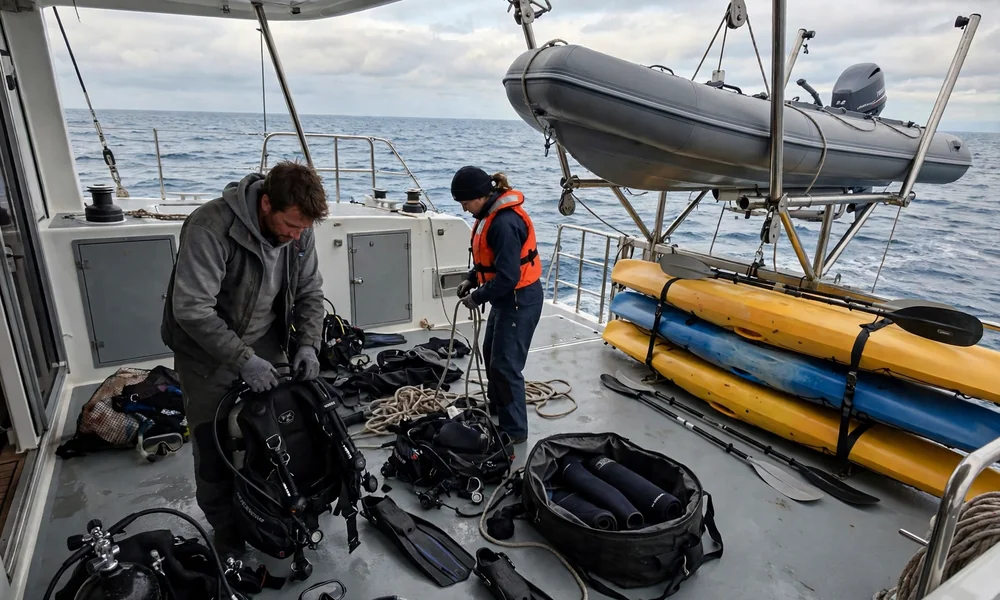
What separates an expedition catamaran from a large cruising catamaran is the equipment it carries. A powerful tender, often a rigid inflatable with a substantial outboard, is the boat’s real transport once anchored: it ferries guests ashore, scouts anchorages and tows water toys. Dive compressors and racks for scuba tanks are common, as are kayaks, paddleboards and fishing gear, all stored on the aft deck or in a dedicated locker.
Some carry more serious kit: a small submarine or remotely operated vehicle for looking at reefs, a crane for heavier tenders, or a helipad on the flybridge. The through-line is the same: the catamaran is not the destination, it is the base from which the destination is explored.
Catamaran or expedition yacht?
The obvious comparison is with the expedition yacht, the single-hull version of the same idea. What a luxury expedition yacht is describes a long-range monohull built for remote cruising, and the two boats share the same mission. The catamaran’s advantages are space, stability and shallow draught: more deck area per metre of length, a level ride, and the ability to anchor close in. The monohull’s advantages are seakeeping in heavy weather, where a single deep hull can be more comfortable in a big ocean swell, and a simpler structure that some owners trust more far from help.
Cost is the other difference. A catamaran of a given length is generally more expensive to build than a monohull, because it is effectively two boats joined together, and it costs more to berth, since marinas charge by beam. In remote water, where the boat anchors rather than berths, that cost matters less, and the extra space matters more. Owners who plan to spend their time at anchor in warm, remote places tend to choose the catamaran. Owners who plan long ocean passages in heavy weather tend to choose the monohull.
Who buys one, and why
Expedition catamarans are bought by people who have already owned a cruising yacht and found its limits, or by owners who want to explore without the scale and crew of a superyacht. A typical owner is someone who has cruised the Mediterranean and the Caribbean and now wants the Pacific islands, the coast of Patagonia, or the fjords of Norway. They want to go further, stay longer, and bring the comfort with them.
The running costs are substantial but modest beside a superyacht: a small professional crew, fuel, insurance and maintenance on a complex vessel. Many owners charter the boat out for part of the year, and the expedition market is strong, because a catamaran that can reach a remote reef with a dive compressor aboard offers a holiday no resort can match.
A luxury expedition catamaran, then, is a compromise made to disappear. It takes the space and stability of a catamaran, the range and toughness of an expedition ship, and the comfort of a good hotel, and it puts them together in a boat that can anchor off a beach nobody else can reach. The luxury is not the marble or the teak. It is the freedom to choose the map, point at the empty part of it, and go there in comfort.


