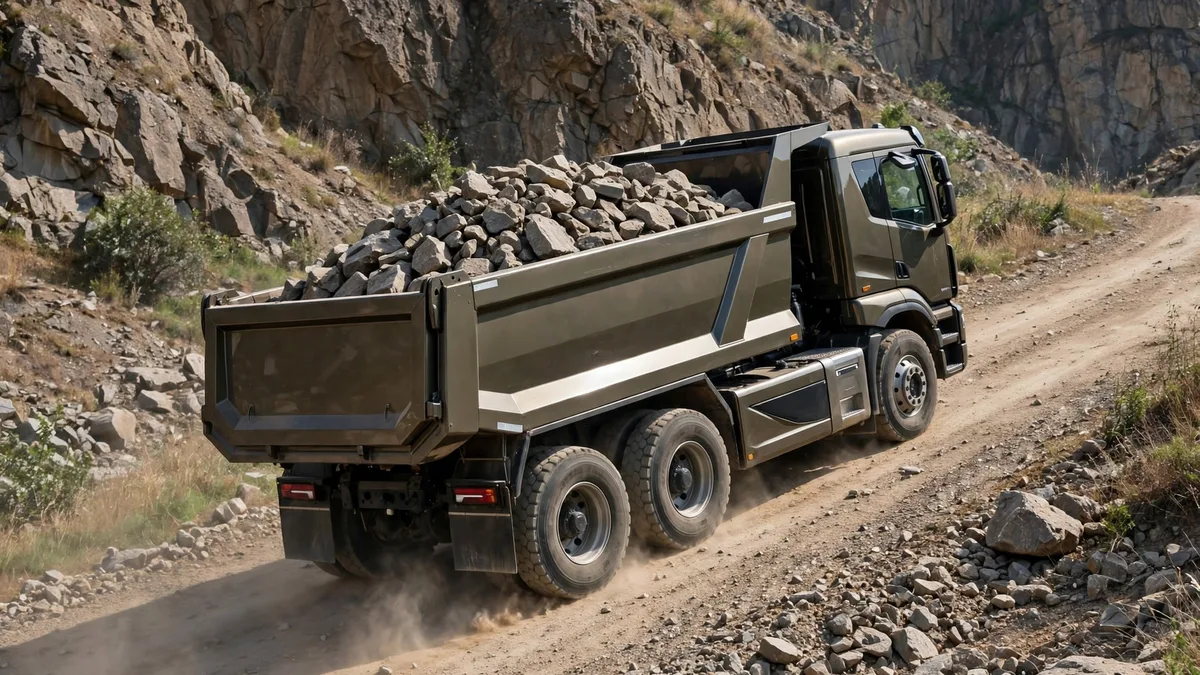
On a quarry road at midday, a dump truck climbs a dusty slope with a full load of stone, and the only sound is the crunch of tyres on gravel. There is no diesel roar echoing off the rock face, no cloud of black smoke, and when the truck stops at the top, the driver tips the bed with a quiet hum and the stone slides out in one clean heap. It is a luxury electric dump truck, built to haul like a workhorse and behave like a gentleman.
A luxury electric dump truck is a heavy hauling vehicle powered by batteries and electric motors, built to carry stone, soil and rubble on building sites, quarries and private estates. It is made for owners who need a truck that works hard all day without fumes, noise or the smell of diesel in a finished garden. Building one means joining a truck chassis strong enough for twenty tonnes with a battery system delicate enough to need cooling, sealing and careful software, because a dump truck must be both a brute and a precision instrument.
How It’s Made
Step 1: Building the chassis and the axles
Every dump truck starts as a ladder of thick steel rails, cut and drilled by computer-guided machines, then bolted and riveted into a frame that will carry the bed, the battery and a full load of stone. The frame is the backbone of the truck, and it is tested for flex, because a frame that twists too much will crack the battery case or jam the tipping mechanism. Workers check every bolt by hand, and the frame is painted in a thick coat that resists stone chips and road salt.
Step 2: Fitting the battery pack and the drive motors
Where a diesel truck has a fuel tank and a large engine, the electric dump truck carries its battery packs in steel cases slung low between the frame rails, where their weight keeps the truck stable on a slope. Each case is sealed against dust and water, cooled by a liquid circuit, and wired to a central controller that watches every cell for heat or imbalance. The cases are bolted in from below, so they can be removed for service without taking the whole truck apart.

Electric motors sit on the axles, one for each driven wheel or one large motor for each axle, and they drive the wheels through a simple reduction gear, with no clutch and no multi-speed gearbox to wear out. The motors give full torque from a standstill, so a loaded truck can pull away on a steep quarry ramp without rolling back, and they recover energy when the truck brakes downhill, feeding power back into the battery. The same direct electric drive appears in other heavy machines, and the way a luxury electric crane is made shows how electric motors give a heavy lifter fine control at low speed.
Step 3: Building the tipping bed
Under the bed sits the tipping ram, a long hydraulic cylinder that lifts the front of the bed until the load slides out of the back. The ram is driven by an electric pump, and it is fitted with a safety valve that stops the bed from falling if a hose fails. The driver controls the tip from the cab with a single lever, and a sensor warns if the truck is parked on a slope too steep to tip safely. The bed is tested empty and full, tipped hundreds of times, before the truck is allowed to carry a real load.
Step 4: Fitting the cab and the controls
The cab is a quiet room on top of a hard-working truck, with a wide windscreen, a heated and ventilated seat, air conditioning and a screen that shows the battery level, the load weight and the state of the bed. The controls are simple: a lever for drive, a lever for the tip, and a screen for everything else, because a driver hauling stone all day should not have to hunt through menus. Sound insulation keeps the cab calm, and the mirrors are heated so they stay clear in rain and frost.
Behind the cab sit the charging socket, the air compressor and the hydraulic reservoir, all tucked behind locked panels that keep them clean and dry. The charging socket takes a fast charger, so the truck can top up during a lunch break, and the compressor feeds the air brakes, which are tested to stop a fully loaded truck on a wet downhill slope. The cab itself is tilted forward on its hinges for service, giving mechanics easy access to the motors and the battery controller underneath.
Step 5: Load trials, road tests and handover
Before a luxury electric dump truck is handed over, it is loaded with stone to its full rated weight and driven over a test course of ramps, potholes and tight turns, while engineers watch the battery temperature, the brake wear and the flex of the frame. The bed is tipped again and again, the truck is charged and discharged, and the range is measured with a full load, not an empty one, because a range figure that only works empty is no use to an owner.
Then the truck makes its first real delivery, usually a load of stone to a building site, with the engineers following in a second vehicle to watch for any fault. Only when the load has been carried, tipped and the truck has returned with charge to spare is it signed off. The care taken over testing a premium electric workhorse is a theme across the range, and the way a luxury electric forklift earns its price shows how much proving goes into a machine before it is trusted, while a luxury electric snowcat is made for the same kind of hard, quiet work in difficult places.
| Specification | Typical machine |
|---|---|
| Power source | Battery packs in sealed steel cases between the frame rails |
| Motors | Electric motors on the axles with reduction gears, no gearbox |
| Chassis | Bolted steel ladder frame with heavy axles and springs |
| Bed | Steel tipping box with hydraulic ram and sealed tailgate |
| Load | A full load of stone, soil or rubble, tipped in one motion |
| Cab | Quiet, air-conditioned, battery, load and bed displays |
| Brakes | Air brakes with regenerative braking downhill |
| Working time | A full day of hauling on one overnight charge |

A luxury electric dump truck is an estimate of $220,000 to $520,000, depending on its load capacity, the size of its battery and the finish of its cab. The price covers the truck, the battery and charging equipment, the tipping bed, the first years of service and the driver training that comes with a premium machine.
Here is a rare fact worth knowing. The first dump trucks were horse-drawn carts with a hinged bed that a man tipped by pulling a lever, and the load often fell in a heap that had to be shovelled clear by hand. The first motor dump trucks of the early 1900s could carry only a couple of tonnes and broke down so often that a second truck usually followed to tow the first home. A modern electric dump truck carries ten times that load, tips it with a quiet hydraulic hum, and can brake downhill while feeding energy back into its own battery.