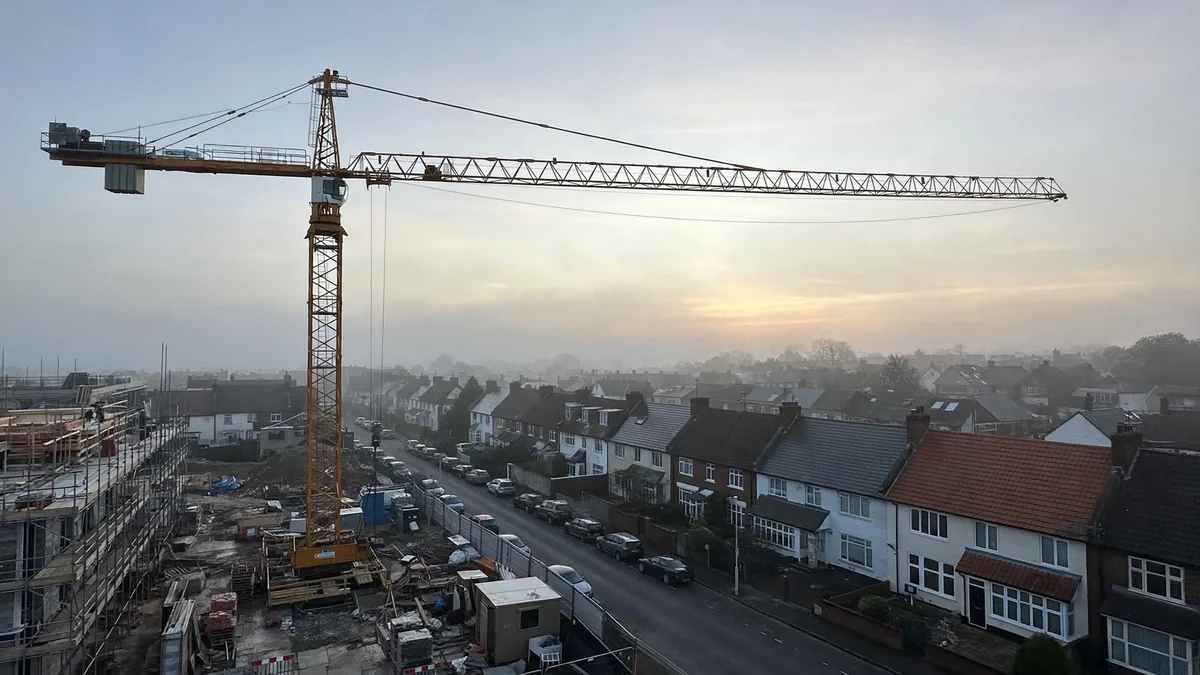
On a building site at first light, a crane stands taller than everything around it, its long arm reaching over the rooftops while the streets below are still quiet. Then, without the roar of a diesel engine, the arm begins to swing, and a load of steel rises smoothly into the sky. It is a luxury electric crane, and the people working under it can talk to each other in normal voices while it lifts.
A luxury electric crane is a lifting machine powered by batteries and electric motors, built to place heavy loads with great precision on construction sites, in ports and on private estates. It is made for owners who need a crane that works cleanly, quietly and exactly, whether it is lifting glass panels onto a villa or steel beams onto a tower. Building one means joining heavy steelwork with fine electric control, because a crane must be both enormously strong and delicately precise.
How It’s Made
Step 1: Forging the base and the mast
Every crane starts at the ground, with a base of thick steel that spreads the weight of the whole machine. The base is bolted to a concrete foundation or to a set of steel outriggers, and it is levelled with great care, because a crane that leans even a little will swing its load off line. On top of the base sits the slewing ring, a huge ball bearing that lets the whole top of the crane turn in a full circle.
The mast is built from steel sections that stack on top of each other like a tower of boxes, each one bolted to the next with high-strength bolts. The same care with a heavy steel frame under a big machine appears in other electric vehicles, and the way a luxury electric truck is made shows how a strong chassis is built before anything else is fitted.
Step 2: Fitting the battery pack and the motors
Where a diesel crane has a fuel tank and a noisy engine, the electric crane carries a battery pack in a steel case at its base, protected from rain, dust and knocks.
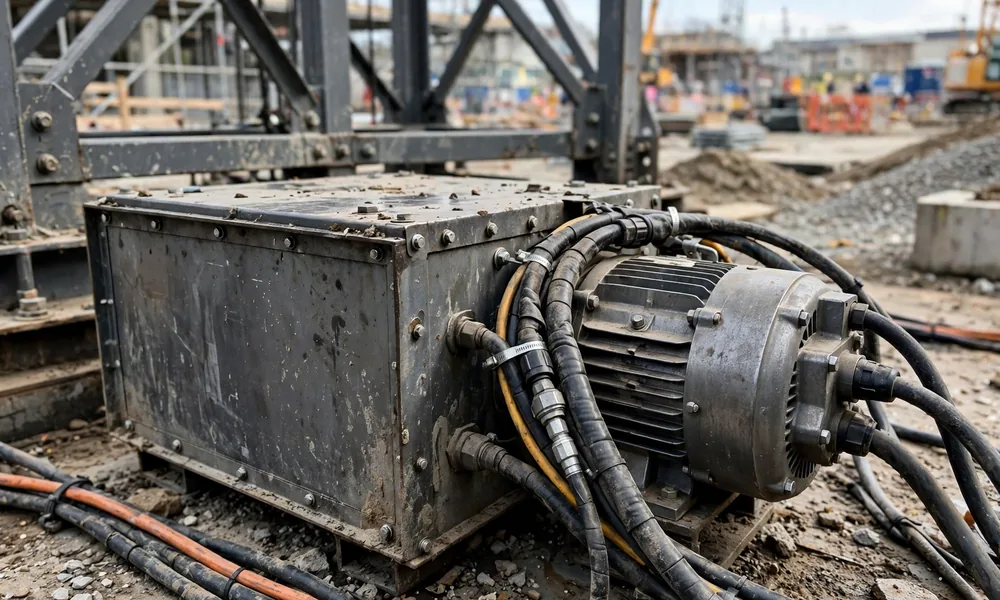
Electric motors do all the work of the crane: one turns the top of the crane on its slewing ring, one raises and lowers the hook, and one moves the trolley along the jib. Each motor is fitted with a brake that holds the load still even if the power is cut, and each one is controlled by a drive that can move a load by a single centimetre at a time. That fine control is what makes an electric crane a luxury machine, because a load of glass or stone cannot be jerked into place.
Step 3: Building the jib and the counter-jib
The jib is the long arm of the crane, built from a lattice of thin steel tubes welded into triangles. The lattice design is strong and light, so the jib can reach far without weighing the crane down.
Behind the mast sits the counter-jib, a short arm that carries the concrete counterweights and the operator’s cab. The counterweights balance the load on the jib, so the crane does not tip forward when it lifts.
Step 4: Fitting the hook, the trolley and the cables
The hook block hangs from the end of a steel cable that runs over the tip of the jib, down to the load and back up through a set of pulleys. The cable is wound onto a drum in the machinery house, and the drum is driven by an electric motor that can reel the cable in and out at a steady speed.
The trolley is a small wheeled frame that runs along the underside of the jib, carrying the hook out and in. It is driven by its own motor and cable, so the operator can place a load exactly over its landing point without swinging the whole crane. The same idea of a separate motor for each movement is used across electric machinery, and the way a luxury electric forklift is made shows how electric drive gives a heavy lifter fine control at low speed.
Step 5: Fitting the cab and the safety systems
The operator’s cab hangs from the counter-jib, high above the site, with glass on every side so the operator can see the hook, the load and the landing point. The cab is air-conditioned and suspended on dampers, and inside it there are two joysticks, a screen showing the weight of the load and the reach of the jib, and a radio for talking to the banksman on the ground.
The safety systems are fitted at the same time. A load sensor in the hook block tells the crane how heavy the load is, and if the load is too heavy for the reach, the crane simply refuses to lift it. An anemometer on the top of the mast watches the wind, and if the wind rises too high, an alarm sounds and the crane is parked with its jib free to swing. These systems are tested again and again before the crane is handed over.
Step 6: Testing, load trials and the first lift
Before a luxury electric crane is allowed to work, it is tested with loads that are heavier than anything it will lift in service. The crane lifts, swings and lowers a test weight through every part of its reach, while engineers watch the mast for flex, the cables for stretch and the brakes for slip.
Then the crane makes its first real lift, usually a load of steel or a pallet of blocks, with the engineers watching from the ground. Only when the load has been placed exactly where it was meant to go, without a jerk or a sway, is the crane signed off. The same long proving run is part of every big electric build, and the way a luxury electric boat is made shows how a large electric machine is tested before it is trusted with real work.
| Specification | Typical luxury electric crane |
|---|---|
| Power source | Large battery pack at the base, charged overnight |
| Motors | Separate motors for slewing, hoisting and trolley |
| Mast | Bolted steel sections on a slewing ring bearing |
| Jib | Lattice steel arm with counter-jib and counterweights |
| Hook and cable | Forged steel hook, drum-wound cable, trolley drive |
| Cab | Glazed, air-conditioned, load and wind displays |
| Safety | Load sensor, wind alarm, brakes that hold on power loss |
| Working time | A full day of lifting on one overnight charge |

A luxury electric crane is an estimate of $400,000 to $1,200,000, depending on the height of the mast, the reach of the jib and the weight it must lift. The price covers the crane, the battery and charging equipment, the transport and erection on site, and the first years of inspection and support.
Here is a rare fact worth knowing. The first cranes were worked by men walking inside giant wooden wheels, like hamsters, and the wheel turned a drum that wound the lifting rope. A team of men in a treadwheel could lift a stone weighing several tonnes, slowly and steadily, to the top of a cathedral. A modern electric crane does the same job with a motor the size of a suitcase, and its operator can place a load of glass onto a rooftop to within a few centimetres, while the whole machine makes less noise than a conversation on the street below.


