The ferry pulls away from the quay and the first thing the passengers notice is what is missing. There is no diesel rumble through the deck, no vibration in the handrail, no exhaust haze drifting over the stern. The water slides past, the lounge stays calm, and people keep talking at normal volume while the ship gathers speed. It feels less like a ferry and more like a large, very quiet living room that happens to be crossing the water.
That calm is built, not bought. A luxury electric ferry is made by taking a conventional hull and rebuilding everything inside it around batteries, power electronics and electric motors, then fitting a cabin quiet enough to match. The yard has to solve a problem no diesel ferry ever faced: carrying enough energy, charging it fast enough, and keeping a ship full of passengers safe around very large voltages.
This is how a luxury electric ferry is made, from the steel hull and the battery compartments to the motors, the charging arm and the fitted lounge, and why the quietest ship on the water takes some of the most exacting work in the yard.

Step 1: The hull is built around the batteries
Every electric ferry starts as a hull, but the drawings are different from a diesel boat from the first line. The battery banks are heavy, and they have to sit low and central, so the yard builds the hull around their compartments, with steel frames, sealed bulkheads and cooling channels planned in before the plating goes on. The hull is cut, welded and faired in the usual way, then checked for shape and strength, because a vessel that carries tonnes of batteries must be stiff enough to hold them steady in a seaway. The guide to how a luxury electric ferry works follows the finished vessel from a cold start at the terminal to full speed on open water, and the hull built in this first step is what carries all of that energy safely.
Step 2: Battery modules are lowered in and wired up
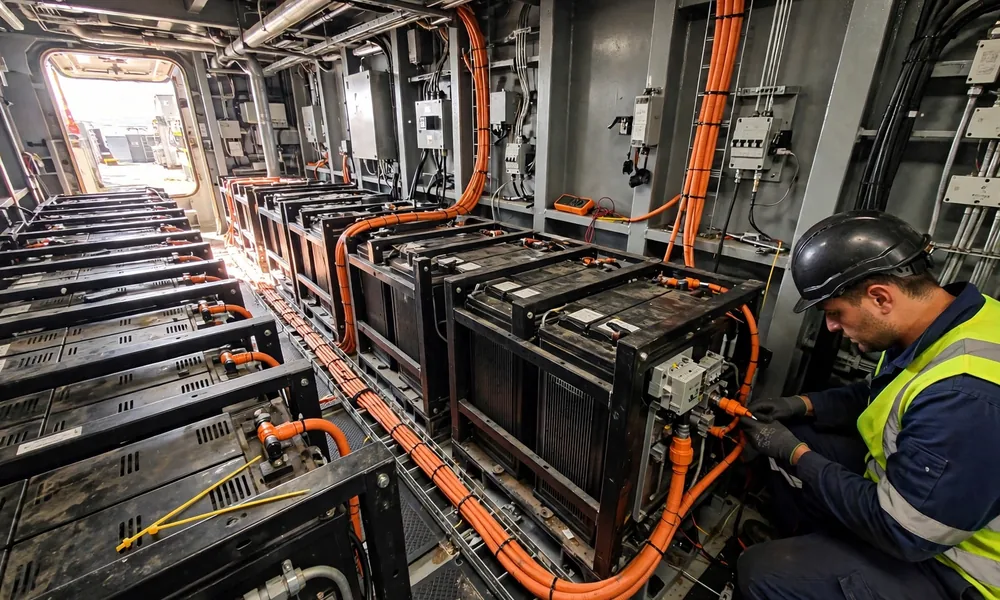
With the hull ready, the battery modules arrive, and this is the most careful lift in the whole build. Each module is a sealed unit of cells, lowered by crane into its compartment, bolted to shock-absorbing mounts and connected to cooling loops that will carry away the heat of charging and discharging. High-voltage cables are routed through shielded trays, labelled at every joint, and separated from the low-voltage wiring that runs the lights and the navigation.
Step 3: Power electronics and electric motors go in
Between the batteries and the propellers sit the power electronics, the part of the ferry that does the most invisible work. Inverters turn the batteries’ stored energy into the controlled current the motors need, and the motors themselves, compact electric units mounted low in the hull, drive the propellers directly, with no gearboxes in between. The yard mounts the motors on stiff beds, aligns the shafts with gauges, and seals the stern tubes against the sea. Then the whole drivetrain is tested on the bench, spinning the shafts while engineers watch the temperatures, the vibration and the power draw, and tune the controls until the motors run smoothly from a whisper to full power.
Step 4: Charging, safety and fire systems are fitted
An electric ferry is only as useful as its charging, so the yard fits the shore connection early and tests it hard. A high-power charging socket, often rated at several megawatts, is mounted on the deck, wired to the battery management system, and linked to an automated charging arm at the terminal that connects the moment the ferry docks. The battery management system watches every cell, every temperature and every voltage, and it is tested by deliberately tripping faults, so the crew knows it will act before a small problem becomes a large one.
Step 5: The lounge is fitted for silence
Once the engineering is in, the ferry becomes a luxury room, and the fitting is designed around the quiet the drivetrain has bought. Joiners fit wide leather chairs, low tables, soft lighting and a small galley, with acoustic panels in the walls and the floor to soak up the last traces of sound. Double glazing goes into the windows, the air system is tuned to move fresh air without a draught, and every fitting is fixed against the motion of the sea. The guide to the luxury electric ferry spec sheet, explained reads the numbers behind this calm, from battery capacity to charging power, and the lounge fitted here is where those numbers turn into a ride passengers can feel.
Step 6: Painting, sea trials and the charging test
With the cabin finished, the hull is painted, the deck fittings are sealed, and the vessel is launched. The first trials check the obvious things, that it floats level, that nothing leaks, that the motors turn and the steering answers, and then the real work begins: running at every speed, measuring the range, and testing the charging at the terminal again and again. The same quiet electric idea on a smaller, sun-powered hull is covered in the guide to how a luxury solar ferry is made, where the roof itself helps to charge the batteries between crossings.
The spec sheet at a glance
| Specification | Typical luxury figure | What it tells you |
|---|---|---|
| Hull material | Steel or aluminium, built around battery rooms | How stiff the vessel is, and how safely it carries its batteries |
| Battery capacity | Often several megawatt-hours | How far the ferry can cross before it must charge |
| Drivetrain | Battery electric, direct-drive motors | How quiet the lounge stays, and how few moving parts there are |
| Charging power | Often several megawatts at the terminal | How quickly the ferry is ready for its next crossing |
| Cruising speed | Roughly 10 to 18 knots | How fast the crossing feels in comfort |
| Passengers | Often 100 to 400, in lounge seating | How many guests the cabin carries |
| Emissions | None at the vessel itself | How clean the air stays on deck and at the quay |
| Safety | Battery management, gas detection, fire suppression | How the vessel watches and protects its own batteries |
| Build time | Many months, much of it electrical fitting | How much of the vessel is wired and tested by hand |

What it costs
A luxury electric ferry typically costs an estimated $10 million to $40 million, depending on its size, its passenger count, its battery capacity and how lavish the lounge is fitted. The estimate covers the vessel alone, not the terminal charging, the crew or the running costs. Most of the price is in the battery banks, the power electronics and the charging system, and in the safety and testing that lets a ship full of passengers sail on stored electricity.
A rare fact
One detail few passengers ever learn is that an electric ferry can feed energy back into its own batteries when it slows down, and the reason is simple: the propellers keep turning as the vessel decelerates, and the motors work in reverse as generators. That recovered energy goes straight back into the battery banks, so every arrival at the quay puts a little power back in the tank, which is why the most efficient moment in the whole crossing is the moment the ferry is coming to a stop.


