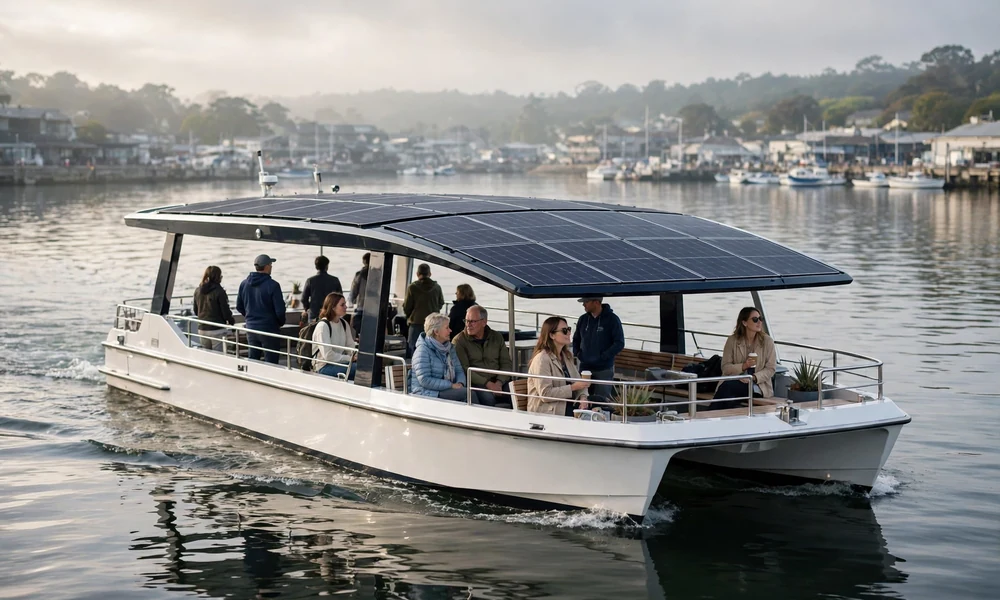
A luxury solar ferry does not look like a ferry when it is being built. In the yard it looks like a floating roof: a wide, flat deck covered in dark glass panels, sitting on a slim hull that seems far too small to carry it. There is no funnel, no engine room full of diesel, and no smell of fuel anywhere on the slipway.
That roof is the whole idea. The ferry makes its own power from the sun, stores it in batteries below deck, and moves passengers across the water in near silence. Building it means joining a light hull, a huge solar array, and an electric drive into one quiet machine. This is how a luxury solar ferry is made.

Step 1: A light hull, built for a roof
The build starts with the hull, and it has to be light, because the solar roof and the batteries are heavy. The hull is usually aluminium or a composite of glass fibre and foam core, laid up in sections and welded or bonded together on the slipway. It is wide and shallow, which gives the ferry stability and lets it work in harbours and rivers where a deep-draught ship could not go.
The hull is shaped to slip through the water with as little drag as possible, because every bit of saved drag is range the solar panels do not have to provide. How an electric ferry is made follows the same hull-first build on a battery ferry, and the structure here starts the same way, with the roof still to come.
Step 2: The solar roof
The solar roof is the most visible part of the ferry, and it is built as a structure in its own right. A framework of aluminium beams spans the full width of the deck, and the solar panels are mounted on it in rows, tilted slightly so rain runs off and the panels catch the sun through the day. The roof also shades the passenger deck below, which keeps the lounge cool without air conditioning running all day.
Each panel is wired into strings, and the strings run down through sealed conduits to the power room below.
Step 3: Batteries and the electric drive
Below deck, the ferry carries a large lithium battery bank, split into modules in sealed compartments low in the hull. The batteries store the solar power for cloudy spells and evening crossings, and they are managed by a system that watches every module for temperature and charge. The compartments have cooling and fire protection, and the cables to the motors run through sealed trunking.
The motors are electric pods or shaft-driven units at the stern, quiet and free of exhaust. Twin motors give the ferry fine control in a crowded harbour, letting it turn almost in its own length, and they can be run at different speeds to steer.
Step 4: Charging and the power system
A solar ferry gathers power from the sun, but it also charges from the shore. At the quay, the ferry plugs into a shore connection that tops up the batteries overnight or between crossings, and the power system blends the solar input, the shore power, and the battery charge into one smooth supply.
The system also runs the hotel loads: lighting, air conditioning, the galley, and the charging points for passengers. On a sunny day the roof can cover much of that load directly, and the batteries stay full for the crossings. How a luxury solar catamaran works describes the same blend of sun, shore power, and batteries on a smaller vessel, and the ferry scales that idea up to carry a hundred passengers or more.
Step 5: The passenger spaces
Once the structure and the drive are complete, the passenger spaces are fitted out. The main lounge sits under the solar roof, with wide windows, pale wood, and comfortable seating arranged so every passenger can see the water. A small galley serves drinks and snacks, and the open deck at the stern gives passengers a place to stand in the open air.
The boarding areas are built for speed, with wide doors and level gangways so passengers can step on and off without climbing stairs.

Step 6: Launch, trials, and handover
Launching a solar ferry is a careful operation, because the roof makes the vessel top-heavy until the batteries and ballast are in place. The ferry is lowered into the water, the waterline is checked, and the stability is tested with the tanks and batteries loaded as they will be in service. Any list is corrected before the trials begin.
The sea trials test everything the yard built: the solar output on a sunny day, the range on battery alone, the charging from shore power, and the handling in a crowded harbour. The engineers record the energy use at cruising speed and check that the ferry can complete its daily route on sun and shore power alone. Only when the numbers match the design does the yard hand the ferry over. The best electric ferries, ranked compares the ferries already in service, and the differences between them often come down to how well the solar roof, the batteries, and the motors work together.
Specifications
| Detail | Specification |
|---|---|
| Length | Around 20 to 30 metres |
| Passengers | Around 100 to 150 passengers |
| Solar array | Around 60 to 100 kilowatts peak |
| Battery bank | Around 300 to 600 kilowatt-hours |
| Electric motors | Two motors, around 100 kilowatts each |
| Cruising speed | Around 8 to 10 knots |
| Range on battery | Around 40 to 80 nautical miles |
| Hull material | Aluminium or glass fibre composite |
Price
The estimated price of a new luxury solar ferry is around 4 million dollars, and that figure is an estimate only, because the cost depends on length, passenger capacity, and the size of the solar array and battery bank. The roof structure and panels, the batteries, and the electric drive account for a large share, followed by the hull and the passenger fit-out. An operator is paying for a ferry that runs on sunlight and shore power, with almost no fuel cost and no exhaust over the water it crosses.
A rare fact
Few people know that a solar ferry can keep making power while it is tied up at the quay. The roof keeps working all day, even when the ferry is not moving, so the batteries are often fuller at the end of the day than they were at the start. On a sunny route with long stops between crossings, the ferry can run for days without ever plugging in, living entirely on the light that falls on its own roof.
When the ferry leaves the yard for the first time, it does so without smoke, without noise, and without a fuel bill waiting at the other end. The passengers notice the quiet first, then the light in the lounge, and then the fact that the roof above them is doing the work. That is how a luxury solar ferry is made.