The ferry leaves the pier on a grey morning, and for the first few minutes it looks like any other boat: a low white hull, rows of windows, commuters with coffee cups and headphones. Then, as the speed builds, something strange happens. The hull rises out of the water, lifted on thin wings that nobody can see, and the boat begins to fly. The spray disappears. The thud of the waves stops. The ferry glides across the harbour on a cushion of air and water, faster than the cars on the bridge beside it, and the passengers look up from their phones, because the ride has suddenly gone smooth.
An electric hydrofoil ferry is a commuter boat that flies. Foils, shaped like aircraft wings, extend below the hull and lift the boat clear of the water once it reaches speed, cutting drag so sharply that the boat can travel fast on a fraction of the energy a normal ferry needs. Add an electric motor and a battery bank, and the result is a ferry that is quick, quiet, and clean, with no diesel smoke and no wake tearing up the shoreline. Cities with crowded roads and wide stretches of water are looking at these boats as a way to move people without building another bridge.

How It Works
An electric hydrofoil ferry works by solving one problem: water is heavy to push through. A normal ferry drags its whole hull through the water, which takes enormous power. A hydrofoil lifts the hull out of the water, so only the thin foils and struts stay submerged, and the drag falls away. The electric system supplies the power, and a computer keeps the boat level. Here is how the machine works, step by step.
1. The foils lift the hull. Below the ferry, two or more wing-shaped foils are mounted on struts. As the boat speeds up, water flows over the foils and creates lift, just as air flowing over an aircraft wing creates lift. At a certain speed, usually around 15 to 20 knots, the lift is strong enough to raise the hull clear of the water. Only the foils, the struts, and the propeller stay submerged.
2. Electric motors provide the push. The ferry is driven by one or two electric motors, mounted in pods below the hull or at the back of the foils. The motors are quiet, smooth, and efficient, and they deliver full power instantly, which matters when the boat needs to accelerate onto its foils. The power comes from a large lithium battery bank, housed low in the hull for stability. Because the foils cut the drag so sharply, the motors can be smaller than those on a conventional ferry, and the batteries last longer. The way an electric boat motor is built for marine use is the foundation the whole ferry is built on.
3. A computer keeps the ride level. Flying on foils is not a job for a human hand alone. If a wave lifts one side, the computer corrects it before the passengers feel a thing. The pilot steers with a simple wheel or joystick and watches a display that shows speed, height, and battery level. The system also has limits: if the water gets too rough, the computer lowers the boat back onto its hull and it continues as a normal ferry, slower but safe.
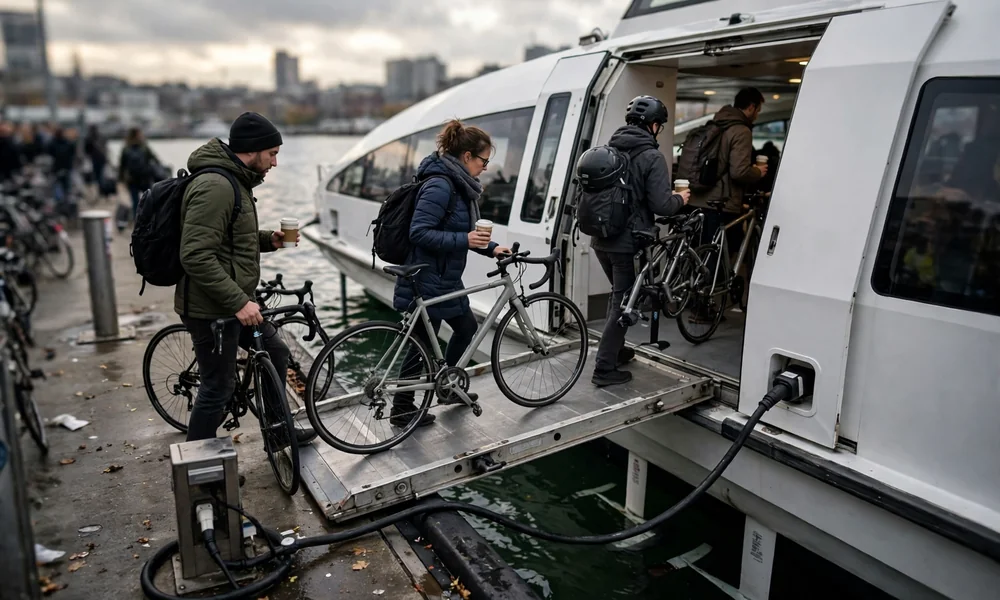
4. Batteries and charging set the route. The battery bank decides how far the ferry can go. A typical electric hydrofoil ferry carries enough energy for a route of 30 to 80 nautical miles, with recharging at each end. Some operators plan a longer charge at midday or overnight, when the boat is out of service. The battery and range figures of an electric boat are what decide whether a route is possible, and operators check them before they promise a timetable.
5. Docking on the hull. To dock, the ferry slows down, the foils lose their lift, and the hull settles back into the water. The boat then moves at low speed on its hull, like any other ferry, and the crew bring it alongside the pier. The foils are retracted or raised where the design allows, so they do not strike the pier or the seabed in shallow water.
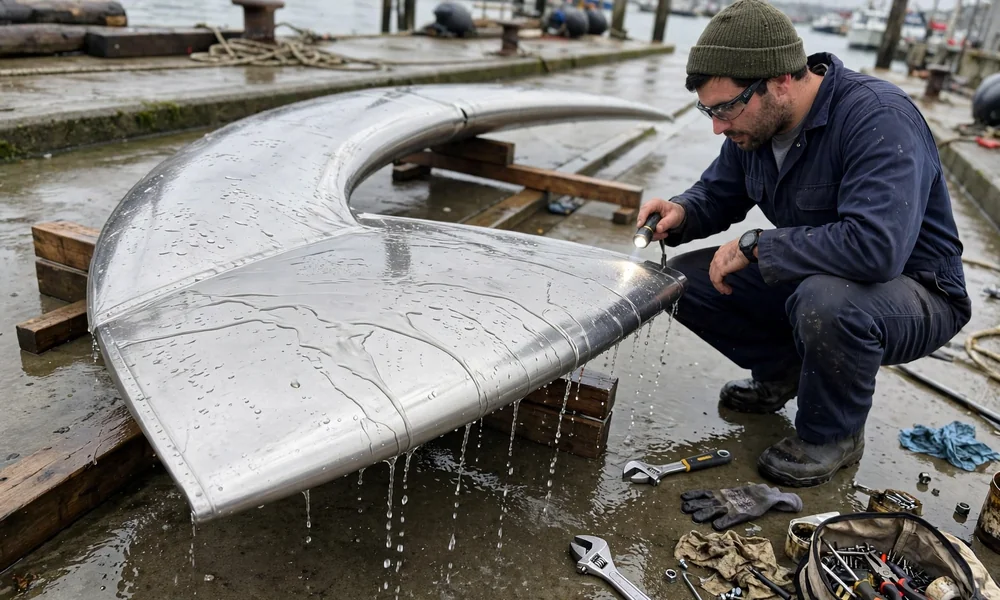
6. Maintenance and safety. A hydrofoil ferry has more moving parts than a simple boat, and the foils need regular inspection for corrosion, cracks, and marine growth. The ferry is lifted out of the water on a schedule, the foils are cleaned and checked, and the batteries are tested cell by cell. Safety systems include a backup power supply, a manual foil control, and a rule that the boat returns to hull-borne speed if any sensor disagrees with the others. The crew are trained to handle the transition between flying and floating, because the moment the hull rises out of the water is the moment everyone on board pays attention. The best electric boat propulsion systems share the same design idea: a backup for every part that matters.
Cities are watching these ferries closely, because they solve a problem that roads cannot. A harbour crossing that takes forty minutes by car can take fifteen minutes by hydrofoil ferry, with no traffic, no emissions, and no new road to build. Operators say the economics work best on busy commuter routes where the ferry runs all day, because the fuel saving and the speed pay back the higher purchase price over time, and the passengers vote with their feet.
Specifications
| Detail | Typical figure |
|---|---|
| Length overall | 15 to 30 metres |
| Passengers | 50 to 150 people |
| Battery capacity | 500 kWh to 2 MWh |
| Cruising speed on foils | 25 to 35 knots |
| Take-off speed | 15 to 20 knots |
| Route range | 30 to 80 nautical miles |
| Propulsion | Electric motors in pods |
| Charging time | 15 minutes to overnight |
Price
An electric hydrofoil ferry is estimated to cost roughly $5 million to $15 million, depending on its size, passenger capacity, and battery bank. A small 50-passenger ferry for a short harbour route sits near the lower end, while a larger 150-passenger vessel with a bigger battery and a full commuter fit-out can pass the upper end. These are estimates, not quotes, and the price does not include the charging infrastructure at the piers, which the operator or the city must build separately.
Running costs are estimated at roughly $500,000 to $1.5 million a year, covering crew, maintenance, charging, and insurance. Electricity is far cheaper than diesel for the same distance, and the electric motors need less maintenance than diesel engines, but the batteries and the foils need regular care, and the charging equipment must be maintained too.
A Rare Fact
Hydrofoils were first tested more than a century ago, and in the 1950s they carried passengers across the Mediterranean at speeds that seemed impossible for a boat. The early hydrofoils were noisy, thirsty, and hard to maintain, and they faded away when cheap fuel made big conventional ferries cheaper to run. Today the same wing that lifted those old boats is back, this time on a ferry that runs on batteries and is steered by a computer, and the idea that seemed like a dead end for fifty years has turned out to be waiting for the right motor.


