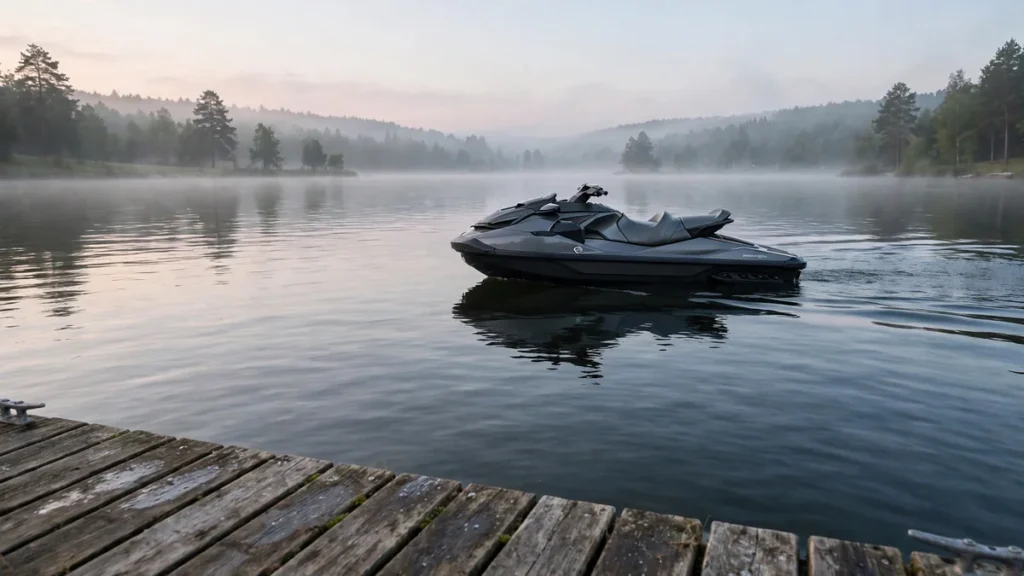
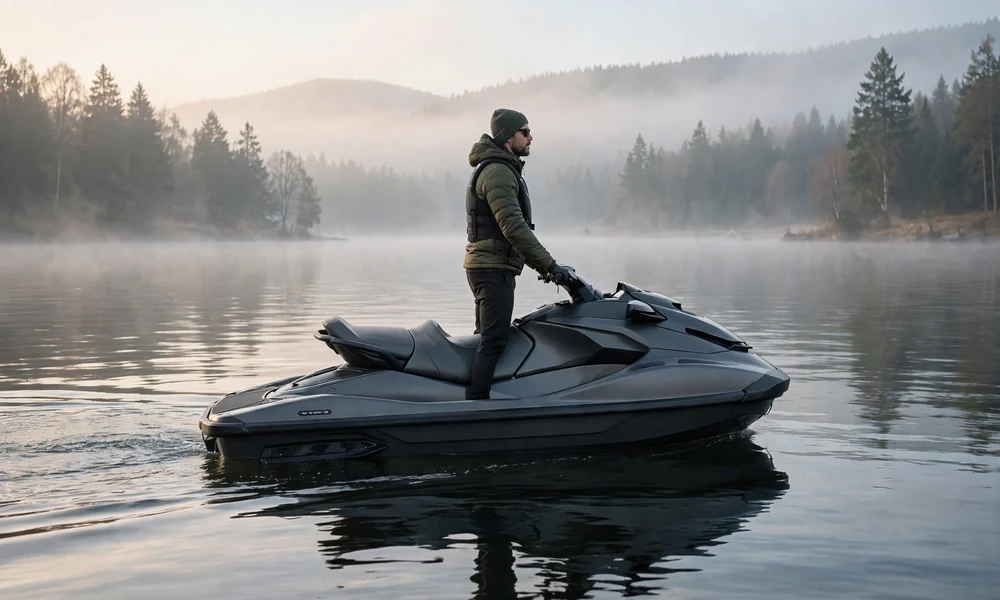
At dawn on a still lake, a machine glides past without a sound. There is no engine roar, no smell of fuel, no wake of spray kicked up by a propeller. Just a low, sleek hull cutting the water, a rider standing relaxed at the bars, and a faint hum that fades before the birds have finished their first song. The people on the dock stare, because they have never seen a jet ski move like that, and they have certainly never seen one move that quietly.
A luxury electric jet ski is a different machine from the petrol jet skis that have ruled the water for decades. It has no fuel tank, no exhaust, and no gearbox, and its hull is shaped as carefully as a yacht’s. Only a few builders make them, and each one is assembled by hand in small numbers. What follows is how one is made, from the first layer of carbon fibre in the mould to the day it slides silently into the water.

How a Luxury Electric Jet Ski Is Made
Step 1: Laying up the carbon fibre hull
Everything starts in the mould, a polished form shaped like the underside of the hull. Workers lay sheets of carbon fibre cloth into it by hand, brushing each layer with resin and rolling out every air bubble, because a single bubble trapped in the laminate becomes a weak spot that will crack under the pounding of waves. A luxury hull uses more layers than a mass-market one, with extra cloth around the keel and the transom, where the forces are greatest. The mould is then sealed in a vacuum bag and cured in an oven, which squeezes the layers together and hardens the resin into a single rigid shell. When the hull comes out of the mould, it weighs a fraction of a fibreglass hull of the same size.
Step 2: Building the sealed battery pack
While the hull cures, the battery pack is built in a separate dry room. Cells are grouped into modules and sealed inside a waterproof aluminium case, because a battery that meets salt water is a battery that is finished. The case is fitted with pressure valves that let it breathe as it warms and cools, and with sensors that watch the temperature of every module. Cooling channels run through the case, carrying water from outside the hull, so the battery stays cool even on a hot day at full throttle. The pack is tested for leaks by submerging it in a tank and watching for the tiniest bubble, and it is charged and discharged once before it ever goes near the water.
Step 3: Fitting the electric jet pump
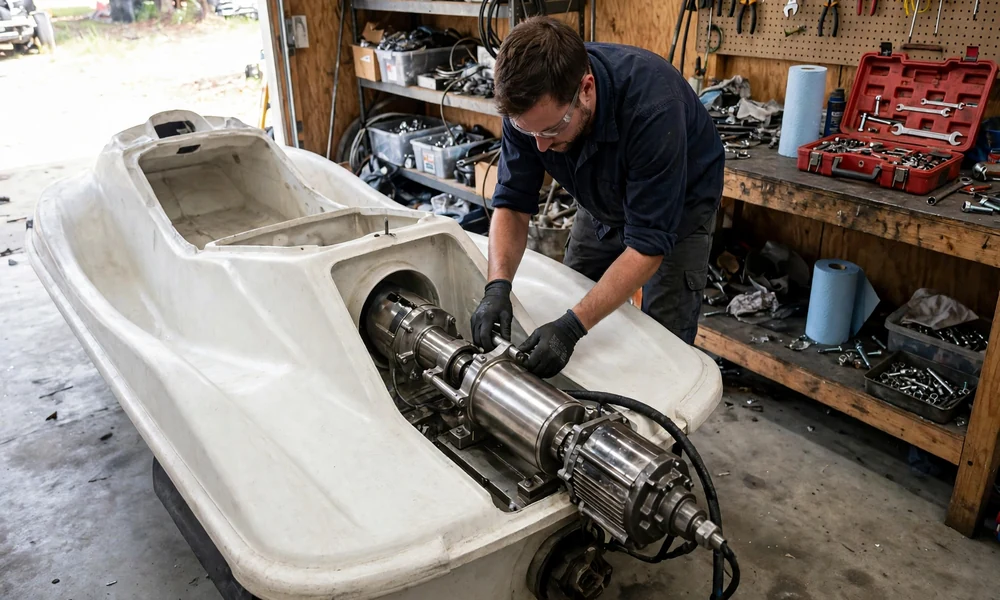
The heart of the machine is the jet pump, a tunnel through the back of the hull with an impeller inside it. An electric motor, mounted directly on the pump shaft, spins the impeller, which sucks water in from underneath and fires it out of the nozzle at the back. There is no propeller sticking out below the hull, which is why a jet ski can run in shallow water that would wreck a propeller boat. The impeller is machined from stainless steel and balanced to a fine tolerance, because an unbalanced impeller vibrates, and vibration at ten thousand revolutions a minute will shake a machine apart. The nozzle steers with the handlebars, and a reverse bucket drops down behind it to push water forward when the rider wants to back up. The whole pump is assembled in a clean room and tested in a tank before it is fitted.
Step 4: Installing the electronics and controls
With the battery and pump in place, the electronics go in. A waterproof control unit sits near the centre of the hull, linking the throttle, the battery, and the motor, and deciding how much power to deliver for every twist of the grip. The dashboard is a small colour screen, sealed against spray, showing speed, battery level, and range, and the handlebars carry the throttle, the start button, and a lanyard that kills the power if the rider falls off. Every cable is routed through sealed conduits and every connector is waterproof, because a single drop of salt water in the wrong place can short the whole system. The builders test the electronics by spraying the finished machine with a hose for an hour, then opening it up to check that the inside is completely dry.
Step 5: Trimming the deck and seat
The deck is where the luxury shows. It is moulded in carbon fibre like the hull, then finished with a non-slip surface that stays grippy when wet, and trimmed with leather or marine-grade vinyl on the seat. The seat is shaped to hold the rider in place through turns, with a raised back for support, and the footwells are deep enough to brace against in rough water. Storage compartments are built into the nose and under the seat, sealed with rubber gaskets, and the whole deck is fitted to the hull with a watertight joint. Sound insulation goes under the deck, because a luxury machine should sound like nothing at all.
Step 6: Testing on the water
Before any customer takes delivery, the finished jet ski is taken to the water. A test rider runs it through its paces: full-throttle acceleration, hard turns, sudden stops, and long runs at cruising speed, while engineers on the dock watch the telemetry for battery temperature and motor load. The hull is checked for leaks, the pump is checked for vibration, and the steering is adjusted until it feels exactly right. Then the machine is washed with fresh water, dried, and polished, its battery charged to eighty percent, and it is handed to its owner with a cover, a charger, and a briefing on how to ride it. Its first real journey is a silent one, and that is the point.
Specifications
| Feature | Typical luxury electric jet ski |
|---|---|
| Battery capacity | 15 to 25 kWh |
| Power | 120 to 200 hp |
| Top speed | 90 to 110 km per hour |
| Range | 60 to 100 km |
| Charging | 0 to 80 percent in about 1 hour |
| Hull | Carbon fibre, vacuum-cured |
| Weight | 280 to 350 kg |
How Much Does a Luxury Electric Jet Ski Cost?
A luxury electric jet ski typically costs an estimated $35,000 to $60,000, depending on the battery size, the power, and the level of finish. A well-equipped model from a specialist builder sits near the lower end, while a flagship with a larger battery, a carbon fibre hull, and a fully bespoke deck can reach the top of the range. The estimate covers the machine itself; a fast charger and a trailer add several thousand dollars more. Running costs are low, since electricity is cheaper than petrol and the electric drivetrain has almost nothing to service, but the battery and the hand-built hull are the reasons the purchase price stays high.
A Rare Fact
The first jet skis were built in the 1970s as stand-up machines for a single rider, and nobody imagined they would one day be silent. The jet ski of today still uses the same pump principle as those early machines, water in, water out, only now an electric motor does the spinning. A luxury electric jet ski costs so much because its battery and carbon hull are built by hand in tiny numbers, and the luxury chase boat that follows it across the bay is the only other machine on the water that can keep up without making a sound of its own.