It weighs less than a suitcase, folds in two seconds, and will carry its rider across a city at 25 kilometres an hour without a single pedal stroke. The luxury electric kick scooter looks simple — a deck, a stem, two wheels — but the ones worth their price are precision machines, built to survive potholes, rain and daily folding for years. Inside that slim deck hides a battery, a controller and a motor that would have filled a backpack a decade ago.
The best scooters are made by companies that think like aerospace engineers about weight and like motorbike makers about brakes, because a rider standing on a small deck at speed has very little margin for error. Every gram is accounted for, every weld is inspected, and the folding mechanism is tested thousands of times. Here is how a luxury electric kick scooter is made, from a billet of aluminium to a machine that slips under a train seat.
How It’s Made
Step 1: The deck is machined from aluminium
The deck is the heart of the scooter, and on a luxury model it starts life as a solid extrusion or a billet of 6061 aluminium alloy. A computer-controlled mill carves out the hollow inside that will hold the battery, leaving ribs and walls just thick enough to stay stiff under a rider’s weight. The top surface is given a grippy texture, either machined directly or covered with a replaceable rubber mat, and the edges are rounded so they do not cut into shoes. The deck is then anodised, which hardens its surface against scratches and gives it that deep, even colour that cheap scooters lose within a month of use.
Step 2: The battery and controller are sealed inside
The battery pack is built from the same kind of lithium cells used in power tools and laptops, grouped into a slim, flat pack that slides into the deck. A typical luxury scooter carries 500 to 700 watt-hours, enough for 40 to 60 kilometres of real riding, and the pack is wrapped in a fire-resistant sleeve and sealed with a gasketed lid. Beside it sits the controller, a small circuit board that decides how much power the motor gets, and it is potted in resin to protect it from vibration and water. Workers test the sealed deck by spraying it with water, because a scooter that dies in the rain is a scooter that will not be trusted.
Step 3: Hub motors are built into the wheels
Most luxury scooters drive one wheel, and the most powerful drive both. The motor is a brushless hub unit built directly into the wheel, with copper windings, strong magnets and a sealed bearing, and it is laced into a rim with a solid or pneumatic tyre. A single-motor scooter usually makes 350 to 500 watts, while a dual-motor model can make more than 1,000 watts and climb hills that would stop a bicycle. The motor is tested on a spinning rig that measures its power and listens for vibration, and any unit that hums unevenly is pulled apart and rebuilt before it reaches a deck.
Step 4: The folding stem and handlebars are fitted
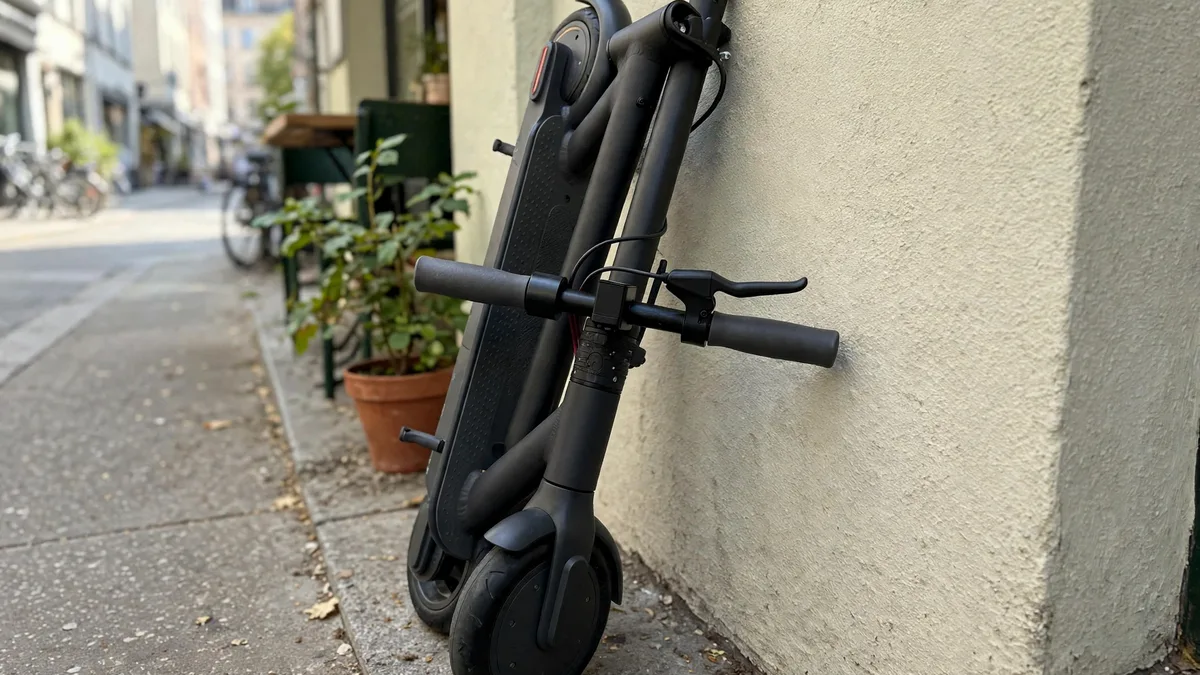
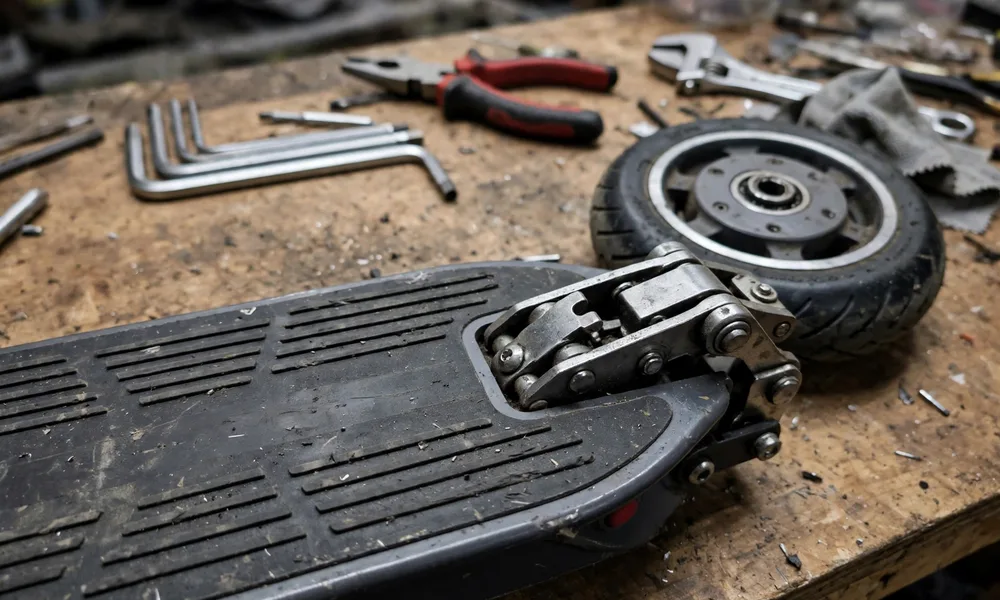
The stem is a tube of aluminium or carbon fibre that rises from the front wheel to the handlebars, and it folds down onto the deck with a single latch for carrying. The folding joint is the most stressed part of the whole scooter, so it is machined from solid metal and held by a hardened pin and a secondary safety catch. The handlebars carry the throttle, the brake lever, a small display and a bell, and the cables run inside the stem so they cannot snag. Workers fold and unfold each stem a thousand times on a test rig, and the latch must still lock with the same firm click on the thousandth fold as on the first.
Step 5: Suspension, brakes and tyres are tuned
A small wheel feels every bump, so a luxury scooter needs suspension to be rideable. The front and rear get spring or rubber suspension units, tuned so the deck stays level over rough pavement without bouncing the rider off. Braking is handled by a disc brake on at least one wheel, backed by electronic regenerative braking that feeds a little power back into the battery, and the two systems are tuned to work together without grabbing. The tyres are 10-inch pneumatic units on the best models, wide enough to grip in the wet and thick enough to shrug off glass and thorns.
Step 6: Software, lights and the final road test
The last stage is mostly invisible. The scooter’s software is loaded and calibrated: three riding modes, a speed limit that matches local law, a walk-assist mode for pushing it through a crowd, and an app connection that lets the owner lock the scooter from a phone. Integrated lights front and rear run off the main battery, and reflective strips are added to the stem. Finally, a technician rides every scooter around a test course of speed bumps, wet corners and a steep ramp, checking the brakes, the folding latch and the motor. Only a scooter that passes silently, with no rattles, is boxed with its charger.
Kick Scooter Specifications
| Specification | Typical luxury figure |
|---|---|
| Deck | CNC-machined 6061 aluminium, sealed battery bay |
| Motor | 350–1,000 W brushless hub motor, single or dual |
| Battery | 500–700 Wh lithium, sealed in deck |
| Top speed | About 25 km/h assisted (estimate, varies by law) |
| Range | About 40–60 km per charge (estimate) |
| Tyres | 10 inch pneumatic, puncture-resistant |
| Brakes | Disc brake plus regenerative braking |
| Weight | About 14–20 kg |
How Much Does One Cost?
A luxury electric kick scooter typically costs between about $1,500 and $3,500, with dual-motor performance models reaching $4,500 or more. Those are estimates based on current premium models. The price is driven by the machined deck, the sealed battery and the quality of the motor and brakes, and it is the difference between a scooter that lasts three years of daily commuting and one that develops a wobble in the stem after three months. For a rider who uses it instead of a car or a taxi for short trips, the running cost is little more than the electricity to charge it.
A Rare Fact
The kick scooter is far older than the electric motor that now powers it. Wooden scooters with iron wheels were a children’s toy in the 1800s, and a German inventor patented a scooter with a small petrol engine as early as 1915. The modern electric version only became practical when lithium batteries got light enough to hide in the deck — the same battery revolution that gave us the smartphone. In other words, the scooter waited a hundred years for its battery to catch up with its idea.

The scooter’s appeal is that it asks almost nothing of its owner: no parking space, no fuel, no licence in most places, just a charge overnight and a fold at the door. Its engineering is a scaled-down version of bigger machines — the hub motor idea is shared with a electric Vespa, the balance and control thinking echoes a Segway, and the frame craft is the same discipline described in electric scooter frame. What looks like a toy is, underneath, a small electric vehicle built to a motorbike’s standards of braking and a bicycle’s standards of weight.


