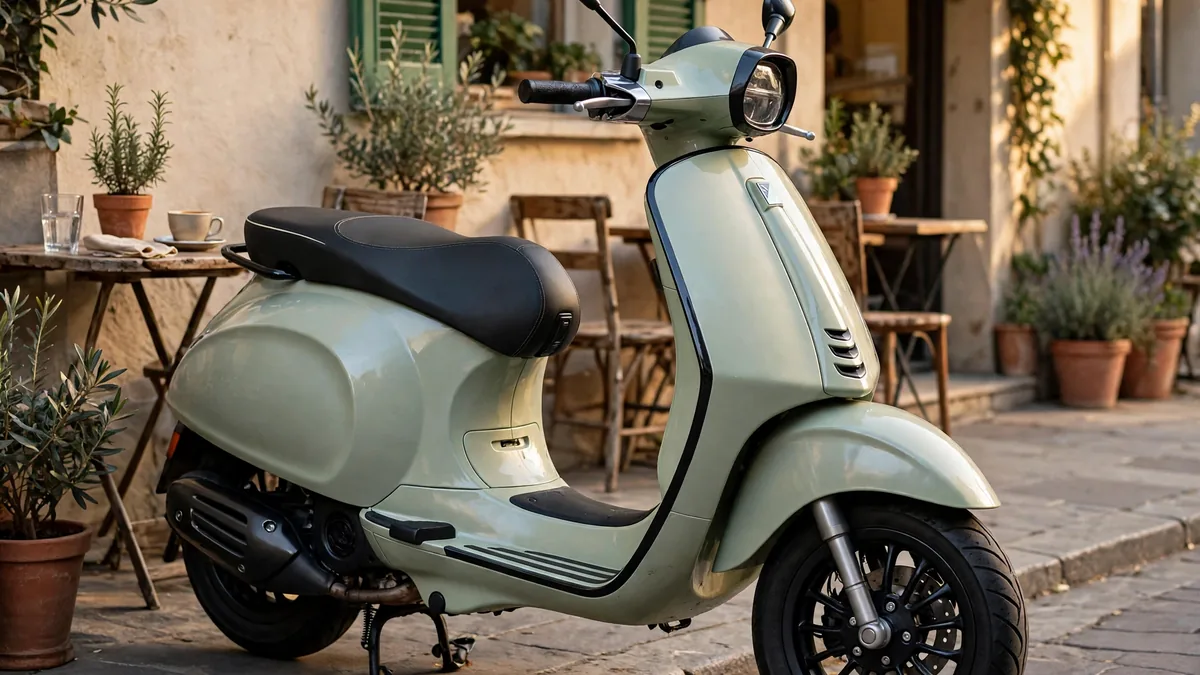
On a quiet lane outside a small Italian town, a rider in a linen jacket pulls up outside a cafe on a Vespa the colour of pale sage, and the machine draws a second look from everyone passing. It is small, it is silent, and it looks as if it was designed in a studio rather than built on a production line.
This is how a luxury electric Vespa works, from the battery and the hub motor to the regenerative braking, the ride and the small details, and how it turns a short city journey into something quiet, smooth and oddly pleasurable, every single day.
Step 1: The battery stores the ride
Everything on a luxury electric Vespa starts with the battery, and it is hidden where the petrol tank used to be, low in the body under the seat. It is a pack of lithium cells, roughly one and a half to three kilowatt-hours, wired together and watched by a small board that monitors every cell’s temperature and charge. The battery is the heaviest part of the scooter, and placing it low is what keeps the Vespa stable, because the weight sits between the wheels rather than high up. The factory story behind the machine is worth knowing too, and the guide to how a luxury electric Vespa is made follows it from the pressed-steel body to the battery and hub motor.
Step 2: The hub motor turns power into motion
There is no engine on a luxury electric Vespa, and no gearbox either. Instead there is a hub motor, a ring of copper windings and magnets built directly into the rear wheel, and when the rider twists the throttle, the controller sends power from the battery to the motor, and the wheel itself turns. The motor makes roughly two to four kilowatts, which sounds modest, but an electric motor pulls hardest from a standstill. The numbers behind all of this are worth reading too, and the guide to luxury electric Vespa specs explained reads the spec sheet figure by figure.
Step 3: The controller and throttle talk to each other
Between the battery and the motor sits the controller, a small box of electronics that decides how much power the motor gets and how quickly. The throttle grip is connected to it, and the controller reads the twist of the grip many times a second, smoothing out the rider’s input so the Vespa accelerates gently rather than lurching. The controller also watches the motor’s temperature and the battery’s charge, and it will quietly limit the power if either gets too hot or too low, so the scooter never strands its rider. The rider never sees any of this; they only feel that the Vespa always does exactly what their hand asked for.
Step 4: Regenerative braking puts energy back
A luxury electric Vespa does not just spend its battery; it also puts some of it back. When the rider rolls off the throttle or squeezes the brake, the hub motor runs in reverse, acting as a generator, and the energy of the slowing scooter is turned back into electricity and fed into the battery. The effect is strongest in stop-start city traffic, where the scooter is slowing down every few hundred metres, and it can stretch the range by a useful margin. The two systems blend so smoothly that most riders never notice where one ends and the other begins.
Step 5: The suspension and tyres tune the ride
A Vespa is a small machine, and small machines feel every bump, so the ride is tuned carefully. The front suspension is a single-sided arm, a Vespa signature, with a small shock absorber that lets the wheel move over bumps without shaking the handlebars, and the rear has a shock of its own, tucked under the body. The steel monocoque body, the same pressed-steel shape the petrol Vespa has worn for decades, gives the ride its solidity, because the body is also the frame, and there is nothing to flex or rattle. The guide to how a luxury moped works shows the same small-machine tuning on a machine with a very different engine.
Step 6: The lights, display and silence finish the ride
The last part of how a luxury electric Vespa works is the part the rider sees and hears, or rather does not hear. The lights are all light-emitting diodes, bright and frugal with power, and the headlight is shaped to throw a wide, even beam across a dark lane. And then there is the silence: without an engine, the loudest sound at city speed is the tyres on the road, and the wind past the rider’s helmet.

The spec sheet at a glance
| Specification | Typical luxury figure | What it tells you |
|---|---|---|
| Motor power | Roughly 2 to 4 kilowatts | How strongly it pulls away from a standstill |
| Battery capacity | Roughly 1.5 to 3 kilowatt-hours | How much energy it carries, and how far it goes |
| Range | Roughly 60 to 120 kilometres | How far it travels on a full charge |
| Top speed | Roughly 45 to 90 kilometres per hour | How fast it can legally and safely travel |
| Weight | Roughly 80 to 120 kilograms | How heavy it feels to push, park and carry |
| Charging time | Roughly 3 to 5 hours | How long a full charge takes from a wall socket |
| Brakes | Disc brakes with regenerative braking | How it stops, and how it puts energy back |
| Body | Pressed steel monocoque | How solid the ride feels, and how it resists rust |
| Display | Small round screen, phone link | How the rider sees speed, charge and range |
What good design looks like
A well-designed luxury electric Vespa gives itself away in small details. The throttle should feel smooth from the first millimetre of twist, the brakes should blend from motor to disc without a step, and the scooter should be silent at a standstill, because the whole point of the machine is that the city fades away and the ride is just the rider and the road.

What it costs
A luxury electric Vespa typically costs an estimated $7,000 to $12,000, depending on the battery, the motor and the trim. The estimate covers the scooter alone, not a helmet, insurance or charging equipment. The price is mostly in the battery, the steel body and the finish.
A rare fact
One detail few riders ever learn is that the hub motor on a luxury electric Vespa can also work as a reverse gear. Because the motor is built into the wheel and driven by electronics, the controller can spin it backwards at walking pace, so the rider can back the scooter out of a tight parking space without pushing it, a small trick that a petrol Vespa could never do.
From a battery hidden low under the seat to a silent glide down a tree-lined street, a luxury electric Vespa works by turning a short city journey into something quiet, smooth and oddly pleasurable, and by doing it so simply that there is almost nothing left to go wrong.


