Dawn on a mountain road, and a motorcycle leans into the first bend of the day. There is no rumble from the exhaust, no vibration shaking the mirrors, only the soft rush of wind and the faint whine of an electric motor pulling hard out of the corner. The rider feels the torque instantly, the way a wave lifts a boat, and the machine seems to read the road rather than fight it. This is the promise of the luxury electric motorcycle: the thrill of a superbike, delivered in near silence.
Building one is nothing like bolting a motor onto a petrol frame. A luxury electric motorcycle is designed from the battery outward, because the battery is the heaviest, most expensive, and most important part of the machine. Every gram of weight, every curve of the bodywork, and every line of software exists to make that battery safe, the motor efficient, and the rider connected to the road. What follows is how such a machine is made, from the first sketch to the day it rolls out of the factory under its own quiet power.
How a Luxury Electric Motorcycle Is Made
Step 1: Designing the machine around the battery. Engineers begin with the battery pack, not the engine, because the pack decides the shape of everything else. On a luxury electric motorcycle the pack sits low and central, between the rider’s knees, where its weight keeps the centre of gravity close to the ground and the bike stable at speed. Designers model the frame, the motor position, and the bodywork together on a computer, testing how the bike will handle, how air will flow over it, and how heat will escape from the motor and the cells. The target is a machine that feels balanced at a standstill and planted at motorway speed, with a range that lets the rider enjoy a full day on the road. The frame itself is often a mix of aluminium and carbon fibre, chosen to be stiff enough to carry the battery without flexing, yet light enough to keep the bike agile.
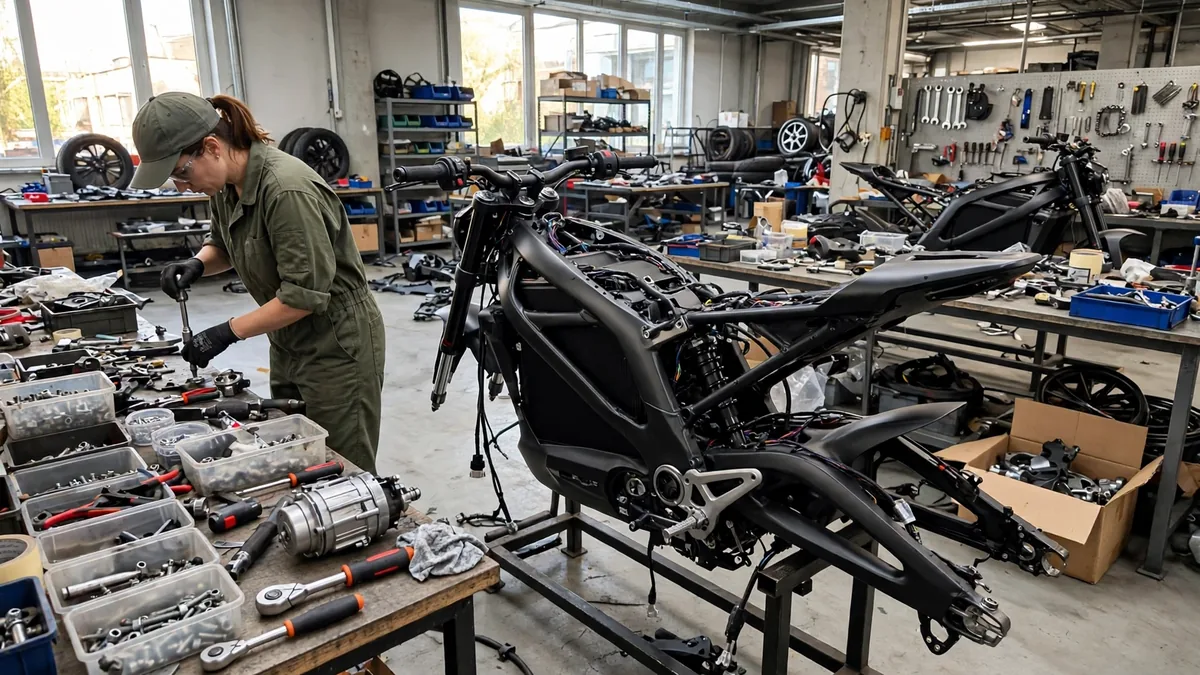
Step 2: Building the frame and chassis. The chassis is welded or bonded from aluminium extrusions and castings, then machined to tolerances measured in fractions of a millimetre. On the most expensive machines, carbon fibre panels are cured in an autoclave, a heated pressure chamber that hardens the resin into a shell lighter than aluminium and stronger than steel. The steering head, swingarm pivot, and motor mounts are aligned on a jig so the wheels track true, because at the speeds these bikes reach, a millimetre of misalignment becomes a wobble the rider can feel. Suspension parts, brakes, and wheels are fitted next, with the same care given to a racing machine, since a luxury electric motorcycle is expected to stop and turn as well as it accelerates.
Step 3: Making the battery pack. The battery is built from hundreds of cylindrical or pouch cells, grouped into modules and wired to a management system that watches the voltage and temperature of every cell. Technicians assemble the modules in a clean, dry room, because moisture and dust are enemies of a lithium battery, then seal the pack in a rigid aluminium case that is both crash protection and a structural part of the bike. Cooling channels run through the pack, carrying heat away on a hard ride and warming the cells on a cold morning. The pack is tested for charge, discharge, and insulation before it ever meets the frame, and it is bolted in with a cradle designed to protect it in a fall. The principles behind the pack, from cell chemistry to thermal management, follow the same ideas explained in how an EV battery pack is made, shrunk down to fit between two wheels.
Step 4: Fitting the motor and drivetrain. The electric motor is a compact unit, often no bigger than a dinner plate, that delivers its full torque the moment the rider twists the throttle. It is mounted low in the frame and connected to the rear wheel by a belt or a chain, chosen for quiet running and low maintenance. Engineers tune the motor controller, the software brain that decides how much power flows to the motor, so the acceleration feels smooth rather than violent, with riding modes that trade range for speed at the touch of a button. Regenerative braking is added, so the motor becomes a generator when the rider slows down, feeding energy back into the battery. The result is a drivetrain with one moving part in the motor itself, a fraction of the complexity of a petrol engine.
Step 5: Wiring the electronics and rider systems. A luxury electric motorcycle is as much computer as machine. A central display shows range, speed, and battery health, while sensors watch wheel speed, lean angle, and throttle position hundreds of times a second. Traction control, cornering anti-lock brakes, and cruise control all run from this network, and the bike can receive software updates over the air, gaining new features long after it leaves the factory. The wiring harness is routed through the frame in sealed channels, protected from rain and vibration, and every connector is tested before the bodywork goes on. The braking systems on these machines share much of their thinking with smaller electric two-wheelers, including the rider aids described in how electric bike ABS works.
Step 6: Bodywork, finishing, and testing. The bodywork is fitted last: sculpted panels in carbon fibre or painted aluminium that hide the battery and shape the airflow. Paint is applied in multiple coats and polished by hand, and the saddle, grips, and controls are trimmed in leather and machined metal. Then the finished bike goes to a rolling road, a dynamometer, where engineers run it through its full speed range, checking power, braking, and battery behaviour under load. A test rider takes it out on real roads, listening for rattles, feeling for vibration, and confirming that the machine behaves exactly as the computer promised. Only when it passes does it earn its badge and its price tag.
Specifications
| Specification | Typical figure |
|---|---|
| Motor power | 80–120 kW (107–161 hp) |
| Battery capacity | 15–22 kWh |
| Range | 160–260 km per charge |
| 0–100 km/h | 2.8–3.5 seconds |
| Top speed | 180–220 km/h |
| Weight | 220–260 kg |
| Charging | DC fast charge, 0–80% in about 30–40 minutes |
How Much Does a Luxury Electric Motorcycle Cost?
Prices vary widely by brand and specification, but as a guide, a luxury electric motorcycle typically costs an estimated $25,000 to $45,000, with limited hand-built models reaching an estimated $60,000 or more. The battery alone can account for a third of the cost, and the carbon fibre bodywork, premium suspension, and electronics add the rest. Running costs are far lower than a petrol superbike: electricity is cheaper than fuel, there is no oil to change, and the motor has almost nothing to wear out. For buyers, the price buys silence, instant torque, and a machine that feels like the future of motorcycling, and the smaller electric two-wheelers that share its technology are covered in how a luxury electric bicycle is made.
A Rare Fact
Some luxury electric motorcycles are so quiet that engineers add an artificial sound, not for the rider, but for pedestrians who might not hear the bike coming. A few manufacturers tune that sound like an instrument, giving each model its own voice, so the quietest motorcycle on the road still announces itself, just on its own terms.