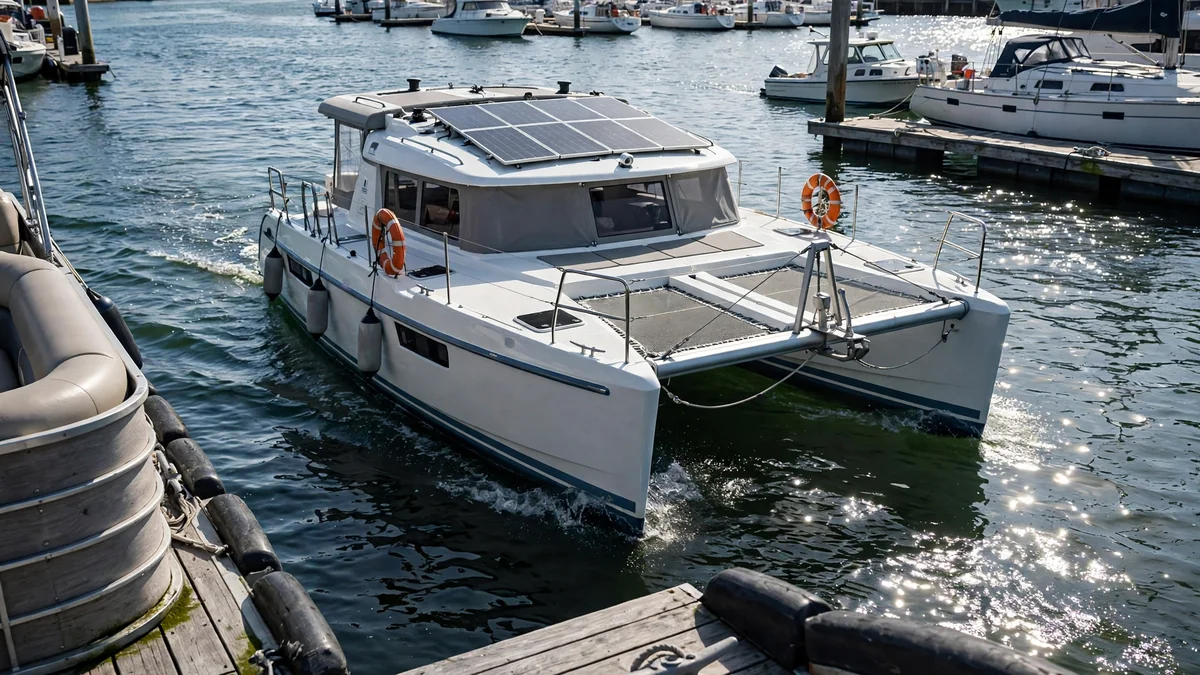
A catamaran already looks like the future of cruising: two slender hulls, a wide flat deck, and no need for a heavy keel. A hybrid catamaran adds a second idea to that shape. Instead of one diesel engine in each hull, it carries diesel engines, electric motors and a battery bank, and it can move on diesel, on electricity, or on both at once. The twin-hull layout is what makes the hybrid part work so well, because a catamaran has something a single-hull yacht does not: room.
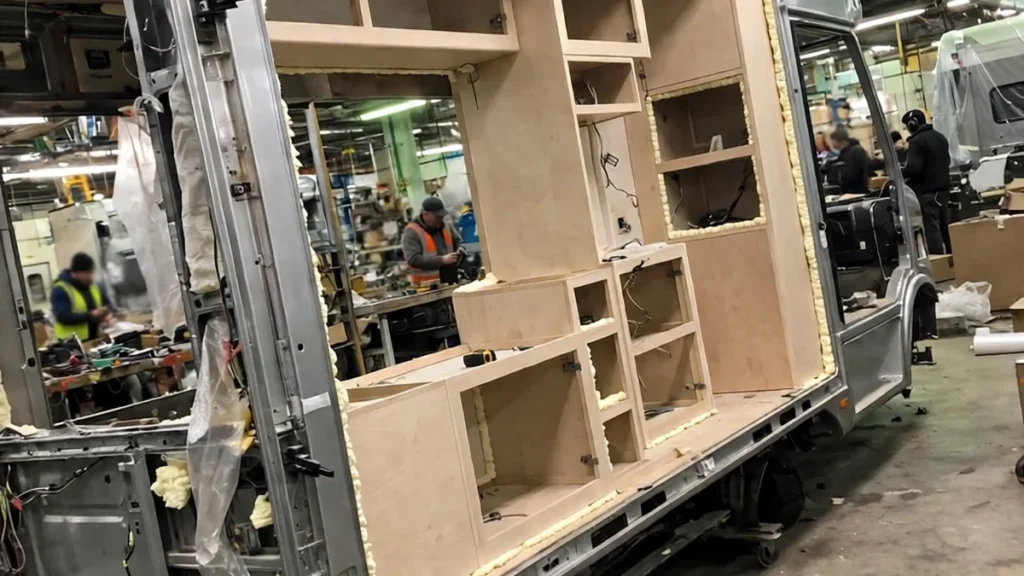
That room is the key to the whole design. Two hulls mean two engine spaces, a broad bridge deck for solar panels, and space for batteries that a narrow monohull would struggle to find. A hybrid catamaran is not a hybrid yacht with an extra hull. It is a boat whose shape and whose power system were made for each other, and understanding it means starting with the hulls, not the engines.
Why Two Hulls Suit Hybrid Power
A single-hull yacht keeps its engine in one space, low in the middle of the boat. A catamaran has an engine in each hull, and that separation is a gift to a hybrid designer. Each hull can carry its own electric motor and its own battery bank, with the diesel generator sitting in one hull or split across both. If one side fails, the other still works, and the boat can limp home on a single hull’s power. Redundancy is built into the shape.
The wide deck matters just as much. Solar panels need flat area, and a catamaran’s bridge deck offers far more of it than a monohull’s narrow coachroof. Many hybrid cats carry several kilowatts of solar, enough to run the boat’s hotel loads — lights, refrigeration, navigation — and to trickle charge the batteries on a sunny day at anchor. The panels do not replace the engines, but they shrink the amount of diesel the boat burns while it is not moving.
How the Hybrid System Works
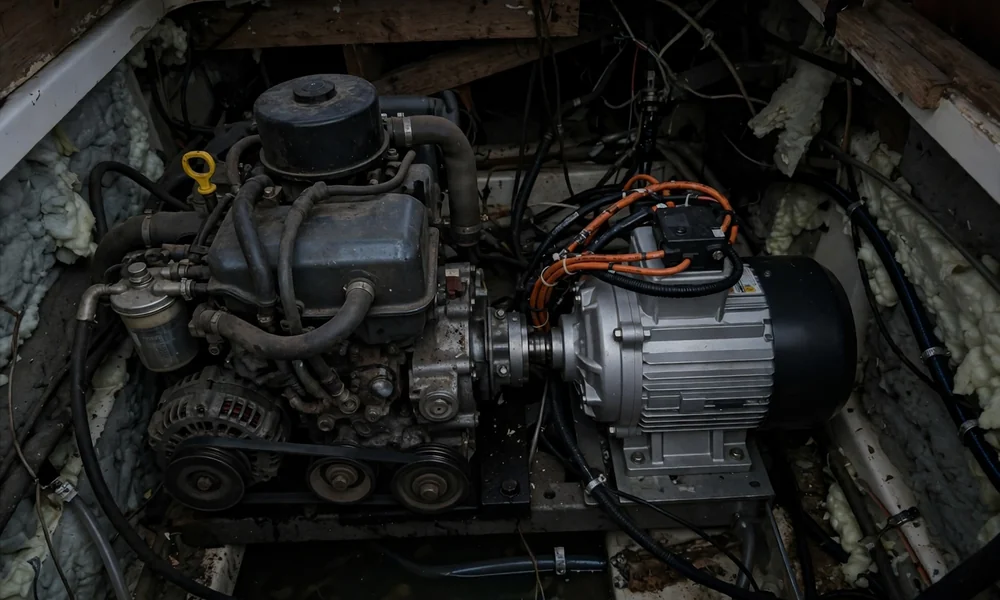
Most hybrid catamarans use one of two layouts. In a parallel hybrid, a diesel engine and an electric motor share the same propeller shaft in each hull. The boat can run on diesel alone for speed, on electric power alone for silence, or on both together for maximum push. The electric motor sits between the engine and the gearbox, and a clutch decides which source drives the shaft.
In a serial hybrid, the diesel never touches the propeller at all. It drives a generator that charges the batteries, and electric motors alone turn the propellers. This is simpler mechanically, because there is no clutch and no gearbox to coordinate, and it lets the diesel run at its most efficient speed regardless of how fast the boat is going. The trade-off is that every bit of energy passes through the generator and the battery, losing a little at each step.
Either way, the batteries are the heart of the system. They store energy from the diesel generator, from the solar panels, and from regeneration: when the boat sails, the propellers can spin backwards in the water and act as generators, feeding power back into the bank. A sailing catamaran making seven knots can generate a useful amount of electricity this way, which is why hybrid cats appeal to sailors who actually sail, rather than motor everywhere.
What a Day Aboard Looks Like
At anchor, a hybrid catamaran is at its best. The diesels are off, the solar panels cover the daily loads, and the boat is silent. The crew cooks, runs the watermaker and charges their devices from the battery bank, and on a sunny day the panels may put back more than the boat uses. This is the experience that sells hybrid cats: a quiet anchorage with no generator hum and no exhaust smell.
Leaving harbour, the boat slips out on electric power alone. It is slow — a few knots — but it is silent and clean, and for a short hop to the next bay it may be all the power the crew needs. When they need speed, or when the wind dies on a passage, the diesels wake up. Some boats run the diesels to drive the propellers directly; others run them as generators while the electric motors do the pushing. Either way, the boat now has its full speed available.
Real Examples on the Water
Hybrid and solar-electric catamarans are no longer concepts. Sunreef Yachts builds its Eco range of sailing and power catamarans with large solar arrays, electric propulsion and battery banks, with diesel generators as backup. Silent Yachts builds solar-electric power catamarans designed to cruise without diesel at all on sunny days, using huge roof-mounted solar fields. Both are real, production boats, and both show the same pattern: the catamaran shape makes room for the solar area and the batteries that the concept needs.
The idea is not new to big boats either. A hybrid superyacht uses the same combination of diesel, electric motors and batteries, and the logic is the same: silence at anchor, efficiency at low speed, full power when it is needed. The superyacht version is a single hull with a much bigger budget; the catamaran version is the same idea at a scale ordinary sailors can buy.
The Advantages, Honestly Weighed
The real advantages are quiet and comfort. Silent running at anchor and in harbour is a genuine improvement to life aboard, and it is the benefit owners mention first. Lower fuel use follows, especially for boats that spend most of their time at low speed or at anchor, where a diesel engine is at its least efficient. A diesel running at a fraction of its rated power wastes fuel; a battery running a small load does not.
Redundancy is the quiet second benefit. Two hulls, two motors and a battery bank mean more ways to keep moving when something breaks. A diesel failure on one side leaves the other side working, and the battery can power the boat for a short distance even with both diesels out. For a boat that may be days from a mechanic, that matters.
The Limits
The limits start with cost. A hybrid catamaran costs substantially more than the same boat with twin diesels, because it carries both systems plus batteries. The batteries will need replacing after a decade or so, and that is a large bill arriving all at once. For an owner who motors everywhere at full speed, the fuel savings will never repay the extra cost.
Range on electricity alone is short. A hybrid cat can motor silently for a few hours at low speed, not for a day at cruising speed, because the battery bank is small compared with the energy a boat needs to push water aside. Anyone who imagines crossing an ocean on batteries alone has misunderstood the system. The diesel is still the long-range engine, and the batteries are a buffer, not a replacement.
Complexity is the third limit. Two power systems mean more parts, more software, and more that can go wrong far from help. A diesel mechanic in a remote port may not be able to diagnose a hybrid control fault, and the owner may be waiting for a specialist. How an electric catamaran works shows the pure-electric version of the same trade, and how a luxury catamaran is built shows how much structure goes into the hulls that carry all of it. The hybrid catamaran is a better boat for a particular kind of sailing — slow, sunny, and quiet — and a more expensive complication for any other kind.