At dawn in a busy city, the first sound is not a car horn but a soft electric hum. A three-wheeled rickshaw glides past with a family inside, its canopy keeping off the sun and its motor barely whispering over the traffic.
A luxury electric rickshaw is a long way from the rattling three-wheelers of the past. It is built like a small car, with a proper steel chassis, a quiet electric motor, comfortable seats and a roof that actually keeps the rain out. This is how a luxury electric rickshaw is made, from a bare frame to the first fare of the day.

Step 1: The chassis is cut, welded and painted
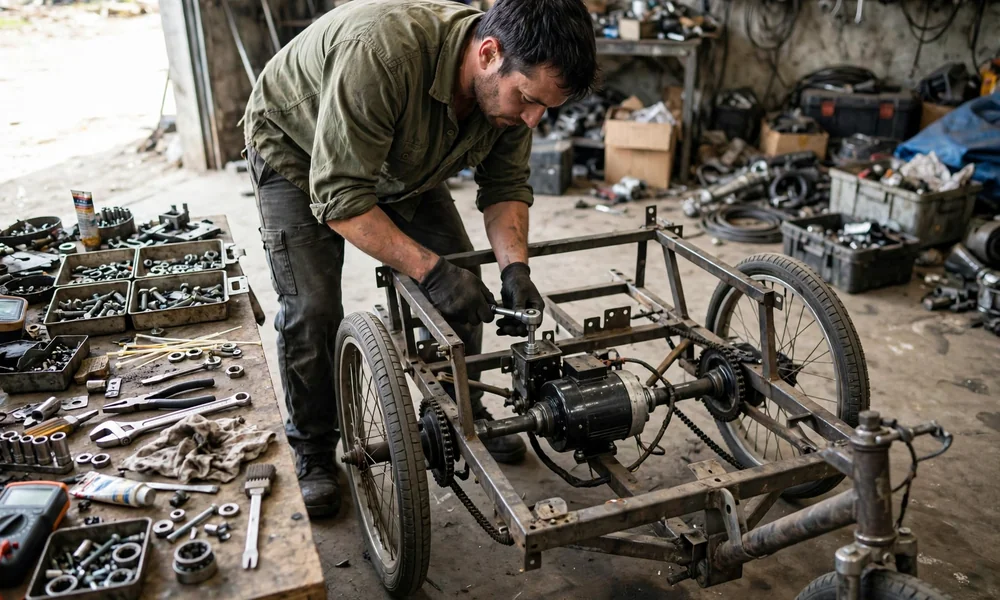
Everything begins with the chassis, a steel ladder frame that has to carry passengers, a battery and a motor over roads that are rarely smooth. Steel tubes are cut to length, set in a jig and welded by hand, each joint checked before the frame moves on. The frame is then dipped or sprayed against rust, because a rickshaw that works in monsoon rain cannot afford a weak spot underneath.
Once the frame is dry, it is painted in the workshop, often in deep colours with a clear coat, and the floor pan is fitted with sound-deadening mats.
Step 2: The motor and drivetrain are fitted
The motor sits at the rear, driving the back axle through a compact gearbox or a belt. A builder lifts the motor into its mount and bolts it down, then connects the controller, a small box of electronics that decides how much power the motor gets when the driver twists the throttle. The same careful power routing that shapes a bigger electric vehicle is described in the guide to how a luxury electric car is made, where the motor, controller and battery must agree before the vehicle moves.
The drivetrain is simple by car standards, and that is the point. Fewer moving parts mean fewer things to break, and a rickshaw that earns its living every day needs to be fixed with ordinary tools in an ordinary workshop. The rear axle, the differential and the brakes are all fitted now, and the wheels are bolted on and spun by hand to check that nothing rubs or wobbles.
Step 3: The battery pack is built and installed
The battery is the most expensive part of the rickshaw, and it is built with the same discipline as a car battery, on a smaller scale. Lithium cells are tested and matched, grouped into a pack and fitted with a management system that watches temperature and charge, cutting power if anything goes wrong. The pack is sealed in a steel case and mounted low under the seats, where its weight keeps the rickshaw stable.
The pack is charged on a bench before installation, and its range is tested with a full load of passengers, not an empty vehicle on a flat road. The cell chemistry and the way the pack is assembled follow the same principles described in the guide to how an EV battery pack is made, scaled down to a vehicle that weighs a fraction of a car. A luxury rickshaw is designed to run a full working day on one charge, then charge overnight from an ordinary socket.
Step 4: The body, canopy and seats take shape
With the running gear in place, the bodywork goes on. Fibreglass or steel panels are fitted over the frame, shaped around the passenger cabin, and the canopy is built from a steel frame with a waterproof fabric or a hard roof. The canopy has to be strong enough to carry a luggage rack and to keep out heavy rain, while still folding or lifting clear for tall passengers.
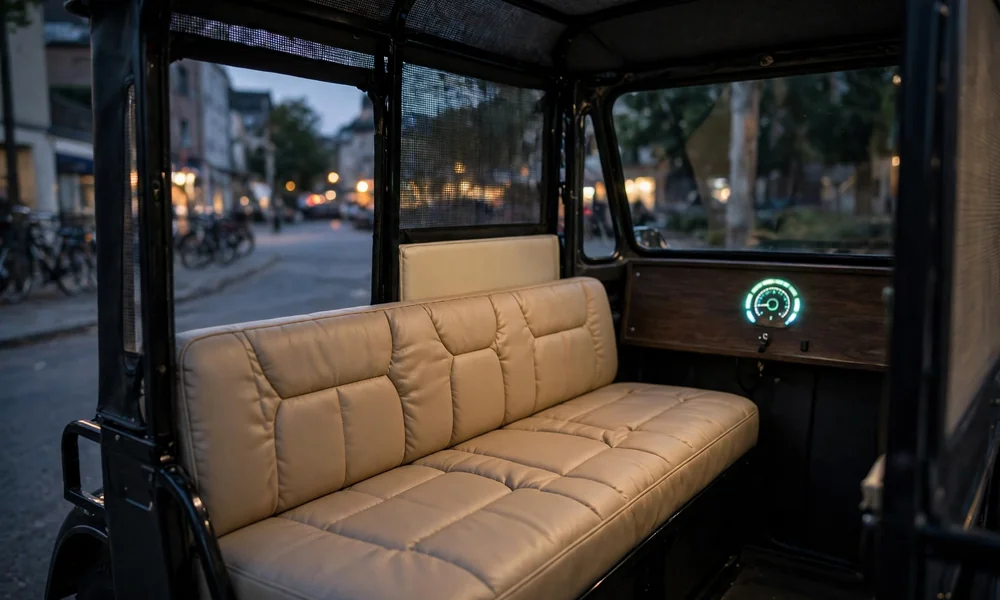
Inside, the seats are the luxury. Bench seats are upholstered in hard-wearing leather or vinyl, with thick foam and stitching that will survive years of passengers sliding in and out. The driver gets a proper seat of their own, with a backrest and a small dashboard holding the speed display, the battery gauge and a switch for the lights.
Step 5: Wiring, lights and safety systems are installed
A luxury rickshaw is wired like a small car, with a proper loom rather than a tangle of loose cables. Headlights, indicators, brake lights and a horn are fitted, and a reversing light and a small camera are often added, since a three-wheeler is harder to see out of than a car.
Safety is fitted at the same time. Seat belts are bolted to the frame, not to the seats, and a sturdy grab rail runs along the side for passengers getting in and out. The brakes are tested on a slope, and the handbrake must hold the fully loaded rickshaw on a hill. The same attention to small, everyday vehicles shows in the guide to how a luxury golf cart is made, where a slow, open vehicle still gets proper brakes, lights and a frame built to last.
Step 6: Testing, tuning and the first fare
Before handover, the finished rickshaw is driven hard. A tester loads it with sandbags to the weight of four passengers and drives it over rough roads, up hills and through water, listening for rattles and checking that the motor does not overheat. The range is measured again under load, and the brakes are tested until they stop the rickshaw straight, without pulling to one side.
The final inspection happens under bright lights, every bolt checked and every panel gap measured, and the canopy is hosed down to prove it keeps the rain out.
The spec sheet at a glance
| Specification | Typical luxury figure |
|---|---|
| Chassis | Welded steel ladder frame |
| Length | 2.6 to 2.9 metres |
| Width | 1.3 to 1.5 metres |
| Seats | Driver plus three to four passengers |
| Motor | Electric, 3 to 6 kilowatts |
| Battery | Lithium, 5 to 10 kilowatt-hours |
| Range | 100 to 160 kilometres per charge |
| Top speed | 45 to 60 kilometres per hour |
| Charging | Overnight from an ordinary socket |
| Brakes | Drum or disc, with handbrake |
| Body | Steel or fibreglass, waterproof canopy |
| Build time | Five to ten days per vehicle |
What it costs, and a rare fact
A luxury electric rickshaw costs an estimated $4,000 to $10,000, depending on the size of the battery, the quality of the bodywork and how much of the interior is hand-finished. The battery alone can be a third of the price, and a bigger pack that covers a full working day is worth more than a fancy paint job.
Here is the rare fact the brochure never mentions. A luxury electric rickshaw is balanced so carefully that its battery sits under the passenger seat, not under the driver, because the weight of the passengers would otherwise tip the balance backwards. The builders weigh each finished rickshaw on scales under all three wheels, and if one wheel carries too much weight they move the battery a few centimetres until the load is even, a quiet piece of engineering no passenger ever sees.