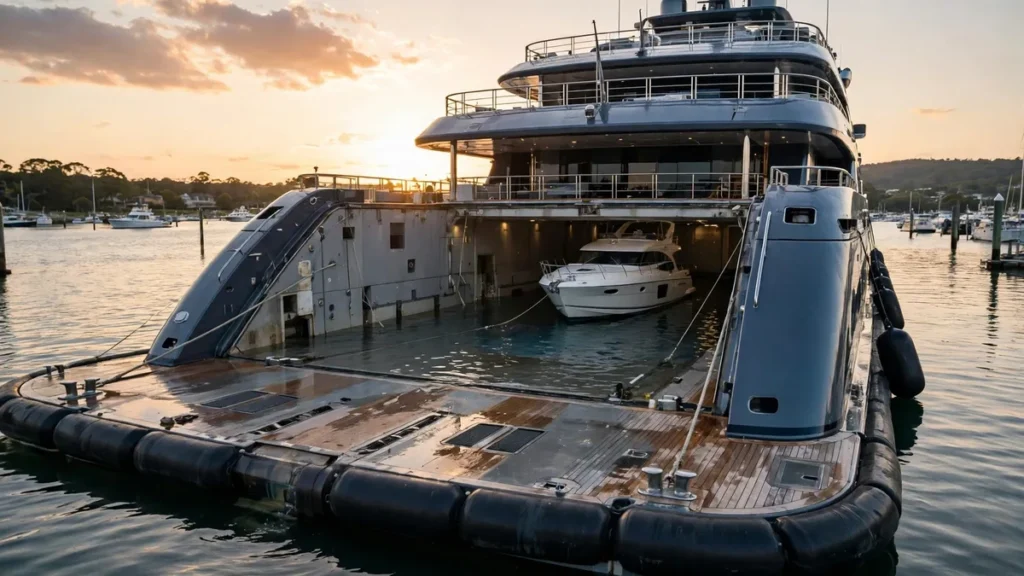
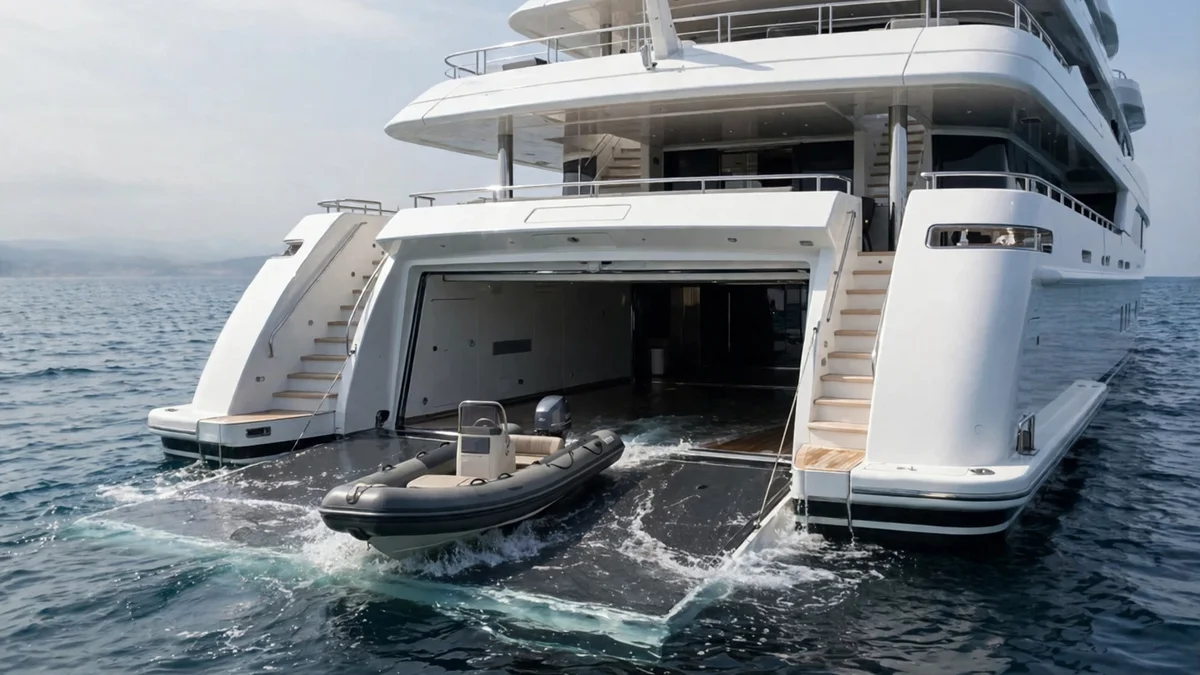
The yacht is anchored in a turquoise bay, and something odd is happening at its stern. The aft deck, which was level with the water a few minutes ago, is sinking. Slowly, deliberately, it slides down until the sea is washing over it, and then a small tender, which was floating beside the yacht, drifts forward and settles onto the submerged deck as if it had parked in a garage. The deck rises again, lifting the tender clear of the water, and the yacht is whole once more. This is a semi-submersible yacht, a vessel that lowers part of itself into the sea on purpose, so it can load and launch boats, submersibles and toys that no crane could lift.
Step 1: Ballast tanks change the yacht’s weight
A semi-submersible yacht works by changing how much it weighs, and it does that with ballast tanks, large compartments in the hull that can be filled with seawater or emptied with compressed air. When the tanks are empty, the yacht floats high, like any other vessel. When the operation is finished, pumps and compressed air blow the water back out, and the yacht rises again.
The tanks are arranged in pairs, port and starboard, so the yacht sinks level instead of listing to one side, and the crew watches the levels on screens in the control room. The system is the same idea a submarine uses to dive, as the guide to how a luxury submarine works describes, but the yacht uses it gently, sinking by a metre or two instead of hundreds, and it never lets the water anywhere near the cabins or the bridge.
Step 2: The deck lowers and the tender floats aboard
The aft deck of a semi-submersible yacht is built like a garage floor that can go underwater. It is a flat, open deck with a low bulwark, strong enough to carry a tender, a submersible or a car, and when the yacht ballasts down, the deck slides beneath the surface.
Then the ballast is blown out, and the deck rises, lifting the tender clear of the sea. The water drains off through scuppers, the tender settles onto its cradle, and the crew lashes it down for the voyage. Building a yacht that can do this starts with the hull itself, as the guide to how a luxury yacht is made describes, and the semi-submersible deck is designed into the hull from the first drawing, not added afterwards.
Step 3: Pumps, valves and compressed air do the lifting
The machinery that raises and lowers the deck is a network of ballast pumps, valves and air compressors, and it is built with redundancy, because a deck that will not rise again is a serious problem. Compressed air bottles stand ready to blow the tanks even if the pumps stop, and the control system watches the tank levels and warns the crew if one side is filling faster than the other.
The operation is slow on purpose. The crew fills the tanks gradually, watching the deck edge approach the water, and they stop the moment the deck is deep enough for the tender to float over it. The yacht’s engineers test the system on every voyage, because the day it is needed is usually the day the weather is turning.
Step 4: The hull stays stable while the deck is down
A yacht with its aft deck underwater is in an unusual state, and stability is the crew’s first worry. The flooded deck adds weight low down, which helps, but the open deck also lets water slosh from side to side, and the yacht must not roll while the tender is floating aboard.
The crew also watches the weather. The support vessel works in the same way beside its yacht, as the guide to how a luxury support vessel is made describes, carrying the toys and the tenders the main yacht cannot, and the semi-submersible yacht is really a support vessel and a yacht in one hull.
Step 5: The deck becomes a beach, a garage and a dock
Once the tender is aboard and the deck is dry, the semi-submersible deck earns its keep in other ways. Lowered a little further, it becomes a dock for a submersible, which floats over the deck and is lifted clear of the sea for servicing. Raised level, it is a garage for tenders, jet skis and diving gear, with room to work on them out of the sun.
The deck is fitted with tie-down points, fresh water wash-downs and a small crane for moving equipment, and the crew uses it as a workshop as much as a garage. Guests use it as a sunbathing platform and a swim deck, and the yacht’s designers have learned to make it beautiful as well as useful, with teak, lighting and seating that fold away when the deck goes down.
Step 6: Safety systems guard the whole operation
Every semi-submersible operation is governed by safety rules, because the yacht is deliberately doing something that would be an emergency on any other vessel. The control room monitors the tank levels, the yacht’s list and the wind, and any one of them going out of limits stops the operation.
The yacht is also fitted with alarms that sound if water reaches a compartment it should not, and the crew drills the operation regularly, including the failure drills: a pump that stops, a valve that sticks, a tender that will not sit straight. The drills are boring, and that is the point. On the day the deck goes down for real, with guests watching and a submersible worth millions floating over it, nobody should have to think about what to do next.

Specifications
| Detail | Specification |
|---|---|
| Length | Around 50 to 90 metres |
| Beam (width) | Around 12 to 16 metres |
| Submersible deck | Around 15 to 25 metres long |
| Deck load | Around 50 to 100 tonnes |
| Ballast system | Seawater tanks, pumps and compressed air |
| Sink depth | Around 1 to 2 metres at the aft deck |
| Propulsion | Twin diesel engines, around 15 knots |
| Guest capacity | Around 12 guests, 15 to 20 crew |
What it costs
The estimated price of a new luxury semi-submersible yacht is around 60,000,000 to 150,000,000 dollars, and that figure is an estimate only, because the cost depends on the size, the deck load and the fit-out. The ballast system and the strengthened hull account for a large share, followed by the accommodation and the tenders it carries. Few yards build them, and each one is designed around the toys its owner wants to carry.
A rare fact
Few people know that the semi-submersible yacht began as a working ship, a heavy-lift vessel that carried oil rigs and other ships as cargo by sinking its deck under them. The yacht world borrowed the idea in the two thousands, when owners realised the same trick could carry a submarine, and the first luxury versions were converted from working ships before yards began building them as yachts from the keel up.