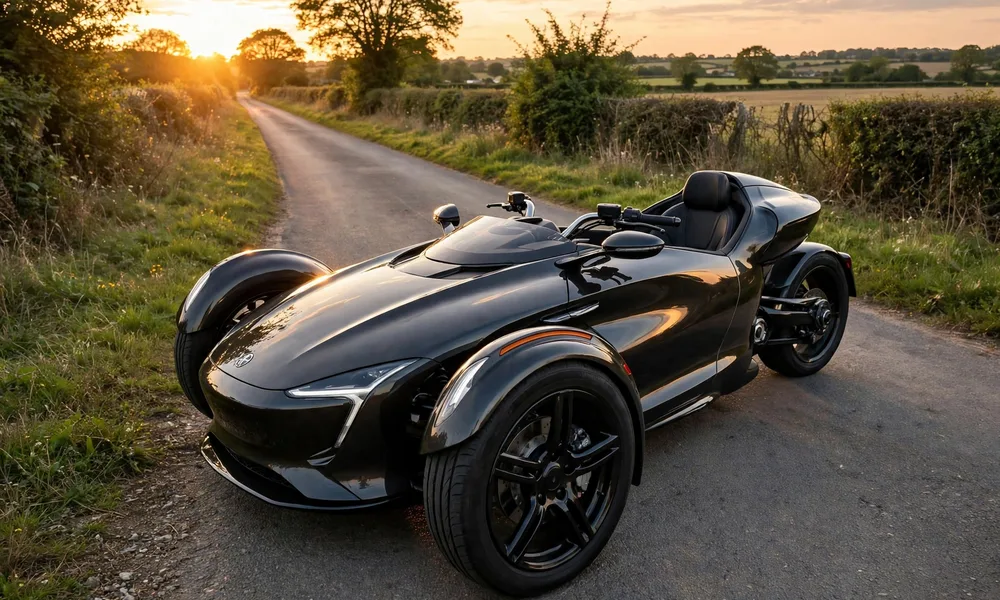
The workshop is quieter than you would expect for a vehicle factory. There is no roar of engines, just the soft click of a torque wrench and the hum of a battery test rig. On the bench sits a three-wheeled machine with a low seat, a wide rear axle and a body finished like a piece of jewellery. A luxury electric trike is a strange, delightful machine: part motorcycle, part car, part armchair, built for people who want the wind in their face without the worry of balancing on two wheels.

Step 1: The frame is welded from steel and aluminium
Every trike starts as a frame, and the frame decides how the machine will ride. Steel or aluminium tubes are cut to length on a jig, a steel table that holds each piece in exactly the right place, and a welder joins them one by one. The front of the frame carries the steering head and a single wheel, while the rear spreads wide to carry two wheels, a layout that gives the trike its stability and its unmistakable stance.
Once the welds are ground smooth, the frame is checked for straightness with lasers, because a twist of even a millimetre would make the trike pull to one side at speed. Then it is powder-coated or painted, often in a deep metallic colour that takes several coats to get right. A trike built this way costs far more than a mass-market machine, and the price of hand-built luxury is the first thing buyers notice, as the guide to why a luxury trike is so expensive explains, with the frame alone taking days of skilled work.
Step 2: Suspension and steering are fitted
A luxury trike must ride smoothly, so the suspension is borrowed from the car world rather than the motorcycle world. Double wishbones or a leaning front end are fitted at the front, with coil springs and dampers tuned for comfort, and the rear axle gets its own suspension so bumps are soaked up before they reach the seat. The steering is set up to feel light at parking speed and steady at motorway speed, a balance that takes careful testing to get right.
Step 3: The battery pack and electric motor go in
The heart of the trike is its battery, a pack of lithium cells bolted low in the frame where its weight keeps the machine stable. The cells are wired together, fitted with a cooling system and a management unit that watches every cell’s charge and temperature, and the whole pack is sealed against rain and road spray. A luxury trike’s battery is sized for range rather than speed, giving a long, relaxed ride between charges.
The motor is usually mounted at the rear, driving the two back wheels through a single-speed gearbox, which is all an electric motor needs. It is silent, smooth and strong from a standstill, and it is the reason the trike feels effortless to ride. Two-wheeled electric machines use the same ideas in a narrower package, and the guide to how a luxury electric motorcycle is made shows how the motor and battery are packaged when balance, rather than stability, is the design problem.
Step 4: The bodywork is shaped and painted
With the running gear finished, the trike gets its body. Panels are shaped from aluminium or carbon fibre, sometimes by hand over a wooden mould, and fitted to the frame with small gaps and flush edges. The bodywork is what makes a luxury trike look like a piece of sculpture rather than a kit car, with curves that catch the light and vents that feed air to the battery and brakes.
Step 5: The cockpit and seat are trimmed by hand
The seat is the part the owner touches every ride, so it is trimmed like a car interior. Leather is cut, stitched and stretched over a shaped base, with heating elements fitted underneath and adjustable back support built in. The handlebars are wrapped in matching leather, the grips are shaped to the hand, and the footboards are covered in rubber or polished metal.
The dashboard is kept simple: a small screen shows speed, range and battery charge, and a few metal switches control the lights, the heated grips and the riding modes. Everything the rider touches is metal, leather or glass, never cheap plastic, and the whole cockpit is assembled by one trimmer who signs the work when it is done. Small electric two-wheelers follow the same trimming discipline at a smaller scale, as the guide to how a luxury e-bike works shows, but the trike has room to do it properly, with space for a proper seat and a proper dashboard.

Step 6: Testing, tuning and the first ride
Before a trike leaves the workshop, it is tested like a car. The battery is charged and discharged, the brakes are tested on a rolling road, and the motor is run through its full range while engineers listen for any vibration or whine. Then a test rider takes it out on real roads, checking the steering, the suspension and the brakes at every speed, and the workshop adjusts the setup until the ride feels right.
Only then is the trike washed, polished and handed over, often with the buyer’s name on a small plaque. The first ride is silent, the motor humming softly, the wind over the screen, and the machine doing exactly what it was built to do: make three wheels feel like the most natural thing in the world.
Specifications at a glance
| Feature | Typical luxury figure |
|---|---|
| Layout | One front wheel, two rear wheels |
| Frame | Welded steel or aluminium, hand-finished |
| Battery | About 10 to 20 kWh, lithium-ion |
| Motor | About 30 to 80 kW electric, rear drive |
| Range | About 120 to 250 km per charge |
| Top speed | About 130 to 180 km/h |
| Seats | One or two, leather-trimmed |
What it costs
A luxury electric trike typically costs between about $40,000 and $120,000, and these are estimates, not fixed prices. The price rises with battery size, bodywork material and the finish of the interior, and many buyers add custom paint, luggage and audio that push it higher still. Running costs are low compared with a petrol machine: electricity is cheap, servicing is simple, and the motor has far fewer moving parts to wear out.
A rare fact
Some luxury trikes lean. A tilting front end lets the whole machine lean into corners like a motorcycle, while the two rear wheels stay planted, so the rider gets the thrill of leaning with the safety of three points of contact. The lean is controlled by a linkage that locks upright at low speed, so the trike stands on its own at traffic lights, and the rider never has to put a foot down. It is the cleverest trick in the trike world, and it is hidden inside the front suspension where almost nobody looks.
From welded tubes to hand-stitched leather, a luxury electric trike is made by people who believe a third wheel is not a compromise but a luxury in itself. The result is a machine that is stable, silent and beautiful, and that turns every short ride into a small occasion.