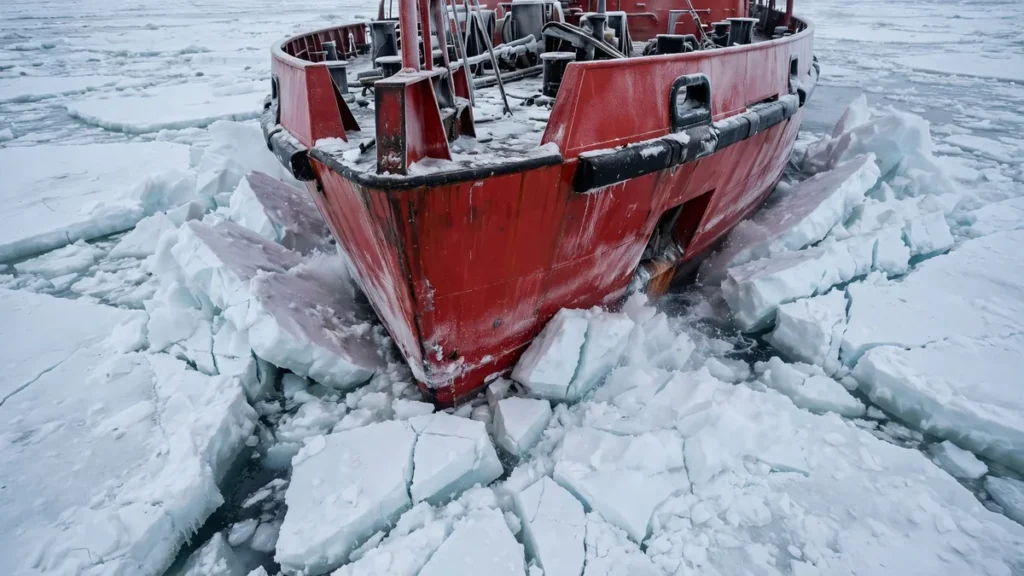
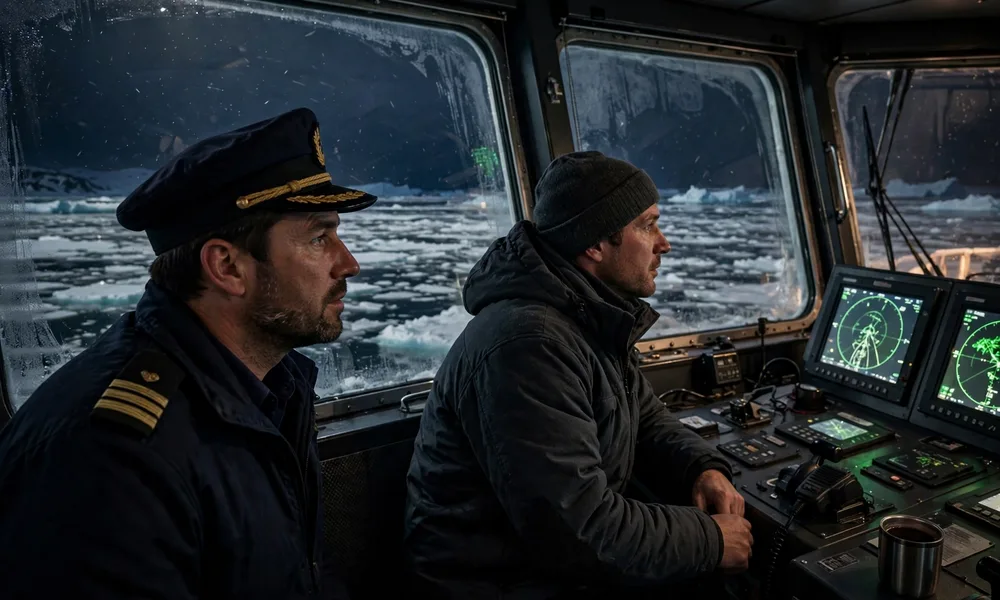
The sea ahead is white to the horizon, a flat sheet of ice with no open water in sight, and the ship is heading straight for it at full speed. On the bridge nobody looks worried. The captain watches the ice, the ice pilot watches the captain, and in the lounge the guests are watching the bow through the windows, waiting for the moment the ship meets the ice. Then it happens: the bow rides up onto the frozen sheet, the ice cracks with a sound like a gunshot, and the ship slides forward through a channel of its own making, leaving black water behind it where a minute ago there was only white.

Step 1: Reading the ice before the ship touches it
An icebreaker never simply charges at the ice. Long before the ship reaches the frozen sea, the ice pilot studies satellite images, helicopter reports and the ship’s own radar, which can tell thick multi-year ice from thin first-year ice. The thickness decides everything: thin ice can be broken at speed, thick ice needs a slow and careful approach, and a pressure ridge, where two sheets have been crushed together, may need to be avoided entirely.
The bridge team plans a route through the weakest ice, like a driver choosing the smoothest line through a rough road. The ship’s speed, the angle of approach and even the time of day are chosen with the ice in mind, because ice is softer in the afternoon sun and harder in the cold of the morning. The steel that makes all of this possible was rolled and welded in the yard, as the story of how a luxury icebreaker is made explains, but out here the steel is only as good as the person reading the ice ahead of it.
Step 2: The bow rides up and breaks the ice with weight
The actual breaking is simpler than it looks. The bow of an icebreaker is shaped like a spoon, sloping gently, so that when the ship drives forward the bow slides up onto the ice instead of smashing into it. The weight of the ship then presses down, and the ice cracks underneath, breaking into slabs that slide aside along the hull. The ship does not punch through the ice. It climbs onto it and lets gravity do the work.
Step 3: Backing and ramming when the ice will not give
Sometimes the ice is too thick to break in a single pass, and then the ship uses its oldest trick: backing and ramming. The captain reverses the ship into the channel it has already cleared, then drives forward again, using the open water to build speed before the bow meets the ice. The impact is harder, the crack is louder, and the ship gains a few more metres. The manoeuvre is repeated as many times as needed, and the crew count the rams the way a boxer counts rounds.
Step 4: Diesel-electric power keeps the thrust exact
The power for all of this comes from diesel-electric engines, often producing tens of thousands of horsepower. The diesel engines do not drive the propellers directly. They drive generators, and the generators feed electric motors that turn the propellers, a system that gives the captain exact control of thrust. When the ship is working through ice, the captain needs to go from full power to a dead stop and back again in seconds, and only an electric drive can do that smoothly.
The engines are also the ship’s heating. In polar waters the engine room is warm, the fuel is kept warm so it flows, and the waste heat warms the guest cabins, the water and even the decks, so that ice does not build up where the crew walk. A ferry crossing open water uses the same kind of power for a very different job, as the guide to how a luxury ferry works describes, but the icebreaker spends its power on breaking rather than on speed, and the engines are sized for that harder life.
Step 5: Keeping the ship and its people warm and safe
The guests, meanwhile, live in a warm bubble. Their cabins are insulated and quiet, the lounge has wide windows onto the ice, and the ship’s stabilisers keep the motion gentle even when the ship is working hard. The crew watch the weather constantly, because a polar storm can arrive in an hour and turn a calm frozen sea into a whiteout. A solar yacht in warmer seas solves the same problem of living off the grid in a different way, as the guide to how a luxury solar yacht works shows, but the icebreaker’s answer is simpler: carry everything, expect nothing, and keep the heat on.
Step 6: Anchoring in the ice and going ashore
At the end of the day’s breaking, the ship finds a place to stop, and stopping in the ice is a skill of its own. The captain chooses a sheltered spot, the ship settles into the channel it has made, and the ice slowly closes around the hull, holding the ship still without an anchor. The crew go out onto the ice in front of the ship, testing its thickness before anyone else follows, and then the guests come out in warm suits to walk on a frozen sea.
Specifications
| Detail | Specification |
|---|---|
| Length | Around 80 to 120 metres |
| Ice class | Breaks ice around 1 to 2 metres thick |
| Power | Diesel-electric, tens of thousands of horsepower |
| Speed in ice | Around 3 to 5 knots through thick ice |
| Open-water speed | Around 15 to 18 knots |
| Guests | Around 50 to 150 passengers |
| Crew | Around 60 to 100 people |
| Endurance | Weeks away from port, fully self-sufficient |
What it costs
The estimated price of a new luxury icebreaker is around 100 to 300 million dollars, and that figure is an estimate only, because the cost depends on the ice class, the size of the ship and the standard of the guest accommodation. The ice-strengthened hull and the diesel-electric power plant account for a large share, followed by the polar safety equipment and the luxury interior. A buyer is paying for a ship that can take its guests to places no other yacht can reach, in comfort, and bring them home again.
A rare fact
Few people know that an icebreaker uses less fuel in thick ice than most people expect, because the ship spends much of its time moving slowly, and the electric drive only draws full power in short bursts when ramming. The real cost of an ice voyage is not the fuel but the time: a hundred miles through heavy ice can take a whole day, and the ship’s schedule is written in pencil, not ink, because the ice always has the last word. Guests who sail on an icebreaker learn this quickly, and most of them say it is the best part: a voyage where nobody, not even the captain, knows exactly when the ship will arrive.