The trail disappears into a white forest, the snow is knee-deep, and the machine gliding through it makes almost no sound at all. There is no engine roar, no smell of exhaust, just the soft whirr of a track and the hiss of a ski on fresh powder. The luxury electric snow bike is the winter cousin of the electric dirt bike: same riding position, same grin, but with the wheels swapped for a track and a ski, so it goes where no wheeled bike can follow.
It works because it spreads its weight over a huge area and drives itself with a rubber track instead of a tyre, the same principle that lets a snowmobile float. The electric motor suits the job perfectly, delivering instant torque for climbing through deep snow and staying quiet enough not to scare wildlife or wake a mountain village. Here is how the whole system works, from the battery in the cold to the track in the powder.

How It Works
Step 1: The motor turns battery power into torque
At the centre of the snow bike is a brushless electric motor, usually rated around 10 to 15 kilowatts, which is modest by car standards but enormous for a machine that weighs less than 150 kilograms. The motor delivers its full torque from a standstill, which matters in snow, because getting moving is the hardest part — a petrol engine has to rev up first, while the electric motor simply pulls. A controller meters the power in response to the throttle, smoothing the delivery so the track does not spin and dig itself into a hole. The whole drivetrain has one moving part in the motor itself, which is why it shrugs off cold that would make a petrol engine hard to start.
Step 2: The rear track grips the snow
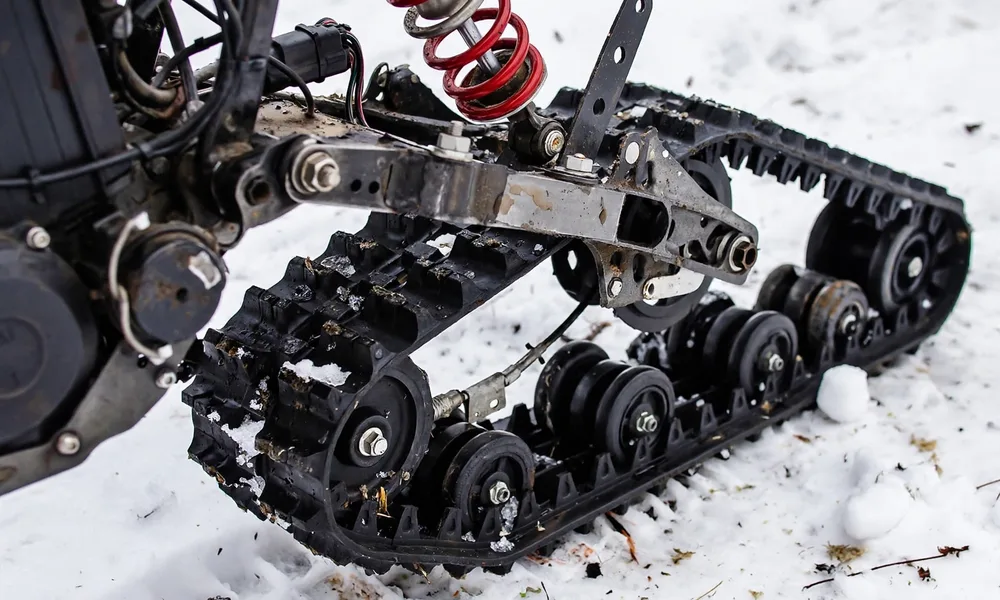
The rear wheel is replaced by a track: a wide rubber belt, about 30 centimetres across, studded with lugs and running around a set of wheels inside a tunnel. The track spreads the bike’s weight over a large area, so it floats on top of the snow instead of sinking, and the lugs bite into the surface like the tread on a boot. A suspension arm keeps the track pressed evenly against the ground, and the track tension is adjustable, because a loose track can derail and a tight one wastes power. Riders can swap tracks for different snow, from a short, stiff track for hard-packed trails to a long, deep-lugged one for powder.
Step 3: The front ski steers the bike
Steering is handled by a single wide ski where the front wheel would be, mounted on the same forks as a normal bike. The ski is made from a tough plastic composite with a steel keel underneath, and it carves through the snow like a boat’s rudder, leaning the bike into a turn. At low speed the rider steers with the handlebars; at higher speed they lean, and the ski follows. A small carbide runner under the ski gives it grip on ice, and the ski can be swapped for a wheel in minutes, which is how the same bike becomes a dirt bike in summer on some models.
Step 4: The battery keeps working in the cold
Cold is the enemy of every battery, so the snow bike’s pack is built for winter. The cells are high-quality lithium units, insulated inside the frame and warmed by their own waste heat and, on some models, by a small heating element that runs while the bike is charging. A typical pack holds 4 to 7 kilowatt-hours, enough for 60 to 100 kilometres of trail riding, and the battery management system watches the temperature of every cell, reducing power gently if the pack gets too cold rather than cutting out suddenly. Riders keep the bike indoors overnight, and the pack is designed to be removed and charged in the warm.
Step 5: Suspension and chassis handle the bumps
Under the snow, the ground is rarely smooth, so the bike gets long-travel suspension at both ends, with the rear track mounted on a pivoting arm that lets it follow the terrain. The frame is a lightweight aluminium or steel trellis, stiff enough to carry the track’s forces but flexible enough not to crack in the cold, and every bearing is sealed against snow and grit. The foot pegs are wide and spiked so boots do not slip, and the handlebars are heated on luxury models, a small luxury that matters enormously when the temperature is minus twenty and the gloves are thin.
Step 6: Braking, controls and the silent ride
Braking is split between a disc brake on the track drive and the drag of the track itself, which slows the bike quickly when the throttle closes — the electric motor also regenerates a little power as it slows. The controls are the same as a dirt bike’s: throttle and front brake on the bars, rear brake at the foot, and a display showing speed, range and battery temperature. The result is a ride that feels familiar to any motorcyclist but sounds like almost nothing, which is part of the appeal: a snow bike can climb through a silent forest without breaking it.
Snow Bike Specifications
| Specification | Typical luxury figure |
|---|---|
| Motor | Brushless electric, about 10–15 kW |
| Battery | 4–7 kWh lithium, insulated and heated |
| Drive | Wide rubber rear track, about 30 cm |
| Steering | Single front ski with steel keel |
| Range | About 60–100 km per charge (estimate) |
| Top speed | About 80–100 km/h on packed snow (estimate) |
| Weight | About 120–150 kg |
| Frame | Aluminium or steel trellis, sealed bearings |
How Much Does One Cost?
A luxury electric snow bike typically costs between about $12,000 and $20,000, with the most capable long-track models reaching past $25,000. Those are estimates based on current premium models. The price reflects the specialised track system, the cold-proof battery and the low production volumes, and it sits below a new snowmobile of similar ability while offering a riding experience no snowmobile can match. Owners tend to be riders who already own a dirt bike and want the same freedom for the four months of the year when the trails are white.
A Rare Fact
The idea of a bike that rides on snow is older than the snowmobile. In the 1920s, inventors in the Alps fitted skis to ordinary bicycles and tried to ride them down glaciers, and the first tracked motorcycle kits appeared in the 1970s, built by riders who bolted snowmobile tracks onto dirt bikes in their garages. The electric version only became practical once batteries could deliver the sudden bursts of torque that deep snow demands. Today’s luxury snow bikes are, in effect, a garage invention from fifty years ago, finally built properly.

The snow bike is a reminder that the electric motor is not just a cleaner engine — it is a better tool for jobs petrol never did well. The instant torque suits deep snow, the silence suits the mountains, and the simple drivetrain suits the cold. Its closest relatives explain it best: the track thinking comes from a electric snowmobile, the grooming and trail logic from a snow cat, and the riding position and controls from a electric dirt bike. Put together, they make a machine that turns winter from a season to endure into a season to ride.


