A petrol dirt bike announces itself long before you see it, with a two-stroke scream that echoes off the trees and sends every walker in the forest reaching for their ears. A luxury electric dirt bike does the opposite. It arrives as a soft whine and a spray of mud, the rider grinning behind a mud-spattered visor, and the only sound left behind is the tyres on the dirt. It is a machine built for riders who love the trail but not the noise, and it works in a way that feels almost like cheating.
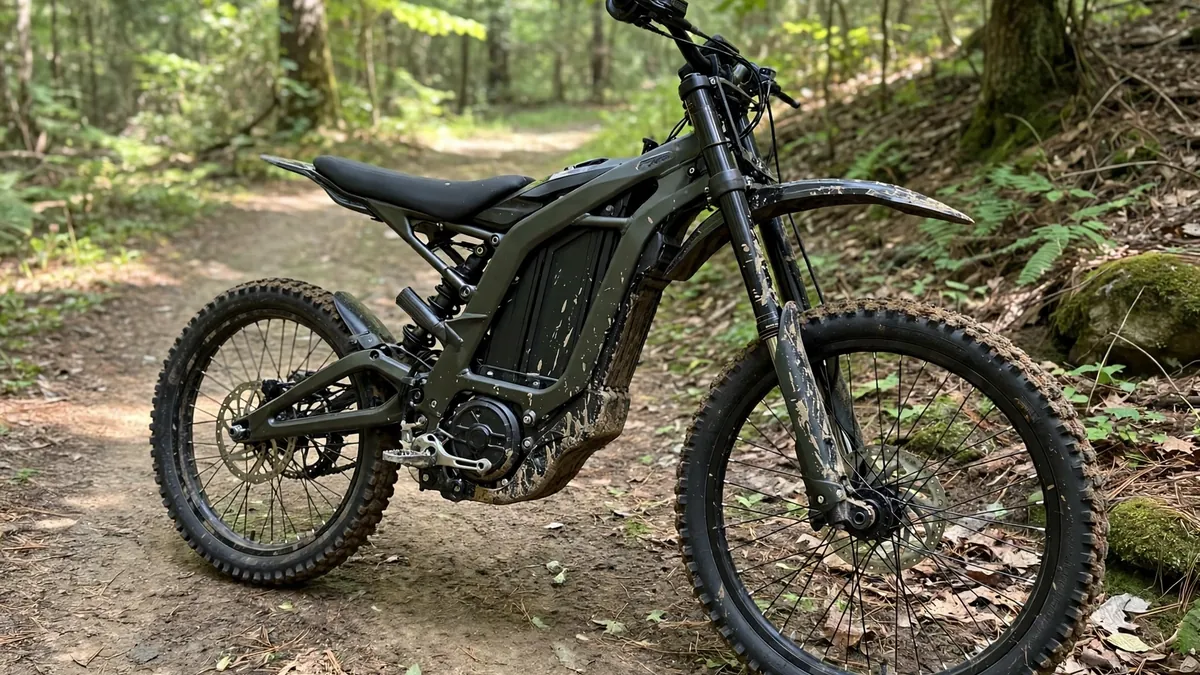
There is no clutch to feather, no gears to pick, no engine to stall on a steep climb. The rider twists the throttle and the motor answers instantly, with all of its pulling power available from a standstill. The battery sits low in the frame, the motor sits where the engine used to live, and the whole bike weighs less than its petrol cousin while feeling stronger at low speed. Here is how a luxury electric dirt bike works, from the battery to the back wheel.
How It Works
Step 1: The battery stores the energy
The battery is a slim, sealed pack of lithium cells that slides into the centre of the frame, low down where it keeps the bike balanced. It holds between two and four kilowatt-hours, enough for two to four hours of hard trail riding, and it is protected by a tough aluminium case that can take a rock strike or a fall without splitting. A management board inside the pack watches every cell, balancing the charge between them and cutting the power if the pack gets too hot or too cold. The case is sealed against water and mud, because a dirt bike spends its life being hosed down after a ride.
Step 2: The controller turns battery power into motor power
Between the battery and the motor sits the controller, a small box of electronics that acts as the bike’s brain. It takes the direct current from the battery and turns it into the three-phase alternating current the motor needs, switching it thousands of times a second. The rider’s throttle tells the controller how much power to send, and the controller smooths that request so the power arrives as a steady push rather than a sudden kick. It also watches the motor’s temperature and the battery’s state, trimming the power back gently if anything gets too hot, so the bike slows down gracefully instead of stopping dead on a hill.
Step 3: The motor turns electricity into torque
The motor itself is a compact ring of copper coils and magnets, mounted low in the frame where a petrol engine would sit. When the controller sends current through the coils, the magnetic field spins the rotor, and that spin becomes the turning force at the wheel. Unlike a petrol engine, which needs to rev up before it makes real power, an electric motor makes its full torque from zero speed, which is why an electric dirt bike can crawl up a steep, rocky climb that would stall a petrol bike. The way a luxury electric motorcycle works uses the same kind of motor, scaled up for the road, with the same instant pull from a standstill.
Step 4: The drivetrain sends power to the back wheel
Most electric dirt bikes use a simple chain or belt from the motor to the rear wheel, with a single fixed gear ratio and no gearbox at all. There is nothing to shift, nothing to slip and nothing to wear out quickly, which leaves the rider free to concentrate on the trail. The chain is sealed or lightly oiled, and the rear sprocket is sized so the bike has strong acceleration at low speed while still reaching a useful top speed on a fire road. The way a luxury electric bike works follows the same simple idea, with one gear and a motor that does the hard work, letting the rider focus on balance and line choice instead of shifting.
Step 5: The suspension and brakes keep the rider in control
A dirt bike lives or dies by its suspension, and a luxury one gets the best of it. Long-travel forks at the front and a linkage shock at the rear soak up rocks, roots and jumps, with adjustments for compression and rebound so the rider can tune the bike for sand, mud or hardpack. The brakes are hydraulic discs, strong enough to stop the bike on a steep downhill but gentle enough to feather with one finger. Because the motor can also slow the bike by regenerating, some of the braking happens electrically, which saves the brake pads and gives the rider finer control on slippery descents.
Step 6: Regenerative braking puts energy back in the battery
When the rider rolls off the throttle or brakes on a downhill, the motor reverses its role and becomes a generator, turning the spinning wheel back into electricity and feeding it into the battery. On a long descent this can add a useful few percent to the range, and it also gives the bike a natural engine-braking feel that petrol riders recognise at once. The way a luxury e-bike works uses the same trick on a smaller scale, recovering a little energy on every downhill. It is a small gain, but on a trail where the nearest charger is hours away, every little gain matters.

Electric Dirt Bike Specifications
| Specification | Typical Luxury Electric Dirt Bike |
|---|---|
| Motor | Brushless electric, 8 to 15 kilowatts |
| Battery | Lithium-ion, 2 to 4 kilowatt-hours |
| Range | 2 to 4 hours of trail riding |
| Top speed | 80 to 110 kilometres per hour |
| Weight | 100 to 120 kilograms |
| Suspension travel | 280 to 310 millimetres |
| Charging time | 2 to 4 hours from a home socket |
The Price
A luxury electric dirt bike costs an estimated $9,000 to $14,000, depending on the battery size, the suspension and the maker. That is more than many petrol dirt bikes, but the running costs are far lower: there is no fuel, no oil, no air filter and no exhaust to replace, and the motor has only one moving part. A full charge costs an estimated $1 to $2 at home, and a service is mostly tyres, brake pads and a software check.
A Rare Fact
Because an electric dirt bike is so quiet, riders can hear things a petrol bike drowns out: the tyres gripping loose gravel, a branch snapping under the wheel, even birdsong on a slow climb. Some trail parks that banned petrol bikes for noise have started welcoming electric ones, opening up riding areas that were closed for years.

Riding an electric dirt bike changes the rhythm of a day on the trails. There is no warming up an engine, no smell of fuel on your gloves, and no shouting over the exhaust to talk to a riding partner at a stop. You twist the throttle, the bike goes, and the forest stays quiet around you.
A luxury electric dirt bike proves that silence can be fast. Its battery sits low in the frame, its motor makes full torque from zero speed, its single gear never needs shifting, and its suspension is built to soak up the worst the trail can offer. It is a machine that lets the rider hear the trail, which turns out to be half the fun.


