A luxury electric tram does not look like a factory product when it glides through a city square. It looks like a long, quiet room on rails, all glass and polished metal, with wide doors, soft lighting and seats that feel more like a lounge than public transport. Nobody on board hears a motor or smells exhaust, and that calm is the whole point.
The price of the finest trams runs into millions, and most of that money is not in the paint or the seats. It is in the body, the batteries, the motors and the slow, careful assembly that keeps a thirty-metre vehicle silent, smooth and safe for decades. A cheap tram is bolted together and sent out to rattle. A luxury electric tram is built in stages, tested at every step, and finished like a hotel on wheels. This is how it is made.

How It’s Made
Step 1: The body shell is designed and welded from aluminium
Every tram starts as a drawing, long before any metal is cut. Engineers plan the body around the passengers, deciding where the doors will open, how wide the aisles must be, and how low the floor can sit so that a wheelchair or a pushchair can roll straight in. Once the design is settled, sheets and extrusions of aluminium are cut, bent and welded into a long, rigid shell. Every weld is inspected, because the body must stay straight for thirty years of daily service.
Step 2: The floor, doors and glass are fitted
With the shell complete, the floor goes in, and it is one of the most carefully built parts of the whole tram. A low, flat floor is laid over the bogies, the wheeled frames that carry the vehicle, with ramps and level thresholds at every door so that nobody has to step up. The doors themselves are wide, powered and fitted with sensors that stop them closing on a bag or a hand. Then the glass is fitted, huge curved panes that run almost the full height of the body, bonded and sealed so they do not rattle, leak or fog, and so that every passenger gets a clear view of the street outside.
Step 3: Motors, batteries and power systems are installed
The next stage is the fitting of the tram’s heart. Electric traction motors are mounted on the bogies, one or two per axle, and connected to the wheels through compact gearboxes that turn high motor speed into the slow, strong pull a heavy tram needs. Battery packs are slung beneath the floor in sealed, crash-protected cases, and the wiring that links them to the motors is run through shielded channels along the body. The whole system is tested under load, so the tram accelerates smoothly and brakes gently.

Step 4: The interior is built like a lounge
Only when the machine works is the interior built, and on a luxury tram this is done to the standard of a good hotel. Seats are upholstered in durable leather or woven fabric, mounted on frames that absorb vibration, and arranged so that every seat has a view and a handhold within reach. Wood or brushed metal panels cover the walls, the ceiling is lined with acoustic material that swallows noise, and warm lighting is fitted in strips that glow softly rather than glaring. The driver’s cab is finished last, with a single clear screen, a simple controller and a seat designed for an eight-hour shift, because a comfortable driver is a safe driver.
Step 5: Electronics, safety systems and software are loaded
A modern tram is as much a computer as a vehicle, and the next stage is the fitting of its brain. Cameras are mounted at the front and sides, sensors watch the track ahead, and a central computer links the motors, the brakes, the doors and the passenger displays into one system. The software is loaded and calibrated so that the tram knows exactly where it is, how fast it is going, and when to slow for a bend or a crowded stop.
Step 6: The tram is tested on the track before delivery
The last stage of the build happens away from the factory, on real track. During trials the tram is run empty, then loaded with sandbags to simulate a full crowd, through curves, over points and up gradients, in rain and in heat. Engineers ride along with notebooks, logging every squeak, every vibration and every door that hesitates, and the factory fixes each one before the tram is handed over. Only when it has run thousands of kilometres without a fault, and the drivers are happy with every control and every sightline, does the tram enter service, ready to carry a city quietly for the next thirty years.
| Spec | Detail |
|---|---|
| Body | Welded aluminium shell with a low, flat floor for step-free boarding |
| Motors | Electric traction motors on the bogies, driving the wheels through gearboxes |
| Power | Overhead pantograph plus underfloor battery packs for wire-free sections |
| Length | Around 30 metres, carrying roughly 200 passengers |
| Interior | Leather and fabric seats, acoustic ceiling, warm lighting, wide doors |
| Testing | Thousands of kilometres of trials, loaded and empty, before delivery |
The most expensive part of a luxury tram is not the glass or the seats, but the silence. Every stage is a chance for a small rattle to become a thirty-year annoyance, a weld that flexes, a door that thumps, a motor that hums, and the factory’s job is to catch each one before the tram ever carries a passenger.
What One Costs
A luxury electric tram typically costs an estimated $3 million to $6 million, and the price is set mostly by the motors, the batteries and the custom interior rather than the size of the body. A long model with full battery range, a premium lounge interior and the latest safety systems sits at the top of the range, while a simpler tram with a smaller battery and a standard interior costs far less. The price is in the engineering, not the badge, and how a luxury electric tram works explains what all those motors and batteries actually do, while the luxury electric bus specs explained shows how a similar electric drivetrain is packaged for the road.
A Rare Fact
Some luxury electric trams can run for kilometres with no overhead wire at all, because their underfloor batteries charge while they travel under the wires and then take over in historic city centres where wires are banned. The tram simply lowers its pantograph, glides silently past old squares and cathedrals, and raises it again when the wires return, which is why the factory spends so long on the batteries and the changeover software.
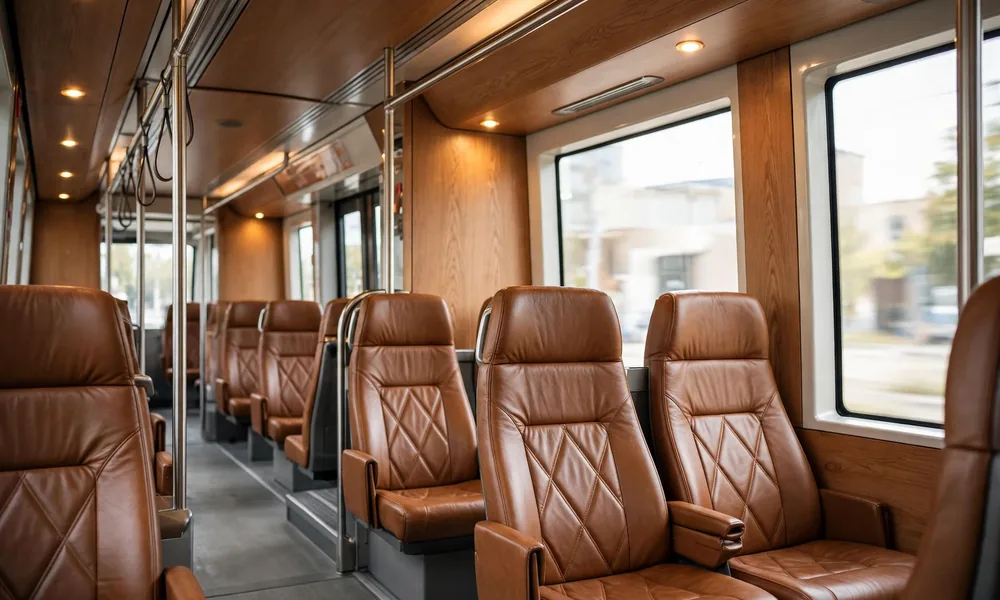
A luxury electric tram is an aluminium shell, a set of quiet motors, a bank of batteries and a lounge interior, built slowly and tested for thousands of kilometres so it can carry a city in silence for thirty years. It moves on rails, draws power from the sky, and feels more like a room than a vehicle. For the price of the rail network it runs on, why a luxury electric train costs so much explains what a larger electric railway vehicle built to the same standard really adds up to.


